Chronicle Editor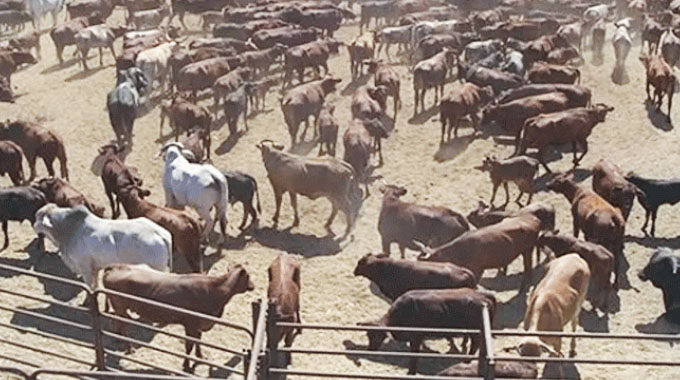
Farming Issues with Mhlupheki Dube
Recently, I found myself going through the paces of selling a few of my oxen and I came face to face with market frustrations that livestock farmers always lament with no solutions provided.
My encounter with market shenanigans from apex players in the livestock value chain left me more convinced than before that this sector seriously needs to be regulated if the principle of fair trade is to be upheld.
It has been an age-old lamentation from livestock farmers that they always get the shorter end of the stick from livestock buyers, be they middle-level players who buy directly on the ground or upper-level players such as abattoir operators and meat wholesalers.
I consider myself an averagely informed person when it comes to the livestock value chain and naturally, I would not blindly dump my animals on to any buyer without conducting due diligence on ongoing prices.
I have been watching livestock price trends for years to understand when they spike upwards and when they nose dive. So, when I was to sell, I monitored the prices for almost two months and noticed the upward movement, with a very meaningful increase in the last three or so weeks.

Currently, commercial grade of a carcass is selling for around $3.50/kg in most abattoirs while some butcheries will offer slightly more by ten or twenty cents per kilogram.
Then, this abattoir, which was my first choice to take my animals, because of its proximity to where my animals are, decides to offer a price, which is fifty cents below what other abattoirs are offering.
Honestly, what kind of market criminality is this? If it’s a super grade carcass, choice or commercial, does it not follow that it should at least trade for the same or similar prices regardless of where the abattoir is located? Why would an abattoir offer $3/kg for a commercial grade carcass while other abattoirs not so far away from that abattoir are buying the same grade at $3.50/kg?
If it’s the same quality of grade, shouldn’t this be a guideline that the price range should be within reasonably comparable differences? If the carcass grading system means anything, it is that the meat that falls into this grade is deemed to be of the same quality and if this is the case, why would we have a price disparity that is far apart than east and west?
This is purely criminal if you ask me. Talking about carcass grading, my oxen, which were coming from a feedlot, well-conditioned and undoubtedly commercial grades even by the eye of a novice, were graded economy by the Government grader at this abattoir in Bulawayo where I finally took my animals.
I sent my son, who is visibly young to deliver the animals because I was committed elsewhere and perhaps for that reason, the grader decided to have a field day with my animals by downgrading them.

It was such a poor grading that even the butchery that bought the animals did not agree with the grading and went on to protest and get the grade changed on the slaughter sheet to a commercial grade, which it was. These were big oxen, each weighing over five hundred kilograms in live weight.
Any novice knows that during this time of the year, you will never get an animal that is economy grade and gives you over two hundred and fifty kilograms of meat after dressing. With that kind of meat on its bones, it’s definitely a commercial going upwards because economy grades are too thin to have that kind of meat on their bones.
I am convinced that the downgrading of my animals was no mistake because my son questioned the guy and he was adamant, only to instantly change when the buyer who is a butchery owner in town protested. My theory is that, this is an existing scandal between the grader(s) and some butchery operators who are always hanging around the abattoirs in Bulawayo to buy cattle brought in by farmers.
The grader deliberately downgrades your animals and gets a bribe for his effort from the buyer. I was almost scammed of five hundred dollars in loss due to the deliberate downgrading of my two animals from an obvious commercial grade to an economy.
So, the buyer would buy my two animals five hundred dollars cheaper and throw a fifty dollar bill to the grader for his sweat! If this is not a scam, then nothing is.
Fortunately for me, I am informed enough to know such aspects of livestock production and marketing and I would obviously query this to high heavens but what about the majority of farmers who are just old madalas and gogos in rural homes?
Having come face to face with these two scandals of yawning price disparity and a mischievous carcass grading process, it is my well-considered view that we need much tighter regulation of the livestock value chain, especially at the apex end of the chain.

There is too much latitude of free space for the players up there to be playing tricks on livestock producers. A price regulatory system or mechanism is definitely needed to protect farmers from wanton arbitrage by callous abattoir operators and meat wholesalers. The carcass grading should have a complaints desk of some sort where aggrieved farmers can lodge their protestations.
It cannot be a “ referee’s decision is final” type of thing when clearly the graders are selling the grade manipulation to the highest bidder at the loss of farmers.
A farmer should be able to request for second opinion grading if not convinced, otherwise as it stands, we are sending both the farmers and their animals to slaughter! If a standard loaf of bread, produced in geographical areas over seven hundred kilometres apart by different bakeries, can still trade across the country for the same price, why should abattoirs within the same vicinity have a price disparity of day and night? Something is definitely not right and needs government intervention. Uyabonga umntaka MaKhumalo.
Mhlupheki Dube is a livestock specialist and farmer. He writes in his own capacity. Feedback [email protected] <mailto:[email protected]> cell 072851275



 Online Reporter