Online Reporter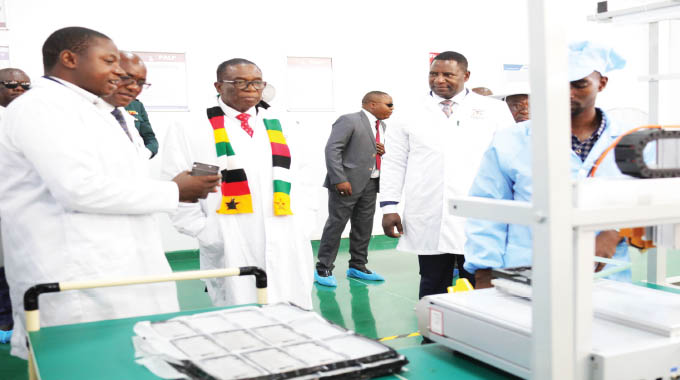
Zimpapers Reporters
Tertiary institutions are key to the country’s modernisation and industrialisation efforts as they provide import substitution and spur economic growth, President Mnangagwa has said.
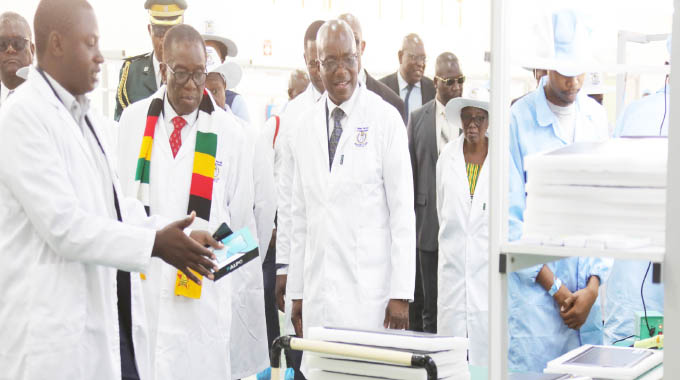
The President made these remarks yesterday after he had commissioned Bindura University of Science Education (Buse)’s Industrial Park, the state-of-the-art Palpo Technologies Production Plant, which assembles laptops, tablets and cellphones, as well as the tertiary institution’s main entrance.
The Palpo plant has a monthly capacity of over 40,000 devices, including the “Titus” artificial intelligence tool preloaded on educational devices, bridging Zimbabwe’s digital divide.
Buse’s Optometry Clinic and lens plant is Africa’s first university-owned prescription lens production facility, capable of producing 1,200 pairs of lenses daily, drastically reducing the cost and waiting time for eye care services.
Central to Buse’s rural industrialisation drive is the Zambezi Valley Masawu Plant in Muzarabani, currently 94 percent complete. The plant will process Masawu fruits sourced from local communities, creating jobs, boosting rural economies and supporting national food security.
Other innovations include “Chiringa,” a real-time monitoring and evaluation system now adopted by the Government for tracking national projects and an e-tolling system designed in collaboration with Zinara to modernise tollgate operations using RFID and NFC technologies.
President Mnangagwa expressed his satisfaction with the strides being made by the country’s institutions of higher learning in advancing development, particularly Buse.
“I am highly impressed by our team here (driving) innovation (and) technology development. This is what it ought to be across the country, across the board.
“Each time we come here, we find that this young man (Vice Chancellor Professor Eddie Mwenje) has new ideas, and that of course means that he is buying more and more time for himself in many ways,” said the President with a chuckle.
The locally assembled gadgets at the Palpo Technologies Production Plant will be more affordable than imports, thereby increasing accessibility for all and sundry.
At full operational capacity, the plant will produce up to 12,000 laptops and tablets, as well as 3,000 mobile phones.
Quizzed on how important the country’s universities’ innovations are to Zimbabwe’s development agenda, the President said they were a vital cog.
“First of all, you are here asking me because you went through these facilities, that’s how important they are. Now that you are asking me, we must have such facilities across the board so that our people are educated,” he said.
President Mnangagwa said Zimbabweans needed to be informed on the development trajectory being spearheaded by the Second Republic.
“We have a system of making sure we spread and have everybody across the country understand what we are doing, what our aims are, what our goals are, how much we are developing, where we were last year and where we are now, and where we intend to go.
“These are the occasions which showcase our agenda,” he said.
President Mnangagwa has been at the heart of driving the country’s education transformation agenda, particularly through the Heritage-Based Education 5.0 model, which focuses on five core missions for tertiary institutions in Zimbabwe.
These are teaching through imparting relevant knowledge rooted in local realities; research– generating new understanding based on local needs; community service – applying knowledge for societal benefit; innovation – creating new products and solutions and industrialisation – transforming ideas into industries and jobs.
This has resulted in most of the country’s tertiary institutions stepping up to the plate and leading in life-changing innovations that are responsive to the needs of the people.
A total of 2,115 students graduated yesterday at BUSE as the university reaffirmed its position as a powerhouse of science, technology, engineering and mathematics (STEM) education.
Among the graduates, 1,098 (52 percent) were female and 1,017 (48 percent) were male.
A total of 1,332 students graduated with first degrees, 405 earned master’s degrees, three received doctorates, 341 obtained diplomas, and 25 completed postgraduate diplomas.
The university, which is also celebrating its silver jubilee, marked its 25th anniversary with groundbreaking achievements that align with Zimbabwe’s vision for a knowledge-driven economy.
In 2027, BUSE plans to host the 2027 Women in Physics Conference, the first time in Africa, further cementing its position as a leader in STEM education and scientific innovation.
Addressing the silver jubilee graduation ceremony in Bindura, the Vice Chancellor Professor Eddie Mwenje said the university has evolved from a specialised science education college into a comprehensive institution driving innovation and industrialisation in line with the national Education 5.0 philosophy.
From its humble beginnings with only 113 students in 2000, BUSE now boasts over 7,000 learners, with 74 percent enrolled in STEM programmes.
To date, more than 25,000 graduates have been produced, including scientists, engineers, entrepreneurs and educationists serving across Zimbabwe and beyond.
The University also celebrated its students’ international success.
BUSE’s Enactus team claimed second place at the 2025 Enactus World Cup in Bangkok, Thailand, where it was competing against global heavyweights such as the United States, Canada, Germany and Brazil.
Student representative Brita Gwezere hailed President Mnangagwa’s vision for innovation and empowerment.
She said the Government’s transformative Education 5.0 policy has empowered students through innovation, industrialisation and practical learning.
“This philosophy has transformed our higher education landscape, giving rise to innovation hubs across the country, including our own at BUSE,” she said.
“It is a testament to your belief in homegrown solutions and productive innovation.”
She expressed gratitude to the Government for the work-study programme, which supports more than 150 financially disadvantaged students and enables them to pursue their education with dignity.
Facial Paidamoyo Chitate, who was awarded President Mnangagwa’s Chancellor’s award of US$1000, was in disbelief that she won nine awards.
Chitate, who was doing a degree in Natural Resources and Management, said she needed time to sit down and plan how to invest her prize money.
She looks forward to working with the Government in implementing policies that are in line with natural resources.
“I am happy to win a Presidential award. I want to work in the mining sector or collaborate with corporates engaging in aforestation drive to minimise the effects of climate change,” she said.
Among the graduates was Zimpapers staff Patience Mhlobo, who was doing MSc Digital Marketing and also Mines and Mineral Development Deputy Minister Polite Kambamura.