Chronicle Editor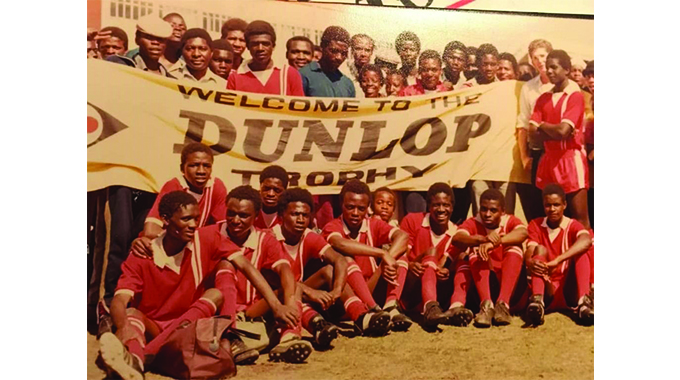
Stephen Walsh
EARLY on Sunday mornings, in the lush green and leafy lanes around Christ’s Hospital, around 10 miles (16km) from Gatwick Airport in the deep south of England, an eagle-eyed observer might see me, a grey-haired English teacher taking a weekly run wearing black and white stripes.
Passing Newcastle United fans sometimes smile or even stop me, thinking they are seeing a fellow ‘Magpies’ fan 200 miles (about 320km) away from home.
But then they catch sight of an unfamiliar badge on the chest (an oval shield and a pair of crossed spears), a strange motto underneath ‘Siyinqaba’, or BancABC (the shirt is a little bit out of date).
The smile of recognition is quickly replaced by an expression of confusion or curiosity. They ask what lies behind my choice of athletic wear; a Highlanders’ top that reflects my long-distance love for Bosso.
To explain the background, I have to take them back to the 1980s and the first days of newly independent Zimbabwe. In the summer of 1982, I was a young English graduate coming out of Oxford University with no real plan for the future. The job situation was not promising either, and Margaret Thatcher (we nicknamed her ‘The Milk Snatcher’) was in Number 10 Downing Street, bringing about severe economic reforms.
But I heard that the Zimbabwe Ministry of Education had come to town looking for teachers to meet the upsurge in demand for education, which went with independence. Within a few weeks, I was on an Air Zimbabwe flight hearing the unfamiliar announcements (‘Comrade Minister, Ladies and Gentlemen’) and heading for Harare. From there we took a bus via Chegutu, Kadoma, Kwekwe and Gweru to Bulawayo.
I was sent to work at Msiteli Secondary School in Mpopoma. There was actually one other white teacher, a Mr Henstridge, already at Msiteli, and there were several white teachers at Mpopoma High, but it was rare to see white faces in the western suburbs at that time. I think I was considered a novelty.
Nevertheless, the welcome was extremely warm, especially when it was understood that my newly-arrived colleagues and myself did not share some of the attitudes we heard from the local whites of the era. Whether I was taking the early morning bus up Luveve Road, squeezed in between ladies with their tin-baths of tomatoes in an emergency taxi, or walking down to the Mahomva Stores for lunch, or buying a seasonal bag of amacimbi or a couple of Kingsgate cigarettes from the women that sat outside the school gates, I never met one single moment of hostility or suspicion.
When it came to finding my way around, I was very lucky indeed. The headmaster of Msiteli at that time was a larger-than-life character named Mr JD Mweneziko and he wanted to ensure that I settled quickly. His primary method was to take me to places that were probably a bit unusual in the circumstances. By night we went to visit some of the Mpopoma shebeens, one of which was owned by the Parents Teachers Association chairman. By day we would go and drink Ingwebu at Mathonisa or one of the other beer gardens.
However, the major breakthrough came when he found out I was a football fan. Most local whites at that time, not to mention my colleague Mr Henstridge, who went on to play an important part in establishing the Black Rhinos Rugby Club and ‘decolonising’ rugby in Bulawayo, were diehard rugby fans.
As soon as he heard that I preferred the round ball game, Mweneziko immediately made a date. On my first Sunday afternoon in Bulawayo (an untypically grey and wet day) he picked me up at Cecil Hotel where the cohort of newly-arrived teachers was staying, and took me for my first trip to Barbourfields Stadium.
The match was a 2-2 draw between Zimbabwe Saints and Gweru United. From that moment I loved going to watch football at Barbourfields. Before I got a car, I liked to walk to Barbourfields through Makokoba and Mzilikazi, hearing the sounds of Lovemore Majaivana or Soul Brothers from almost every house and bottle stores. I loved climbing up the great concrete stands, listening to the range of whistles from the crowd.
On this first occasion, of course, Mweneziko drove me. As we sat in the rain, Mweneziko proudly pointed out Garikayi Rwodzi and John Sibanda, two Msiteli boys that were already playing for Saints while still at school. The very next week we were back; this time at Luveve Stadium for a Saints match against Eagles. Eagles had Charles Murewa, another of our pupils in their team.
As a stranger in town, I didn’t realise this charm offensive was all part of Mweneziko’s fiendish plan to turn me into a Saints supporter.
Only when I had started teaching properly at the school did I realise, with the help of some ‘friendly’ advice from my pupils, which team I should be supporting. The Msiteli pupil body made it clear in no uncertain terms that there was only one team in town, and that was Highlanders.
Having seen the error of my ways and attached myself to Highlanders, I became a regular spectator at Barbourfields for Highlanders matches. This was another place where you didn’t see too many white faces at that time.
My key seasons in Highlanders’ history are 1983 and 1984. The end of the 1983 season was nothing for Highlanders fans or myself to write home about, as results were poor. But 1984 brought a new excitement for me; the arrival of Scottish coach Bobby Clark, who I had often seen playing back home in Scotland, both for his club side Aberdeen and the Scottish national team.
At the same time that Bobby was coaching Highlanders, I was now coaching Msiteli. Those two tasks turned out to be very different things.
The Msiteli team could take care of itself. The school was a conveyor belt of talent. As well as Garikayi, John and Charlie, the school had Dumisani ‘Savimbi’ Nyoni coming up through the juniors and others like Allen Ndlovu, Michael Nyoni and Busani Nkomazana, who were playing at different levels for various local sides.
Not to mention, of course, the rest of the squad, which was made up of brilliant schoolboy players like the captain Joseph Ndebele. For me, it was a joy to watch their incredible skills and the way they would control the ball even on Msiteli’s sloping, dusty and bumpy pitch.
That team was good enough to win the Dunlop Trophy and the Matabeleland championship, beating giants such as Mzilikazi Secondary and Sobukhazi Secondary in the group stages, and finally defeating Cyrene Mission and Milton High in the final matches at Barbourfields.
Bobby had a much more difficult task bringing Highlanders back to life, but I was there to see him weave his magic in the 1984 season. It didn’t start well. He was struggling with a squad that wasn’t fit for purpose, and the season began with a set of uninspiring draws and defeats. He set about restructuring his squad with the help of some powerful lieutenants, Cosmas Zulu and Doctor Dlamini.
Together they brought in some players who would become Highlanders’ greats. He acquired Douglas ‘British’ Mloyi to give the team some backbone, and he also found Bigboy Ndlovu. His other significant move was to look to the junior Highlanders’ teams for fresh talent, and there he found a further significant duo, Madinda, the eldest of the Ndlovu brothers, and Willard Khumalo, who at the time was only 16.
In all my memories of watching Highlanders that season, those two players are the ever-presents. The atmosphere in the stands when Willard picked up the ball, to a chorus of ‘Wiiiiii’, was unforgettable. And as the season progressed, we saw Madinda (whenever I say his name, I feel I have to say it like the crowd did, ‘Madiiiiiinda’) begin to score goals for fun, from all distances and all angles.
The second half of that season saw Highlanders go on a great run and finish high up the log; I cannot remember precisely what position.
But I do remember them beating most of the big teams of that era. The opponents I remember by their nicknames, from the capital there was Dairibord, the Harare Milkmen, from the Midlands came Bata Power, the Gweru Shoemakers, and from the north, Rio Tinto, the ‘Kadoma Goldminers’.
When I look at the log these days, I find it strange that many of these teams have disappeared. That was the season before Black Rhinos came to the fore, using the power of support they were receiving from (former President) Canaan Banana’s State House to displace Caps and DeMbare as Highlanders’ main rivals. In 1984, the Dynamos of Moses Chunga and the Caps of Shacky Tauro were still the teams to be feared.
I kept going to Barbourfields right up to the time when my contract as a teacher expired in 1985. By then Bobby Clark was long gone, though he left a legacy in the mind of his son Tommy, who later on would return to play for Highlanders and set up the charity Grassroot Soccer, which uses football to roll out health programmes in several sub-Saharan African countries, including Zimbabwe.
After I left Zimbabwe, I tried to keep up with Highlanders, even making a trip now and then to read Chronicle in the High Commission building in The Strand in London. If it was a Tuesday, you could get the paper for the day before, read the results and see the log for that week.
It was a pleasure to see my students, such as ‘Savimbi’ going on to such great careers in football. I kept up with the Saints players too and was pleased to see the late John Sibanda displacing Japhet ‘Short Cat’ M’parutsa as Zimbabwe’s number one. I was sad to see him (Sibanda) take the blame for the Africa Cup of Nations’ disaster after his howler at Rufaro Stadium against Congo-Brazzaville in 1991.
After that time, I lost touch with Highlanders for a while. I retained my interest in Zimbabwe and Ndebele culture, and managed to win a prize for some translations I did of poetry by the great novelist Ndabezinhle Sigogo. Bringing that work to the world in English form felt like a small thank you for the love and respect I received as a young man in Mpopoma.
Once the internet came along, following results and tables became much easier, and I always look to see how Bosso are doing. One day, while browsing the web with some students at my school, I came across a reference not only to Highlanders, but also a sound clip of an anthem to the club presented by none other than Albert Nyathi.
I could not believe that it could be the same Albert, who had been a Msiteli student at the time I taught there. Nyathi was in fact the head boy, though if anything he should have been known as the headman, as he was already 18 or 19 when he was in Form 1. Finding out he was touring with his band Imbongi in the UK that year, we arranged to meet and have been firm friends since then.
In the last decade we have worked together on charity projects. We have established a community garden in Kafusi, in Matabeleland South. At the moment we are working together to fund the building of a hostel for girl boarders at Kafusi High School.
But to end the story by going back to the beginning; it is Albert who gave me the present of the shirt I use to take my Sunday morning runs. Perhaps it’s time he sent me another one to update my gear. Or perhaps, even better, I will be able to make my way south to watch Highlanders again once the pandemic is over and travel is possible again. — @walshythebolshy


 Online Reporter