

 admin
admin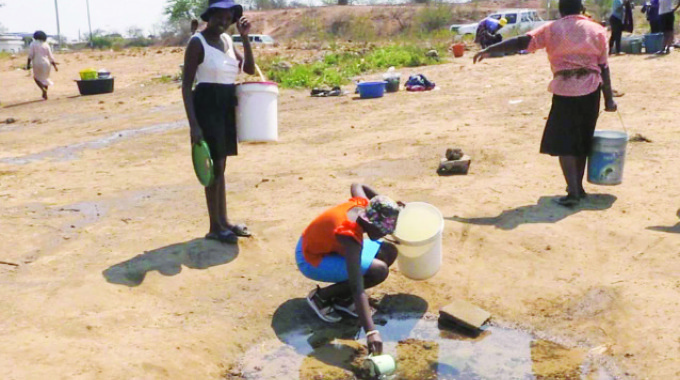
BULAWAYO residents are facing an acute water crisis that has only worsened as the Bulawayo City Council (BCC) has extended the water-shedding schedule from 120 hours to 130 hours per week, starting today.
Even areas previously exempted from water cuts, such as industry and the central business district, will now be included. This development has raised concerns about a possible disease outbreak in a city that is already grappling with many public health issues.
The BCC has acknowledged the increasingly challenging situation and has warned that residents cannot rely on the new schedule due to ongoing efforts to stabilise the water system. Unfortunately, the city’s water supply has been dwindling for years due to factors such as population growth, climate change, and poor resource management. Only last week, BCC decommissioned Upper Ncema Dam, the second dam to be closed after the Umzingwane Dam in November last year, as it had reached a critical level of 2, 08percent. A tour of several suburbs by a Chronicle news crew revealed that many residents have resorted to using unsafe water sources. For instance, in the Old Lobengula, people were witnessed fetching water from a leaking pipe, which they used for drinking and some domestic chores.
Ms Mulape Mbela, a resident and mother of two, expressed her frustration at the situation.
“We haven’t had tap water for nearly a month, and we’ve been forced to fetch water from this burst pipe. Despite the health risks, we have no choice,” she said.
“We are often told to boil water before drinking or cooking but frequent power cuts make it difficult to do so. Therefore, most people resort to using dirty water, without taking the necessary precautions.”
Mr Ricky Mafu voiced concerns over the increasing likelihood of a disease outbreak, such as cholera, as people continue to use unclean containers to fetch water from communal boreholes.
“Several residents come to fetch water from boreholes with unclean buckets. Despite this, they use these buckets to get water from the borehole, which serves as the primary water source for everyone,” he said.
Bulawayo Progressive Residents Association (BPRA) executive director, Mrs Permanent Ngoma, said some suburbs have gone for weeks without running water.
“The decommissioning of dams further exacerbates the water availability challenge. The situation is really bad as some areas go up to three weeks without tap water. We have engaged the council to frequently provide water bowsers,” she said.
“As we look into the growing population of Bulawayo, our expectation as residents is that the local authority and Government, which is responsible for bulk water, should be increasing construction of dams that meet the population growth.”
In a statement, acting town clerk, Mrs Sikhangele Zhou, said the worsening water situation necessitated the increase in water-shedding hours.
“The prevailing water situation has necessitated that the city council increase the number of hours of water shedding from 120 hours to 130 hours with effect from Wednesday (today) 9 October 2024,” she said.
“During this water shortage period, we urge all residents to conserve water in their daily activities. Simple measures such as fixing leaks, minimising water use for non-essential tasks, and reusing water wherever possible can make a significant impact.”
Mrs Zhou said the local authority is exploring alternative water sources and strategies to address the ongoing water scarcity challenges.
A group of parliamentarians recently visited Bulawayo and its supply dams where they witnessed the severity of the city’s water crisis first-hand.
During their visit, they received word that Lower Ncema Dam would be decommissioned by November, leaving the city with scarce supplies from the Insiza and Mtshabezi dams and inadequate inflows from the Nyamandlovu Aquifer.
Bulawayo is facing one of its worst water crises in recent years due to the El Nino-induced drought, which has resulted in low rainfall throughout the country and reduced inflows into the city’s six supply dams.
To combat this issue, the BCC has implemented various strict measures, including introducing punitive fines for those who exceed their daily expected water limits.
These measures also include a reduction of the city’s current monthly free water allocation of 5 000 litres by 40 percent to 3 000l in an effort to ensure the availability of water throughout the year.
Additionally, residents will now be required to pay US$4,13 per kilolitre for any usage beyond their daily allocation.
Unfortunately, the city anticipates that Lower Ncema Dam will also be decommissioned in early November, further exacerbating the water crisis and intensifying the need for immediate and effective solutions.
“The water assessment indicated that after the decommissioning of Upper Ncema in September and Lower Ncema in early November 2024, the amount of water available for abstraction would be from Insiza (51 ML/day), Inyankuni (17 ML/day), Mtshabezi (17 ML/day), and Nyamandlovu (8 ML/day), totalling 93 ML/day.
“To ensure continued supply of water ahead of the next rainy season, which is expected to commence in December 2024, more stringent measures were necessary, and as such the department is therefore proposing implementing a 132-hour water shedding programme,” reads the council report.


 Online Reporter