Chronicle Editor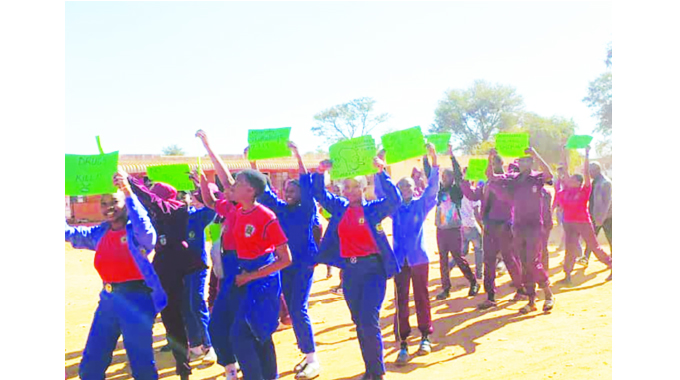
Michael Magoronga, [email protected]
IT is a given that a hangover is a terrible experience for many.
But after the throbbing headaches and unending nausea came a turning point and inspiration to transform lives for Brother Kwirirai Muzenda, a Geography teacher at Loreto High School in Silobela, Midlands Province.
His drinking experience and the sickly feeling after having one too many, left him wondering how the youths feel after being intoxicated.
“I used to consume alcohol and I would at times fail to do things that I would have planned to do due to a hangover. I then imagined how these children feel when they use drugs and consume alcohol. It’s even worse for them because their system is weak,” said Brother Muzenda.
His personal experiences with alcohol coupled with incongruent behaviour by intoxicated learners at the school led the teacher to embark on an anti-drug campaign and eventually the formation of a movement, Stand Against Drug Abuse (Sada).
He said he saw some pupils behaving weirdly, exhibiting signs of intoxication and felt something had to be done to end the madness.
The school has recorded many incidents of bullying, unwanted teenage pregnancies, property damage, poor performances, dropouts, love affairs and many other miscellaneous behaviours influenced by drug abuse.
Loreto High School recently made headlines after a Form 3 learner gave birth at the school hostels.
“The major turning point was when we intercepted one learner smoking marijuana. He admitted that he was now an addict and could not do without it. He pleaded with the school authorities not to expel him from school as he would become worse,” said Brother Muzenda.
After consultations with the Ministry of Primary and Secondary Education, the learner was allowed to continue with lessons and wrote his Ordinary Level final examinations.
To Brother Muzenda, this was a major push factor that led to the formation of Sada, a school-based movement targeting to eradicate drug and substance abuse among learners.
A holder of a Master’s Degree in Education, Brother Muzenda went on to enroll for a Diploma in Counselling to help him handle cases in a professional manner.
As part of the launch, Sada members at Loreto High School embarked on an awareness campaign that saw pupils march through Silobela raising awareness against the use of drugs among the youths.
“This was necessitated by some behaviour that was being exhibited by pupils at school like sleeping in class and even bullying. Some learners would even challenge teachers to fights and you could see that this was not normal. I approached the school head who agreed to the formation of the club and the need to counsel learners against such behaviour,” he said.
The club recently visited young offenders who are serving jail sentences for drug-related offences.
“The purpose of the visit was to try and help learners have a better understanding and awareness of the effects of drug abuse in relation to the law and health. Visiting the young offenders could be of help to these victims of drug abuse so that they get first hand experiences and lessons,” he said.
Brother Muzenda said plans were afoot to spread the reach of the club to other schools in Silobela.

“We are still a very young club but our intention is to introduce it to neighbouring schools so that we can help each other curb the drug and substance abuse menace. With time, we will also introduce it to other Catholic schools,” he said.
The school plans to intensify rapid drug testing, awareness and counselling programs as a means to curb the drug menace at the school.
Tinotenda Chemhuru, an Advanced Level pupil, was elected president of Sada and he says drug abuse has fuelled bullying at a number of schools in the area.
“I have seen serious bullying taking place at school, for example, a Form 1 pupil being locked up in a trunk by senior learners. That is bullying of the highest level and it should not be tolerated,” he said.
Tinotenda said the most widely used drug at the school is marijuana, which leads to aggressiveness by some learners.
“You can easily tell by their level of aggression after they smoke. They even challenge teachers and this is why I think random searches will go a long way to eradicate the drug menace at the school,” he said.
Girls are not to be outdone according to the club’s vice-president, Bernice Jeylar.
She said girls become more vulnerable to sexual abuse after being intoxicated.
“Drugs are unisex and it’s even worse for the girl child as they exacerbate teen pregnancies and child marriages. Girls become more exposed to sexual abuse when they get drunk. Such cases are there across society and it’s very disheartening,” said Bernice.
She said her joining Sada was driven by her personal experiences.
“I have a relative who went through rehabilitation following drug abuse and I saw it fit for me to play a role in educating other learners to desist from drug abuse and avoid what I saw happening with my relative,” she said.
Drug abuse in Zimbabwe has worsened because there are no rehabilitation centres with addicts likely to relapse even after treatment.
The drug and substance abuse menace has since been elevated to a national committee which involves other stakeholders as the Government seeks to decisively deal with the scourge.
President Mnangagwa set up an inter-ministerial taskforce on drug and substance abuse as part of his administration’s efforts to end the scourge which remains a great threat to the attainment of Vision 2030.

The taskforce is chaired by the Ministry of Public Service, Labour and Social Welfare and deputised by the Ministry of Youth, Sport, Arts and Recreation.
The taskforce technical officers are continuously being trained on curbing drug and substance abuse by the Government with support from the World Health Organisation (WHO).
Zimbabwe is also working towards a drug-free society through a drug masterplan, which will help the country achieve Vision 2030.
The masterplan aims at dealing with drug and substance abuse in society.
President Mnangagwa recently said the foundation of a caring society lies in strong families and vibrant communities as primary socialisation begins at these levels.
Loreto High School Development Committee (SDC) chairperson Mr Abraham Sibanda said some day scholars were bringing the drugs from the community.
“The school has both boarding facilities and day scholars. The day scholars are the ones who bring the supply to their friends who are boarders. They sometimes place them in food items so that we can’t detect them,” he said.
Mr Sibanda said search operations coupled with Sada programmes are expected to play a key role in eradicating the drug menace at the school.
“We are going to upscale the search operations when the children come into school and it is our hope that the Sada programmes are also going to help the children and conscientise them about the dangers of drugs,” he said.
Mr Sibanda said the Government and the community should play a role in raising awareness against drugs.
“I think corporal punishment should be brought back because these children are reversing the gains of Vision 2030. The community should play their role as well to name and shame the drug lords and the children who use drugs. It takes a village to raise a child,” he said.
Government has availed $500 million under the drug and substance abuse mitigation fund as part of efforts by the Second Republic to speed up high-impact activities in the fight against the drug menace.
Officiating at the inaugural Economic Development Conference towards a drug-free nation for the attainment of Vision 2030 at the Zimbabwe International Exhibition Centre in Bulawayo recently, President Mnangagwa said, “It is my expectation that the $500 million availed by my Government under the drug and substance abuse mitigation fund will accelerate high-impact activities and results in this fight to end drug abuse. These activities should reach every corner of Zimbabwe, no one and no place should be left behind. The need to mitigate the harm associated with substance abuse as well as negative health and psycho-social effects through the provision of holistic treatment services for affected individuals and families remains critical.”
On its part, President Mnangagwa said Government is rolling out outpatient psycho-social support centres designed to provide screening and counselling services and awareness and prevention services to people affected by drugs, including their families.
“These services are set to ensure the successful re-integration of former drug users back into society. As parents and caregivers, we have a huge role to play in educating our children and the youth to abstain from drug and substance abuse,” he said.



 Online Reporter