admin
admin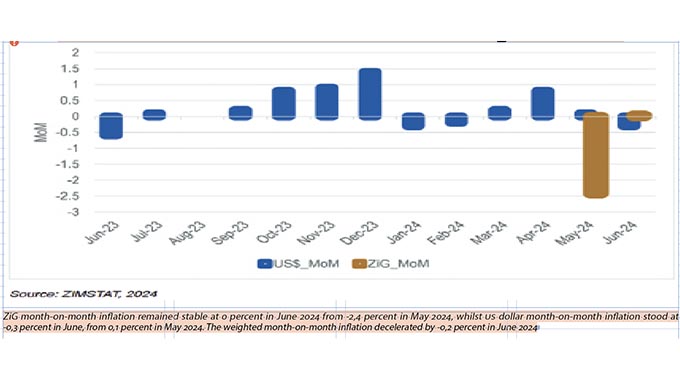
Inflation is projected to remain subdued for the rest of the year due to tight monetary and fiscal policies being pursued by authorities, which has maintained exchange rate stability in the local currency since its launch in April this year.
Significant pressures on the exchange rate at the beginning of the year resulted in spiralling exchange rates and inflation volatility.
Presenting the 2024 mid-term budget review in Parliament, Finance, Economic Development and Investment Promotion Minister Mthuli Ncube said, as a result, the interbank rate weakened from $6 192,40 in January 2024, to $30 674,32 per US$1 by April 2024.
The minister said the introduction of a structured domestic currency, the ZiG, on April 5, 2024, was a critical step in the phased de-dollarisation programme going forward.
The ultimate objective, he said, was to engender macroeconomic stability and re-establish a mono-currency regime that would spur domestic production and boost exports.
Minister Ncube projected the economy to grow by 2 percent in 2024, 6,5 percent in 2025, 5,1 percent in 2026, and 5,2 percent in 2027. The Treasury chief said the positive growth projection of 6,5 percent in 2025 was well above the National Development Strategy (NDS 1) target of 5 percent, which is expected to be anchored by projected normal to above-normal rainfall.
Zimbabwe’s new currency, the ZiG, is fully backed/covered by a composite basket of reserves, comprising foreign currency and precious metals (mainly gold). Minister Ncube said the Treasury would sustain monetary and fiscal measures that engender trust, wide acceptance, and use of the domestic currency.
Over time, this is expected to progressively switch the domestic economy from a foreign to a local currency-dominated currency regime in line with the de-dollarisation strategy.
Authorities are on record saying the use of an overly strong foreign currency limited the tools available to the monetary authorities for dealing with inflation. A strong currency also reduces the economy’s competitiveness.
Since the introduction of the new currency, the ZiG/US dollar exchange rate has been relatively stable, ranging between ZiG13,2 to ZiG13,7 per US dollar, helping to anchor low inflation.
“The stability of the exchange rate has resulted in subdued inflationary pressures in the economy as inflation expectations remain anchored. The full backing of ZiG has instilled market confidence in the efficacy of the new monetary policy measures,” Minister Ncube said.
He added that due to improved market confidence, the parallel market premium has been contained to insignificant levels. Furthermore, the minister noted that the Financial Intelligence Unit (FIU) and other law enforcement agencies have been effective in instilling market discipline.
“The stability of the ZiG has several downstream benefits to the economy, chief among is price and exchange rate stability, as inflation expectations remain fully anchored downwards in the short-to-medium-term,” Minister Ncube said.
The stock of reserve money, a key determinant of exchange rate and inflation behaviour, stood at ZiG6,6 billion in May 2024, compared to ZiG6,5 billion in April 2024. The reserve money stock consisted of a foreign currency component, ZiG5.6 billion; and a local currency component, ZiG1 billion.
The US dollar equivalence of the local currency component of the reserve money amounted to US$77,4 million as of May 2024, well below the international reserves backing the currency, which amounted to US$349 million.
On the other hand, broad money stock stood at ZiG41 billion at the end of May 2024, reflecting an increase of 5,9 percent from ZiG38,8 billion recorded at the end of April 2024. The broad money stock was made up of ZiG33 billion (80,4 percent) in foreign currency deposits and local currency component ZiG8 billion (19,6 percent).
Minister Ncube said it was pleasing to note that the foreign currency component in broad money depicted a declining trend after peaking at around 87 percent earlier this year, reflecting increased use of the local currency in the economy.


 Online Reporter