Chronicle Editor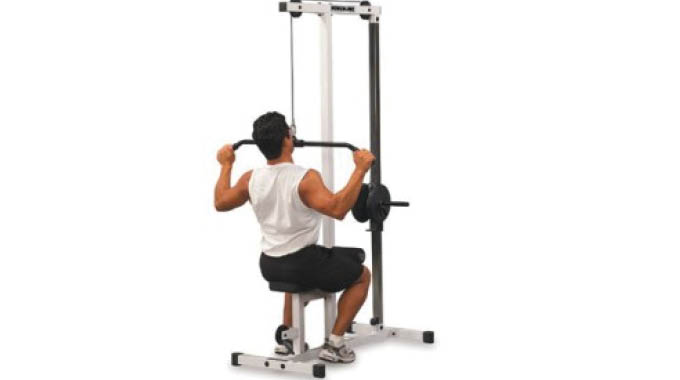
Simon Gama
Some modern machines can be quite complicated to the uninitiated, but maintaining good form with machines tends to be easier than with free weights.
In most cases, the path of the weight and the range of motion are predetermined by the machine’s design. It’s like the difference between heating a frozen pizza and making pizza from scratch.
With most variables set, there is simply less for you to think about and less that could potentially go wrong.
On a machine, it’s generally easier to adjust the amount of weight being used. You merely move a pin, as opposed to either tracking down dumbbells or sliding plates on and off a bar. This is especially important when incorporating a technique like the Weider Descending Sets Training Principle, during which you repeatedly lower the weight with virtually no rest.
Free weights are more versatile
Because they often lock you into a specific motion, machines don’t allow for much variation. Although you can sometimes change your position when using a machine, the path of the weight is predetermined.
On the other hand, barbells and dumbbells allow for seemingly endless variety. With free weights, you can easily alter the trajectory of lifts such as side laterals and triceps extensions, thus placing a unique emphasis on the muscles. Again, it’s like the difference between making a pizza just the way you want it or heating a frozen one. Variations may be subtle, but just as the freshly prepared pizza is generally tastier, the more versatile free-weight movements usually suit your physique better.
Finally, because machines are designed for someone of average height, if you’re more along the lines of either Champion Mbeva or Lovemore Munyamana it may be impossible to use them properly. And in some gyms, the weight stacks are too light for hard-training bodybuilders.
Why you need both
If asked to choose between machines and free weights in some imaginary gun-to-the-head either/or question, most bodybuilders would probably pick free weights. It’s accepted wisdom that old-fashioned iron is superior for gaining mass. Comparing one similar exercise to another, this is generally true, and you can certainly get a great upper-body workout with only free weights. However, machines are nearly mandatory for training hamstrings and calves, and it is unlikely most bodybuilders would build better quadriceps using only barbells and dumbbells rather than the variety of thigh machines a well-equipped gym would offer.
For this reason, if forced to choose one or the other, remember that you can actually train all of your body more thoroughly using machines exclusively.
Luckily, you need not choose
between machines and free weights. You require both, because some free-weight exercises cannot be duplicated with machines and vice-versa. There is no pulley or lever equivalent of the deadlift or the power clean, and using a mechanical device can never replicate the stress of a free-weight squat or bench press. Likewise, any attempt at performing machine lifts such as standing calf raises, leg curls or triceps pushdowns with loose iron is impractical at best.
You can potentially benefit from all exercises, regardless of the equipment you choose. Not every exercise suits every person, however. Perhaps, owing to your physiology, some don’t stress your muscles the way they should; others are awkward. But you won’t know unless you try. You should use every machine in the gym and also experiment with all of the standard free-weight exercises. Perform a new exercise for several workouts to see how your body responds. Just the shock of something new is often enough to cause a growth burst.



 Online Reporter