

 admin
admin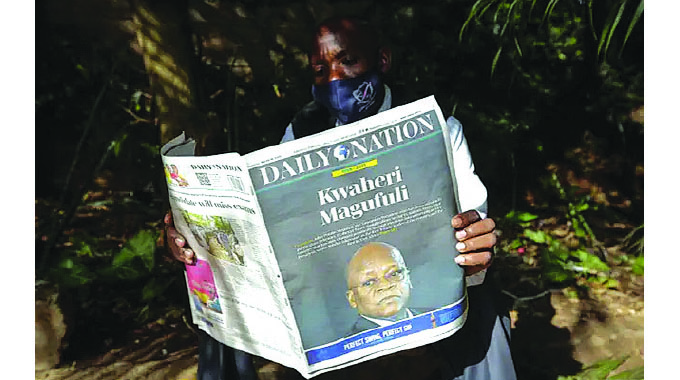
Walter Muchinguri
Senior Researcher & Writer, Zimpapers Knowledge Centre
ON March 17, Tanzanians lost their tough talking, no-nonsense and combative leader President John Pombe Joseph Magufuli, due to heart complications. He had a 10-year battle with heart problems.
A Pan-Africanist, he leaves behind a rich legacy not just for Tanzanians and East Africans, but for the African continent.
President Magufuli (61), breathed his last at Mzena Hospital. He is survived by his wife Janeth and two children, Jessica and Joseph.
He will mostly be remembered for his tough and unwavering stance on corruption and his views on Covid-19.
A former teacher and holder of a Masters and PhD degree in chemistry, President Magufuli’s political career started in 1995 when he was elected a Member of Parliament for Chato constituency in the gold-mining district of Geita, in north-western Tanzania, near Lake Victoria.
He was subsequently appointed Deputy Minister of Works from 1995 to 2000. He then served as Minister of Works from 2000 to 2005; Minister of Lands and Human Settlement from 2006 to 2008; Minister of Livestock and Fisheries from 2008 to 2010; and, Minister of Works for a second time from 2010 to 2015.
During his stint as Minister of works, Dr Magufuli earned the nickname “Tingatinga” (the Bulldozer), due to his push for the underprivileged to be accommodated in the construction programmes he had implemented.
In 2015 Dr Magufuli earned the ticket to represent the ruling Chama Cha Mapinduzi party in the presidential race and he became the East African nation’s fifth president after garnering 58 percent of the vote.
Chama Cha Mapinduzi has been in power since Tanzania attained independence in 1961, with Mwalimu Julius Nyerere as its founding leader.
He chose Samia Suluhu Hassan as his running mate, and they ran a successful election campaign premised on fighting corruption, developing the country and its economy through initiating major public works.
President Magufuli, who succeeded Jakaya Kikwete, literary hit the ground running when on the first day on the job, he caused a stir when he visited the Ministry of Finance offices in the administrative capital Dodoma, asking for the whereabouts of those not at work.
This was to be the precursor to his anti-corruption crusade starting in Government where he ordered the removal of ghost workers from the payroll.
He then escalated his drive to various Government departments, carrying out an audit of jobs with employees being asked to justify their jobs. He also initiated a lot of cost-cutting measures including the reduction of trips by Government officials.
In one instance, President Magufuli is reported to have ordered the reduction of the budget to host a party to inaugurate the new parliament to be slashed from $100 000 to $7 000.
He also clamped on incompetent public officials and went on to fire the head of the main state hospital after finding patients sleeping on the floor, during a surprise visit to the facility.
To give traction to his developmental thrust, President Magufuli advocated for higher taxes to be levied on the private sector in order for Government to raise money to undertake massive infrastructure projects.
He invested in large infrastructure projects such as a standard-gauge railway to connect the country with its neighbours, major highways, and a bus system in the commercial hub of Dar es Salaam. He also increased electricity production, reducing the need for power rationing.
The ‘Bulldozer’ renegotiated stakes in major mining and gas companies to ensure that the State had a bigger stake and gained a lot of pundits for firing public officials deemed to be corrupt, on public television.
President Magufuli took a heavy pay cut after he instructed that his salary be divided by four, resulting in him joining the ranks of the lowest-paid African heads of state.
His fight against corruption gained a lot of plaudits and global attention in December 2015 after pictures and video footage of him picking up rubbish on the street outside State House went viral.
This was after he had earlier cancelled the country’s Independence Day on December 9, breaking a 54-year-old tradition, in order to cut costs and also in view of a cholera outbreak in the country at the time. He instead called for a national clean-up on the day.
“It would be shameful to spend huge sums of money on the celebrations when our people are dying of cholera,” he was quoted by state television, when he made the announcement.
Cholera had killed about 60 people at the time of the announcement.
During the clean-up campaign, AFP news agency reported that President Magufuli, told a crowd of surprised on-lookers as he picked up rubbish off the street that: “Let us work together to keep our country, cities, homes and workplaces clean, safe and healthy.”
The father of two was re-elected in October last year in a landslide victory where he secured more than 84 percent of the votes.
Two months later, President Magufuli made headlines when he announced that he would replace the would-be deputy Minister for Minerals, Mr Francis Ndulane after the latter failed to accurately read the oath of office during a swearing-in ceremony.
He announced the decision at the Dodoma State House after swearing in 21 ministers and 22 deputies, excluding Mr Ndulane who couldn’t make it even after attempting three times. President Magufuli said he would ask authorities to investigate whether the member of Parliament had forged his academic certificates.
In January this year, the Tanzanian leader set himself on a collision course with health experts and scientists after he warned the country’s health ministry against quickly accepting Covid-19 vaccines from foreign companies and countries.
“You should stand firm. Vaccinations are dangerous. If the white man was able to come up with vaccinations, he should have found a vaccination for Aids by now; he would have found a vaccination of tuberculosis by now; he would have found a vaccination for malaria by now; he would have found a vaccination for cancer by now,” he said.
“The Health ministry must know that not every vaccination is meaningful to our nation. Tanzanians must be mindful so that we are not used for trials of some doubtful vaccinations, which can have serious repercussions on our health.
“We have lived for over one year without the virus because our God is able and Satan will always fail. The Health ministry should be cautious, and avoid the temptation to turn us into a country where vaccination trials are conducted freely.”
Until recently Tanzania had not imposed Covid-19 related restrictions on its citizens or enforced Covid-19 preventative measures such as the wearing of masks as recommended by the World Health Organisation.
While the world is focusing on his legacy, Zimbabweans will remember him as a friend and close ally who unequivocally called for the removal of the illegal sanctions against Zimbabwe.
Zimbabwe and Tanzania share a long and deep-seated history of friendship and cooperation that dates back to the liberation struggle when President Nyerere took a deliberate stand to support the continent’s liberation movements, Zimbabwe included. The military wings that fought the colonisers in Mozambique, Rhodesia (Zimbabwe), South Africa, South West Africa (Namibia) and Angola used training camps in Tanzania.
In May 2019, President Magufuli came to Zimbabwe on a two-day working visit, which he subsequently extended, as he held bilateral talks to deepen, promote and consolidate cooperation with his counterpart, President Mnangagwa.
The extension was a rarity in statecraft. Briefing journalists following a two-hour long meeting at State House, President Magufuli said it was high time that Zimbabwe and Tanzania transformed their relations from political to economic co-operation.
“I really enjoyed staying here in Zimbabwe and I think that the cooperation and bilateral relations will continue. I just came here to cement it. So I can say that I am acting like a catalyst and you know the work of a catalyst, it is to speed up the reaction even if it does not take part in the chemical change,” said President Magufuli who had earlier on given his brief in Swahili.
“So I can assure you this good relationship and bilateral relations between the two countries will continue to exist and we have agreed on several issues on trade, tourism, infrastructure, Swahili language, just to mention a few.
Asked if he felt that his call for the removal of illegal sanctions by Western countries would be heard, Dr Magufuli said there was need for a different approach such as engagement.
“To be heard or not to be heard, but I have said it. So it is up to them, but I have tried my level best because Zimbabwe needs to move as far as economic development is concerned, so it cannot move with those sanctions.
“The time has come to decide on a different way so that instead of punishing poor people of Zimbabwe we could just use another method, maybe engagement and solving the problems together. I am sure they have heard because you are there, you will make them hear,” he said.
Three years later, at the 39th SADC summit in Dar es Salaam, as the new of SADC chairman, President Magufuli, pushed for the Heads of State to adopt a resolution for the unconditional lifting of the illegal sanctions against Zimbabwe and for the approval of October 25 of every year as a special day against sanctions in Zimbabwe where member states would be conducting various activities, including preparing dialogues and declarations against the sanctions on Zimbabwe.
The permanent secretary in the Ministry of Information, Publicity and Broadcasting Services Nick Mangwana on Thursday tweeted that Dr Magufuli leaves behind an incorruptible, no-nonsense legacy: “He was a friend of Zimbabwe who never wavered from his resolute stance to oppose the illegal sanctions against this country. His departure will be felt in the region.”
During the opening ceremony of the 39th Ordinary Summit of Heads of State and Government President Magufuli urged the 16- member states to use their vast resources to generate wealth.
“Our countries are not poor they are very rich. We have all the resources to make us rich,” he said, adding that the Southern African Development Community has vast natural resources including fertile land, minerals and wildlife, in addition to human resources.
“We must therefore work together to ensure that we utilise and exploit these resources for the benefit of our countries and people. This is important because it is only through cooperation that we will be able to utilise these resources effectively and achieve our objectives.”
He urged member states to develop their industries, and to trade more with each other to ensure that the region fully benefits from its resources.
President Mnangagwa took to Twitter to convey his heartfelt sympathies to the people of Tanzania. “My deepest condolences to the family of His Excellency President John Magufuli and the people of Tanzania. Africa mourns with you. May his soul rest in peace,” wrote President Mnangagwa.
His South African counterpart, President Cyril Ramaphosa also conveyed his sympathies to Tanzania’s Acting President: “I spoke to Her Excellency, Vice-President Hassan this morning and conveyed the condolences of the people of South Africa … on their loss. As we all know, Tanzania is a country that stood with us during our struggle for freedom and sacrificed a lot, halting and delaying their own development so that we could be free.”
Kenya declared a seven-day mourning period as President Uhuru Kenyatta described President Magufuli as an “illustrious leader and a champion of pan Africanism”.
“I have lost a friend, a colleague, and a visionary ally with whom I worked closely, particularly on our commitment to form lasting bonds between Kenya and Tanzania,” said President Kenyatta.
Boris Johnson the UK Prime Minister tweeted: “I’m sorry to hear that President Magufuli has passed away. My thoughts are with his loved ones and the people of Tanzania.”
Meanwhile, Somalia President Mohammed Farmaajo wrote on his Twitter account: “On behalf of the Government and the nation of Somalia, I would like to extend our heartfelt condolences to the United Republic of #Tanzania following the demise of President John Magufuli. We wish the nation and the Government patience and stability in this period of prayer and mourning.”
The Embassy of China through its official Twitter handle tweeted: “We are deeply saddened by the tragic loss of HE Dr John Pombe Joseph Magufuli, President of Tanzania. President Magufuli is a visionary leader who has devoted his whole life to his nation and people. His contribution to the development of China-TZ relations will be remembered”.
African Development Bank (AfDB) president Akinwumi Adesina also took to social media, describing President Magufuli as “a very committed leader” who worked tirelessly for the development of Tanzania.
“I am terribly saddened by the passing away of my very dear friend and brother, President John Magufuli of Tanzania. A very committed leader. He worked tirelessly for the development of Tanzania. I will greatly miss you and your drive and passion for Africa’s development. RIP,” the AfDB President tweeted.
As Tanzanians observe a 21-day mourning period, newly sworn-in President Samia Suluhu Hassan (61), announced that President Magufuli will be buried on March 25. President Suluhu becomes Tanzania’s first woman head of state and government. She will complete President Magufuli’s five-year term.



 Online Reporter