


 Online Reporter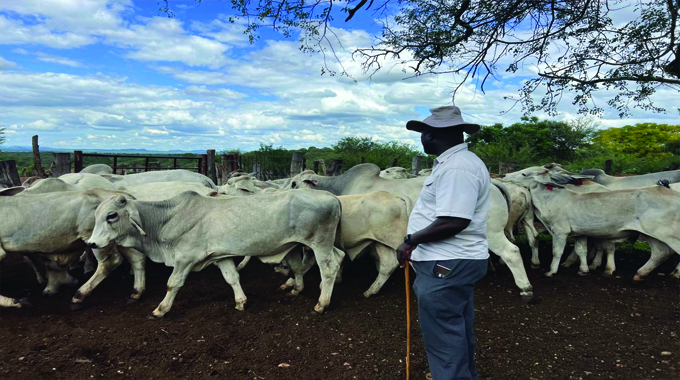
Sukulwenkosi Dube-Matutu, Matabeleland South Bureau
LOSING a single beast is a huge loss for Umzingwane stud breeder, Mr Jairos Mahlangu and putting stringent measures in livestock breeding has paid off for him.
Just as a new-born baby is cared for, a new-born calf in Mr Mahlangu’s kraal is closely monitored up to the weaning stage.
Mr Mahlangu has a herd of 400 Brahmans. He said the first 21 days for a calf are the most important because if not properly taken care of, it can die.

On birth, a calf’s umbilical cord and naval have to be cleaned with methylated spirit and iodine to disinfect and protect it against infection. Cleaning of the naval has to continue up to about two weeks, even after the umbilical cord has ruptured.
Mr Mahlangu said just as a mother’s milk is crucial to her baby, so is a heifer’s milk to a calf as it contains vital antibodies.
“Every animal needs to be taken care of, from the time it’s a calf up until it becomes a heifer. The care and the needs vary with the stage the animal is at. A calf needs its mother’s milk as it is rich in cholesterol which has the necessary antibodies it needs.
“The heifer, which is breastfeeding, also needs to be given adequate food high in nutrients so that it is able to breastfeed. During the first 21 days, a calf shouldn’t be taken for dipping so that its immune system is developed. A calf should be allowed to naturally build its own immune system to help it adapt to the new environment,” he said.
Mr Mahlangu said after 21 days, there is a need to apply tick grease on the calf and after three months, it can be sprayed. He said a calf can be weaned at three months and at that stage, it should be vaccinated against diseases and Sexually Transmitted Infections (STIs).
Mr Mahlangu said after being weaned off, a calf should be given a well-balanced diet.
“Just as a child needs a well-balanced died after being weaned off, so does a calf. To ensure a smooth transition, a calf will need nutritious supplements as being weaned off can be stressful and it can also affect its development,” he said.
He emphasised the need for livestock farmers to take up cattle rearing as a business. Mr Mahlangu said cattle have a crucial role in the lives of people as they have multi-purpose by-products. He said each farmer should see every beast as a valuable asset.

In order to become a successful stud breeder, Mr Mahlangu said he has had to continuously research how to improve his production. He said a farmer has to ensure an animal calves every year.
“When one ventures into livestock production or any other farming activity, it means going all the way. Farming, in order to be conducted successfully, and for it to yield positive results is not part-time but a full-time job. In my case, I have learnt that as a livestock farmer, I have to invest in my herds’ diet and health care. I have to ensure my cattle access the necessary nutrients in the right quantities,” he said.
Mr Mahlangu has established a dipping point in his kraal where he applies tick grease to his animals and sprays them every Sunday. He also takes his animals for further dipping every Wednesday at the communal dip tank to ensure effective protection for his animals.
As part of efforts to enhance production, Mr Mahlangu has intensified silage production. He has two hectares under fodder crops. He also has grass which is earmarked for baling. The fodder crops that he has under production include sorghum, barner grass, maize and sunflower among others. He said sunflowers are rich in protein.
Mr Mahlangu said this was necessitated by lessons learnt during the El Nino-induced drought. He said he had to part with large sums of money in order to buy feed to sustain his animals during the drought.
“Diet is crucial in the performance of livestock. It’s important for farmers to pay particular attention to what their animals eat and in what quantities. Protein is crucial in the diet of an animal as it enhances its productivity and fertility. With enough protein, an animal can calf each year,” he said.
Mr Mahlangu said stud breeders have to take the lead in adopting initiatives that will grow the provincial herd. He said they also have a role in improving breeds.
Mr Mahlangu started off with commercial livestock and upgraded his herd to achieve pure pedigrees.

He said it is important for farmers to fully utilise the land they have. Conducting his farming activities in a communal area has not stopped Mr Mahlangu from expanding his herd. He has rented space in Shangani and Nyamandlovu areas.
In 2008, Mr Mahlangu had about 30 cattle. He gradually built his herd using funds that he got from a furniture business that he was running. Mr Mahlangu said he has been mainly buying heifers in order to enhance the productivity rate of his animals. Over the years, he has gained experience in breeding Brahmans.
Mr Mahlangu said it is his desire to secure bigger land for his animals as it is expensive to keep them in three different locations. He said having them housed in one space will also help to improve care for his livestock.
His passion for livestock breeding dates back to his teenage years. He acquired basic skills on livestock breeding from his father and owned his first beast at the age of 14. “I had to work and sweat in order to get my first beast. When I ventured into livestock rearing, I knew exactly what I was doing, why I was doing it and what I wanted to achieve,” he said.
Matabeleland South provincial livestock specialist, Mr Hatityi Muchemwa said activities of farmers such as Mr Mahlangu will help the country to achieve set targets under livestock production.
He said it will also go a long way in growing the provincial herd and recovering losses experienced in the livestock sector during the El Nino induced drought.
The province recorded a loss of 19 000 cattle due to drought last year.

The Government is accelerating plans to build the national herd to six million by 2025 in line with the country’s agricultural growth recovery plan to meet national demand for meat and dairy products, and to resume exports. This requires not just breeding more cattle, but also ensuring that none are killed by disease.
The national herd stands at 5,5 million and various measures have been put in place to improve the quality of livestock including artificial insemination which involves cross-breeding with semen from selected quality bulls and vaccination programmes. The Government has set a target of 6 million by 2025.
In 2020, the Government approved the Livestock Recovery and Growth Plan (2021-2026), whose main thrust is to put in place solid interventions to address livestock production and productivity issues that lay a good foundation for the livestock sector to assume its prominent role in transforming farmers’ livelihoods and providing the required raw materials for agriculture-led industrial development, among other things. These will culminate in an increase in livestock production and productivity and strengthened animal disease surveillance and control systems.
The Government was concerned with the poor performance of the livestock sector and it promulgated a blueprint to address all areas that were limiting growth.
Observed challenges were associated with animal health, sanitary and feed, safety issues, availability of adequate nutrition, genetics and access to infrastructure suitable for accessing lucrative domestic, regional and international markets. These challenges are responsible for the low off-take, low fertility, high mortality and morbidity, low carcass weight, poor quality and inability to effectively compete on the export market.
The goal is to reduce livestock mortality, for more productive livestock systems that are adapted to meet the incessant drought events caused by climate change.
Climate change has brought its own challenges to the livestock sector. There has been an increase in animal disease outbreaks, frequent droughts and floods. — @DubeMatutu.



 Bongani Ndlovu