admin
admin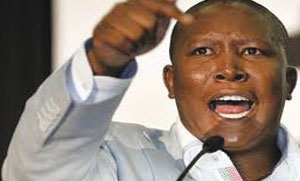
JOHANNESBURG. – Firebrand EFF leader Julius Malema has lashed out at the way Africans are perceived when talking about white or Indian racism, calling some black reporters who are critical of his party “house n****rs”.
Addressing a crowd after a brief appearance in the Newcastle Magistrate’s Court yesterday, Malema defended his comments that the majority of Indian people are racist, as well those by his deputy Floyd Shivambu about Treasury’s Deputy Director General Ismail Momoniat.
He specifically aimed his comments at those critical of “when we speak in Parliament against Momoniat”.
“You know why (they are critical), because (they believe) Africans can’t think unless they have something to hide. That’s how they view us, including these journalists, who are Indian, who are white, and including some of the house n****rs.
He added that Indians said black people were being used by whites to attack them, and that when they spoke out against white racism they were then being used by “this or that and all of that”.
“They think you can’t think until you are given something, because [they believe] Africans can’t think. It’s an insult that we as Africans should unite against…
“Let’s not be scared, let’s not be demoralised. Let’s become more resolute; let’s become more determined to fight against the oppression of black people in general and Africans in particular.”
City Press reported that at the EFF’s Youth Day celebrations earlier in June, Malema characterised the majority of Indians as being racist, saying that their disdain for black people was unmistakable.
“I want to give you two examples of why I say the majority of Indians are racist: If you check the marriage rate between Indians and Africans, it is extremely low. Africans and Indians do not marry each other because the majority of those Indians see us as subhuman.”
Yesterday, Malema maintained his stance.
“We said (the) majority of Indians are racist. They were all screaming, but they are now coming back one-by-one, sobering up and confirming exactly what the EFF is saying – that indeed the majority of Indians are racist. We did not say all Indians.”
Describing what he called the hypocrisy of South Africa, Malema compared his comments to those of former Constitutional Court Judge Zak Yacoob, who said that at least 90 percent of Indians that he had come across were racist.
“When it is said by an Indian – because of racism – it is accepted and allowed,” said Malema.
“Julius Malema comes and repeats after an Indian, (and people say): ‘No you can repeat the things that must be said by Indians only, because you are an African, you are of a lower class.’
“That’s the problem we are dealing with in this country – it is truth when told by a white person, it is truth when it is told by an Indian person, but if it’s told by a person of a lower class, it’s unacceptable.”
The EFF leader told the crowd not to be apologetic when fighting for Africans, because they were the most oppressed.
“I’m not fighting with Indians. I am saying to them that you were oppressed better than us – you had water; you had electricity, you had tar roads, you had Indian schools, you had shops, you had all sorts of things. You were in closer proximity to white people.”
“We did not have anything.
“So when we talk liberation, we can’t do it at the same time and say both Africans and Indians must be elevated at the same time. When we say let’s go up at the same time, Indians will always be ahead, because they are ahead already.”
Earlier in June, the EFF and Shivambu came under fire for comments made in a committee meeting, where Shivambu questioned the presence of Momoniat.
Shivambu reportedly asked why Momoniat attended finance oversight committee meetings, and allegedly accused him of having a superiority complex which did not allow him to take orders from African seniors.
Malema’s case in Newcastle concerns him allegedly calling on EFF supporters in 2016 to invade unoccupied land.
The case against Malema has been postponed to February 25, 2019. The EFF is currently seeking to challenge the constitutionality of the Trespassing Act.
An application by the party to challenge the constitutionality of the Riotous Assemblies Act was removed from the court roll by the North Gauteng High Court in Pretoria in April. – News24



 Online Reporter