Online Reporter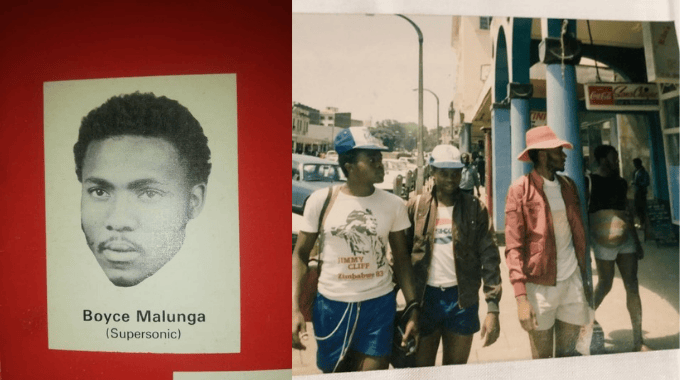
BARRY Daka (May His Soul Rest In Peace) had players who were his problem solvers and among these are three legends Boyce Malunga, Tito Paketh and Master Masiku.
In the later years of his illustrious career, he could be seen and heard on the touchline shouting, “Master Organise, Organise Master.”
One had to be very good to win his trust and favour. He had to be a leader and a great game reader to assist the coach infield.
Daka worked with the brilliant duo of Paketh and Malunga at Supersonic later renamed Olympics and stunned the country with a 3-1 win over Caps United in the final of the 1982 Rothmans Shield.
Sunday Life caught up with the legendary Malunga, better known to his friends as Macari. He is now based in the United Kingdom, where he has been for over 25 years.
Born Douglas Malunga on 16 February 1958 at Mpilo Central Hospital, Malunga grew up in Mzilikazi suburb but spent most of his youth at Barbourfields and attended Lobengula Primary School, which enjoyed great football rivalry with nearby Mzilikazi Primary School.
Malunga started off as a defender, getting football assistance from the late former Highlanders winger and soccer referee Nicodemus Sibanda who was a teacher at Lobengula Primary School.
“We had Sibanda (Nicodemus) he was involved with the school’s soccer programme and I played as a centre-back. In the team, we had Jasper Dliwayo, a good midfielder who was a brother to former Bosso reserve team goalkeeper Victor, who made a name at Risco (Zisco),’ said Malunga.
Like most of his peers, street football and city council club activity was key in passing time.
Malunga, around 1971, joined the Zimbabwe Saints junior development structures, rising up to the reserve team in 1976 at the age of 18.
“We were coached by former junior league leader Lyton Majada. I remember at one stage I was part of the Bulawayo select that clashed with the Mashonaland select at Under-14 level. It was during the multi-racial soccer times,” said Malunga.
He said growing up in those days, there was a lot of inspiration in the big names of the game.
“I was in the reserve team with players like Nhamo Chizunza. We were inspired by William Sibanda and Max Tshuma. They had great football qualities that we admired and many youngsters of that time were blown by the midfield brilliance of the two. William was so good with the ball, and in actual fact it was Sibanda who recommended in 1980 that I rejoin Zimbabwe Saints to replace him,” said Malunga.
His big break came in 1977.
“A number of senior players — Barry Daka, Isaac Mafaro, Chutika Tembo, Itai Chieza, Stanley Nyika, Zenzo Dabengwa, Ananias Dube, Peter Zimuto and Ephraim Moloi quit Highlanders to form Olympics. Barry was the coach so one day he found us playing small-sided games. We were about 12 of us, and he invited us to come over, and we got involved at the foundation stage of Olympics, Garion Nyathi and Lucky Bonda were among the players I was with,” said Malunga.
Malunga said it felt great to rub shoulders with players that he had seen clash with his favourites Sibanda and Tshuma. Highlanders were big, coming from a runners-up spot in 1976 and three consecutive regional titles that had borne a national play-off triumph in 1974.
“In my debut year, I found myself playing against Wankie, Dynamos, Arcadia, Zimbabwe Saints, who groomed me and Rio Tinto at a time Highlanders would make some perimeter fencing out of sacks at Nguboyenja and charge fans to watch them,” said Malunga.
Malunga then joined Old Miltonians and played alongside Tito Paketh, the Boonzaier brothers, Neil and Richard.
In 1980 when Old Miltonians decided not to continue with playing in the new league, Malunga decided to join Zimbabwe Saints.
He acknowledges the positive impact Old Miltonians had in his life. They took him to a company where he started off as a cleaner but eventually worked his way up as a qualified skilled worker in motor mechanics.
“William Sibanda, my childhood hero, a great player by any measure, recommended that I replace him at Saints. It was a good team with big names, Stephen Chuma, Gibson Homela, Douglas Maneto, Max Tshuma, Ebson ‘Sugar’ Muguyo, Emmanuel Sibanda, Ben Makadzange and Philemon Dangarembwa.”
Malunga remembers how he broke his leg after a clash with Highlanders’ Douglas Mloyi.
“Max Tshuma timed a run and placed the ball into space, with goal in sight, Mloyi took me on, breaking my leg in the process and I was in Plaster of Paris for nine months. While recuperating, Dave Lock brought me some gym equipment like weights and I started doing positive physiotherapy, which helped me return to the game sooner after the plaster was taken out,” said Malunga.
It was while he was recovering that he made a decision to join the Olympics because Saints had dumped him.
“Saints did not help me much, that angered Dangarembwa and Makadzange who joined Olympics at about the same time with me in 1981. The move was in solidarity with a colleague,” said Malunga. The following year was their best as a team. Olympics defied the underdog billing and pulled a shocker, beating Caps United 3-1 in the Rothmans final.
“We had beaten Rio Tinto in the semi-finals and we had beaten Chikwanha Rangers 5-1 in the quarter-finals. The final was a Goliath v David affair.
“The Caps United was a mean machine that could not be stopped with the best attack in the land of Stanley Ndunduma, Joel Shambo, Friday Phiri, Tobias Moyo, Stanford ‘Stix’ Mtizwa and Shaky Tauro.
To everyone, we were coming for the slaughter, but we prepared well physically and mentally for that game.
“While Caps camped at a hotel, we camped at Goromonzi, and at 12.50 hours, we were at the stadium, seated just behind one of the goalposts watching curtain raisers. We were psyching ourselves up and we resolved that we would stun them in such a way that they would be left sitting on the turf, wandering what had hit them.
“True to that resolution, we beat them hands down, we were unknowns, perhaps Barry the bigger name, but he was on the bench that day. We completely dominated play, I was in midfield with Tito Paketh.
Barry, who used to instruct us to go and play to solve problems on the pitch, assigned us to deal with Shambo and Mtizwa, dribble past them all afternoon, give them no space to shine.
“Barry believed in us, he would at times play us in attack and bring us to defend later in the game or throw us in midfield and either push us into attack when need arose, with Tito playing nine and myself 10, we understood each other. Tito was a gifted footballer who compared with any of the best in the land.”
At the end of that year Malunga and Tito were part of the 11 Soccer Stars of the Year finalists.
Olympics, who had travelled by bus to Harare returned by air that same evening. They went to their clubhouse a shebeen in Mzilikazi koMatlapeni where they drank all night.
“My wife Vina and brother returned by bus and I had told them to come straight to the shebeen when the bus arrived in Bulawayo. The bus party found us at koMatlapeni drinking the morning away, some did not go to work,” said Malunga.
After the 1984 Olympics problems, which saw Tito, Amin Soma-Phiri and Tobias Mudyambanje move to Highlanders, Malunga went back to Saints and was part of the rebuilding exercise that gained momentum in 1987 with the club finishing in the top four of the Super League and reaching the semi-finals of the Cecafa Cup.
In 1988, Zimbabwe Saints won the league and the Chibuku Trophy.
“I am happy with what I achieved in my career. I am happy that I achieved a lot with my boyhood club Zimbabwe Saints and that I played with some of the greatest players in the local game like Joseph Machingura, Ephraim Chawanda, Henry Mckop, Misheck Sibanda and John Sibanda, a great goalkeeper in my view,” said Malunga who was capped in 1983.
“I enjoyed the old 4-2-4 formation where there were distinct two midfielders which role I played successfully with Max Tshuma at Saints and Tito at Olympics.
Football was football back then and I enjoyed myself on the pitch,” said Malunga who moved into coaching in 1989 and saw him travel to Aberdeen, Scotland in 1990 with a Bulawayo Select.
He described the team as very talented and he is not surprised that Peter Ndlovu went on to achieve so much.
“We had Peter Ndlovu, Benjamin Nkonjera, Lovemore Ncube, Leonard Chunda, Abedi Mugadza, Methembe Ndlovu, Musa Masango, Chris Kahwema and Lloyd Johwa.
What a group of talented boys, I was coach for the trip alongside Ali Dube, who knew the boys and what to do with them at training and matches,” said Malunga, who is with his surviving kid, a son based in the UK.
His daughter and another son died long back.
He describes David Muchineripi of Black Aces as having been his most difficult opponent and contends that the midfield of Shaw Handriade, Kuda Muchemeyi, Hamid Dhana and David Mandigora at Dynamos as having been one of the best in the land.
During his time, Malunga says there were very many good players and that national team coaches were spoilt for choice.
The midfield combination of Clever Hunda and Muchineripi at Black Aces was the most formidable he faced.
Malunga has been away from the game for close to 28 years and remembers the local derbies against Highlanders as hair-raising in both Chikwata and Olympics clashes, with Tymon Mabaleka’s presence and form key to the result.
His younger brother Tsiri Lloyd was an occasional goalkeeper for Olympics.
His Best X1
Mike Mhlanga, Philemon Dangarembwa, Peter Zimuto, Ephraim Chawanda, Steven Chuma, Boyce Malunga, Barry Daka, Max Tshuma, Onias Musana, Tito Paketh and Andrew Kadengu.