admin
admin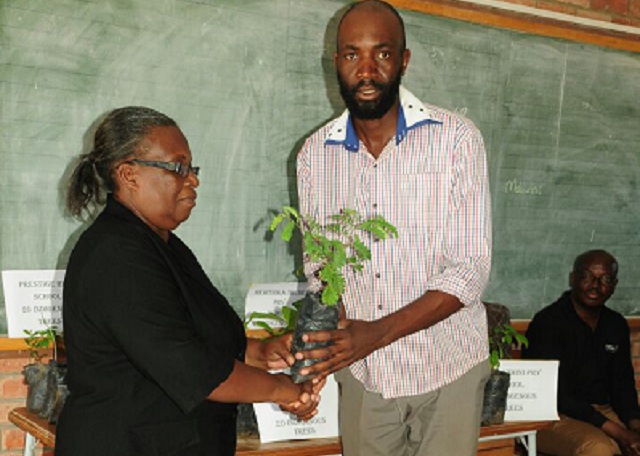
Hazel Marimbiza .
HE could be the countrya��s biggest herbalist and wear that hat with honour. That is Ezra Bonde (39) who has grown 79 500 different herbal tree types.
His passion for the a�?green lifea�? began when he realised how people suffered from various diseases and in most cases not knowing that the cure lay around them in the form of flora.
His visit to Central and East Africa in 2010 opened his eyes.
a�?My visits to Ethiopia and Kenya led me to grow the indigenous and medicinal trees. Ita��s rare to come across a sick person in Kenya. The people there are strong compared to us because they constantly eat herbs,a�? he said speaking on the sidelines of the commemoration of World Earth Day on 22 April atA� Cowdray Parka��s Tategulu Primary School in Bulawayo (ABOVE).
Since his East African voyage, he has been a man on a mission.
a�?When I came back home I started growing herb trees. So far I have grown 79 500 herb trees. I also grow indigenous trees. My hope is to have grown a million trees by 2030,a�? he said.
Zimbabwea��s target for the 2015-2016 season is 15 million trees. In 2014-2015 season, the target was 12 million but according to the Forestry Commission the target was surpassed with 12,5 million trees being planted though emphasis seemed to be on exotic trees that mature fast to replace the fast diminishing forest cover.
Bondea��s personal contribution towards re-greening the country has seen him grow trees in different parts of the country which include Chimanimani, Chipinge, Filabusi and Inyanga.
After growing the trees, Bonde takes it upon himself to empower communities by donating and explaining the importance of growing indigenous and herb trees.
a�?I have already donated indigenous and herb trees to Mkhithika Thebe Primary School, Mahlathini Primary School, Tategulu Primary School, Cowdray Park Secondary School and Cowdray Park Government Primary School,a�? said Bonde.
Each school received 20 trees.
a�?I hope the children will grow up knowing the importance of these indigenous trees,a�? said Bonde.
Bonde outlined some of the health benefits of the herb trees.
a�?Some of the herb trees that I grow cure various diseases such as cancer, headaches, period pains, and low sex drive for men and women suffering from long periods.
Forests play a major role in the carbon cycle on our planet and when forests are cut down, carbon absorption ceases and the carbon stored in the trees is released into the atmosphere as carbon dioxide if the wood is burnt or even if it is left to rot.
Even though agricultural crops also draw in carbon dioxide and release oxygen, forests store up to 100 times more carbon than agricultural fields of the same area.A� This has made deforestation an important factor in global climate change. Climate change is because of a build-up of carbon dioxide in our atmosphere and if we carry on cutting down the main tool we have to reduce the carbon dioxide build up, experts say, we can expect the climate of our planet to change dramatically over the next decades.
Bulawayo Mayor Martin Moyo applauded Bonde for his great initiative.
a�?Bonde has done a good job. I urge the school heads to see to it that these trees survive by watering and nurturing them because they do not only come with health benefits but they are a good measure for reducing global warming.
a�?The greatest tribute we can pay our future generation is to shun deforestation and environmental degradation,a�? said Moyo.
More than 30 million acres of forests and woodlands are lost every year due to deforestation; causing a massive loss of income to poor people living in remote areas who depend on the forest to survive. Judging from the rate at which Zimbabwe is losing its forest cover, the country is in desperate need of many citizens that are in sync with our environment like Bonde and understand the importance of growing trees more than they relish the opportunity to cut them down.



 Online Reporter