
Arthur Marara
Point Blank
In the heart of the Antarctic winter, where temperatures plummet to 57 degrees below zero Celsius, and winds scream across the ice at over a hundred miles per hour, a miracle of collective endurance unfolds.
Thousands of emperor penguins gather in a formation so tight, so synchronised, that from above they appear as a single living organism—breathing as one against the frozen void.
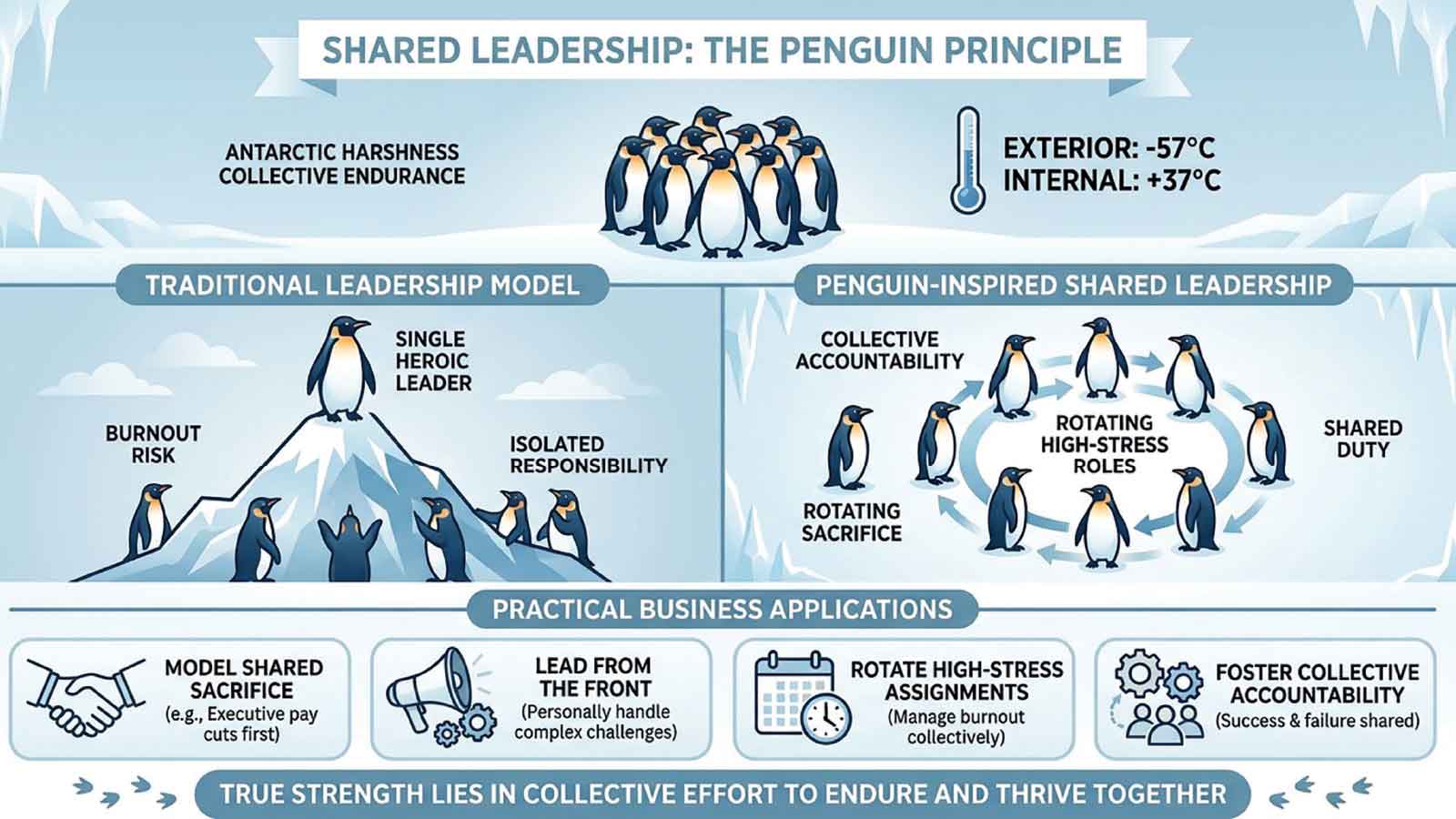
This behaviour, known as “huddling,” is a sophisticated strategy of social thermoregulation. By pressing close together, the colony can raise its internal temperature to as high as 37 degrees Celsius, even when the outside air is far below zero, conserving up to 50 percent of individual energy expenditure.
It is a rotating, selfless system of shared leadership where no individual bears the brutal front for too long, and where the survival of the whole depends on the willingness of each to take their turn on the frozen edge.
For business leaders navigating their own storms—economic downturns, organisational crises, or periods of intense pressure—the emperor penguin offers a profound and counterintuitive lesson: the strongest organisations are not those with a single heroic leader, but those that institutionalise shared responsibility, rotating sacrifice, and unwavering collective accountability.
The Dynamic Dance of Rotating Leadership
The emperor penguin huddle is not static. It is a slow, continuous, organic dance. Penguins on the windward edge—the most exposed and brutal position—gradually work their way inward, shuffling step by step toward the warmth at the centre. Meanwhile, those who have been sheltered at the core slowly move outward to take their turn on the frozen perimeter.
No penguin leads for long. No penguin is permanently sheltered. Leadership—enduring the worst of the conditions—is a rotating, shared duty. By distributing the suffering, the huddle ensures that no single penguin is sacrificed to the cold. The collective endures because the collective shares.
The Business Translation: In times of crisis, the instinct of many leaders is to carry the burden alone—to work longer hours, absorb pressure, and project an image of invulnerability. This is often framed as heroism, but the penguin teaches that this is unsustainable and a missed opportunity.
True resilience comes not from a single leader bearing the weight, but from institutionalising the rotation of hard things.
What does this look like in practice?
- Model shared sacrifice: Executives take the first pay cuts before asking others to sacrifice, demonstrating that no one is exempt from hardship.
- Lead from the front: Leaders personally handle the most difficult customer complaints or complex operational challenges, proving that leadership is not about delegating the unpleasant but about standing at the front when it matters most.
- Rotate high-stress assignments: Create systems where team members rotate through demanding projects, ensuring that burnout is managed collectively rather than borne by a few.
When the pain is shared, trust deepens. When everyone has taken their turn on the windward side, the organisation understands that leadership is not a privilege but a duty—and that duty is honoured by all.
Building Resilience Through Shared Responsibility
The penguin huddle exemplifies that resilience hinges on shared responsibility. When everyone has a role in facing adversity, trust flourishes.
Employees and leaders alike recognize that survival depends on each individual’s willingness to step into discomfort. This culture of shared accountability creates an organisation capable of weathering any winter—be it economic downturns, organisational crises, or rapid market changes.
Furthermore, rotating responsibilities fosters empathy. Leaders who experience the pressures of frontline teams are better equipped to make informed decisions, and teams that see their leaders sharing the load are more likely to feel engaged and committed. It cultivates a sense of collective ownership—an acknowledgment that everyone’s contribution, regardless of rank, is vital.
Practical Applications for Leaders
To emulate the penguins’ huddle, organisations can adopt several strategies:
Institutionalise rotation: Move beyond static hierarchies. Allow team members to rotate through high-pressure roles to build cross-functional resilience and prevent burnout.
Foster collective accountability: Emphasize that success and failure are shared. Recognise and reward behaviours that exemplify collective effort, not just individual heroics.
Promote transparency: Open communication about challenges and shared goals builds trust. When everyone understands the stakes and their role in the collective effort, resilience is strengthened.
Develop adaptive leadership: Empower individuals at all levels to step up and share responsibility as circumstances demand, rather than relying on a rigid chain of command.
The Counterintuitive Power of Shared Leadership
In a world that often celebrates individual heroism, the penguin huddle reminds us that real strength lies in unity. It challenges the notion that resilient organisations are built around a singular visionary leader. Instead, they are cultivated through a culture that values humility, collective responsibility, and the willingness to endure hardship together.
The next time your organisation faces a storm—economic, operational, or cultural—remember the emperor penguins braving the Antarctic winter. Their survival depends not on a single leader, but on a cooperative system of rotation and mutual trust.
True strength, as the penguins show us, is not in individual heroism but in the collective effort to endure and thrive together.
To be continued next week
Arthur Marara is a corporate law attorney, keynote speaker, peak performance, and corporate strategy speaker. With his delightful humour, raw energy, and wealth of life experiences, he captivates audiences and inspires them to unlock their full potential. He is also a leadership expert with extensive experience in leadership development and coaching. He is passionate about developing effective leaders and empowering individuals and organisations to achieve their full potential. Through his engaging talks and workshops, he imparts invaluable insights and practical strategies that empower individuals to lead with confidence and make a lasting impact. Arthur is the author of “Toys for Adults,” a thought-provoking book on entrepreneurship, and “No One is Coming,” a book that seeks to equip leaders to take charge. Send your feedback to bookings@arthurmararaattorneys.
com, visit his website www.arthurmarara.
com, or contact him at +263772467255.