admin
admin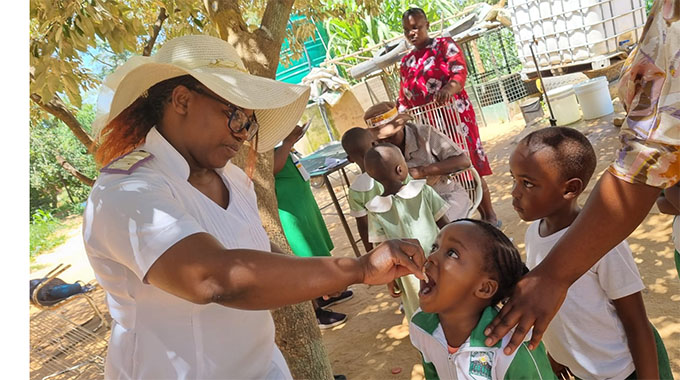
Phyllis Kachere
As Zimbabwe pins its hopes on vaccination to stem the cholera outbreak that has been raging since last February, almost two million people have been vaccinated against the waterborne disease since January 29 to date with Manicaland, one of the hardest hit provinces, having immunized 97 percent of its targeted population.
With support from the International Federation of Red Cross and Red Crescent Societies, Finnish Red Cross and ECHO, the Zimbabwe Red Cross Society’s Secretary general Mr Elias Hwenga said they are complementing Government through social mobilization, and logistical support for the cholera vaccination campaign.
The cholera vaccination campaign is targeting 2.3 million people aged one year and above, living in 160 wards in 26 high risk districts in seven provinces namely Harare, Mashonaland West, Mashonaland East, Mashonaland Central, Manicaland, Masvingo and Midlands.
Government, with support from its auxiliary the ZRCS rolled out a cholera campaign targeting 17 000 people around the Chitakatira Clinic in Bvumba, Manicaland.
Village health worker in Mvududu Village Ms Irene Marembende told this reporter that she does door-to-door campaigns around 370 households educating them on how to combat cholera and what to do when one is infected.
“I do community mobilisations and cholera awareness to 370 households under my purview in the Mvududu area. I also educate them on the dangers of using unsafe water points and what to do to make drinking water safe. Today we have been vaccinating children in early childhood learning centres, primary and secondary schools.
“Tomorrow, we take the vaccines to adults in the surrounding villages. Most villagers are eager to get vaccinated,” said Ms Marembende.

Red Cross volunteer and village health worker Ms Emilia Mudaruvinga also of Mvududu Village said it was pleasing that some villagers belonging to some faith-based organisations have been forthcoming and showed eagerness to be vaccinated.
“They are most known for resisting modern medicine preferring to use their faith for healing, but we have some members who have approached us and want to be vaccinated. And we understand the need for confidentiality when dealing with such cases. We do not want them to be ostracized by their families or church elders, so we keep their names under wraps,” said Ms Mudaruvinga.
Mr Hwenga said besides mobilizing and providing logistical support to the cholera vaccination campaign, the ZRCS’ project has a focus on three key components: prevention, containment, and upscaling.
The campaign aims to prevent the spread of cholera among at risk communities in urban Zimbabwe by breaking transmission through Risk Communication and Community Engagement (RCCE), improve community-level and institutional response capacities to contain outbreaks and limit impact on affected communities, and increase scale up capacities to rapidly and flexibly respond to larger outbreaks in the country.
“Under the Preparedness pillar, the Project purchased 10 Oral Rehydration Point (ORP) kits and household hygiene kits to create buffer stocks in readiness for cholera response. Ten additional ORPs are being procured to support scaling up response. Since December, 2023, the project has deployed three ORPs were deployed in Manicaland, Masvingo and Mazowe.
“The deployments are being supported by teams of volunteers who are continuously providing Risk Communication and Community engagement (RCCE) through door-to-door visits to break transmission in communities. To date, 1 426 patients have been served at the 3 ORPs in Harare while 309 have been referred to nearest health facilities for further attention,” said Mr Hwenga.
The ORPs serve as the primary points of care and the first line of defence for community-level cholera case management through administration of oral rehydration therapy.
He said research has shown that 80 percent of suspected cholera cases (mild to moderate) can be easily managed at community ORP and may not need to visit a local health facility.
“This has the effect of not only decongesting health facilities and reduces transport burden on patients, but can save lives by providing quick treatment. A number of people from poor communities succumb to cholera death due to delayed treatment as travel long distances to health centres.”
Besides providing oral rehydration therapy, the ORPs serve as information and reporting centres where patients get critical information about breaking cholera transmission and treatment and provide critical reports to health facilities about levels of infection and community readiness for response.
According to the Ministry of Health and Child Care statistics, Zimbabwe had 24 117 suspected cholera cases with 455 people having succumbed to the diarrheal disease.



 Online Reporter