Bruce Ndlovu, Sunday News Reporter
ONCE a remote rural outpost created under the colonial segregation era, Maphisa is today emerging as one of Zimbabwe’s most striking examples of rural urbanisation, with elegant double-storey homes, expanding commercial activity and major public infrastructure redefining the settlement’s identity.
As preparations intensify for this year’s Independence Day Celebrations, the rapidly transforming town in Matobo District is drawing national attention, not only for hosting the country’s flagship commemorations, but also for symbolising how post-Independence empowerment policies have reshaped communities once confined to the margins of development. Rows of modern houses with manicured lawns now stand alongside newly built shops, service stations and lodges, a striking contrast to the Maphisa of the 1970s and 80s, when the settlement was little more than a sparsely developed growth point under the Rhodesian government’s Tribal Trust Land Development Corporation (TILCOR). Although colonial authorities established such centres as part of a strategy to create “African towns” within designated African areas, the broader objective was to entrench racial separation and limit black economic mobility.
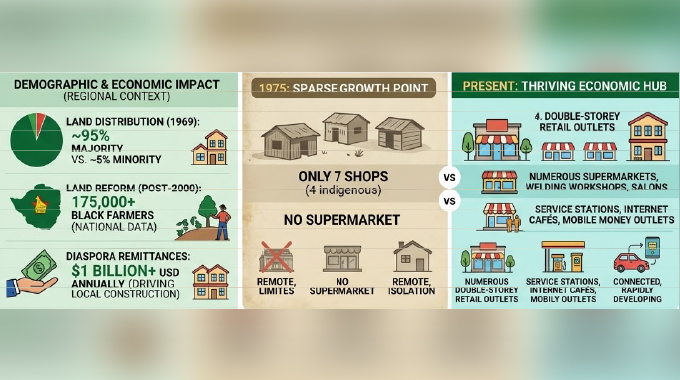
By 1975, Maphisa had only seven shops — four owned by indigenous black entrepreneurs and three built by TILCOR for lease — serving a settlement that was largely isolated from mainstream economic activity. For the residents of Maphisa, this is apt, as the town’s story reflects the country’s post-independence drive to breathe life into rural service centres through the growth point policy, which sought to transform isolated settlements into thriving economic hubs. Ms Anele Ndlovu, who grew up in the area, said Maphisa’s development has altered everyday life for local families.
“As a person who grew up in Maphisa, I feel proud when I look at how much this place has changed. When I was young, there were only a few shops here and for serious shopping, people had to travel to Bulawayo, but today almost everything we need is available locally,” she said.
Formerly known as Antelope Mine, the settlement was renamed Maphisa after independence, reflecting a broader shift in identity and ownership. Its economic trajectory accelerated significantly after the Land Reform Programme, which opened new economic opportunities and stimulated local investment. Two decades ago, the town had no supermarket. Today, it has several retail outlets, welding workshops, salons, tailoring businesses, service stations, internet cafés, photocopying centres, car washes and mobile money outlets dotted across the centre.
Much of the early construction momentum is credited to one of its own sons and local businessman Mr Mngane Ncube, proprietor of Hawkflight Enterprises, whose company undertook several major building projects in the area.
The pace of development was formally recognised two years ago when the Government granted Maphisa town board status.
Matobo Rural District Council chief executive officer Mr Elvis Sibanda said the designation followed years of sustained infrastructure growth.
“There are basic considerations that the ministry must review before a local authority is granted town board status. For one, the township should be developed, and that is what Maphisa achieved,” he said.
“Various infrastructural developments have taken place in Maphisa in terms of housing and the construction of retail premises, and that was instrumental in the growth of the area and eventually the granting of town board status.”
Mr Sibanda said the local authority has since established a town board sub-office to manage the settlement’s expanding administrative needs.
“We have opened a dedicated sub-office to handle Maphisa’s affairs, which is a major milestone for us as a district,” he said.
He added that further residential expansion is already being planned.
“As a local authority, we have been authorised to engage a developer to service residential stands. We are now at the tender stage, and progress is moving in the right direction,” said Mr Sibanda.
He said hosting the national Independence celebrations has further accelerated growth in Maphisa.
“The hosting of the celebrations in Maphisa is a remarkable opportunity for the district because it brings both infrastructure and socio-economic benefits,” he said.
Among the flagship projects underway is the construction of a stadium, which Mr Sibanda described as a long-term asset for both the district and province.
“As a local authority, we stand to benefit a lot. For example, the construction of a stadium is important not only to Maphisa but to the province at large. Previously, we did not have a suitable stadium for our communities to use.”
Mr Sibanda said they will also reap many benefits from the infrastructure being constructed.
He further noted that the preparations for the national event had created employment opportunities while attracting investment into the town.
“The celebrations have also created many employment opportunities for our young people and the community at large. We have also seen a lot of investment coming in, including from people who see long-term value in Maphisa, hence the construction of many lodges and chalets around the town,” he said.
Mr Sibanda also credited the diaspora community and local investors, particularly those involved in mining, for contributing to the town’s rapid transformation.
“The structures going up are a welcome development and this is one of the key factors jump-starting the growth of the town board area. I would say that we have to thank both the diaspora and the local community, particularly those in mining, who have prioritised the construction of beautiful structures in their home area,” he said.
Mr Sibanda said the upcoming national celebrations had also encouraged residents to improve their properties, with some opening their homes to visitors who will travel to the area for the historic event.
“I think the Independence scenario has just given people in the area an opportunity to showcase the rapid development that has taken place in Maphisa over the years. A lot of people have even upgraded their facilities for the upcoming celebrations,” he said.
“I know that some homes have been hired out to our visitors for that period. The people coming are not going to use these structures for free, but they will pay a token of appreciation for the period in question.”
Mr Sibanda also paid tribute to Government policies that he said had created an environment conducive to development.
“I want to thank President Mnangagwa for what we see in Maphisa today. If our policies were not friendly towards empowerment or development, Maphisa would still be a little growth point struggling to make its mark, but that is not the case,” he said.
“We have created a fertile environment for development to take root, and the result is what we see today.”