
Tawanda Musarurwa
Check Point Desk
BY any measure, artisanal and small-scale mining is now one of Zimbabwe’s largest labour markets.
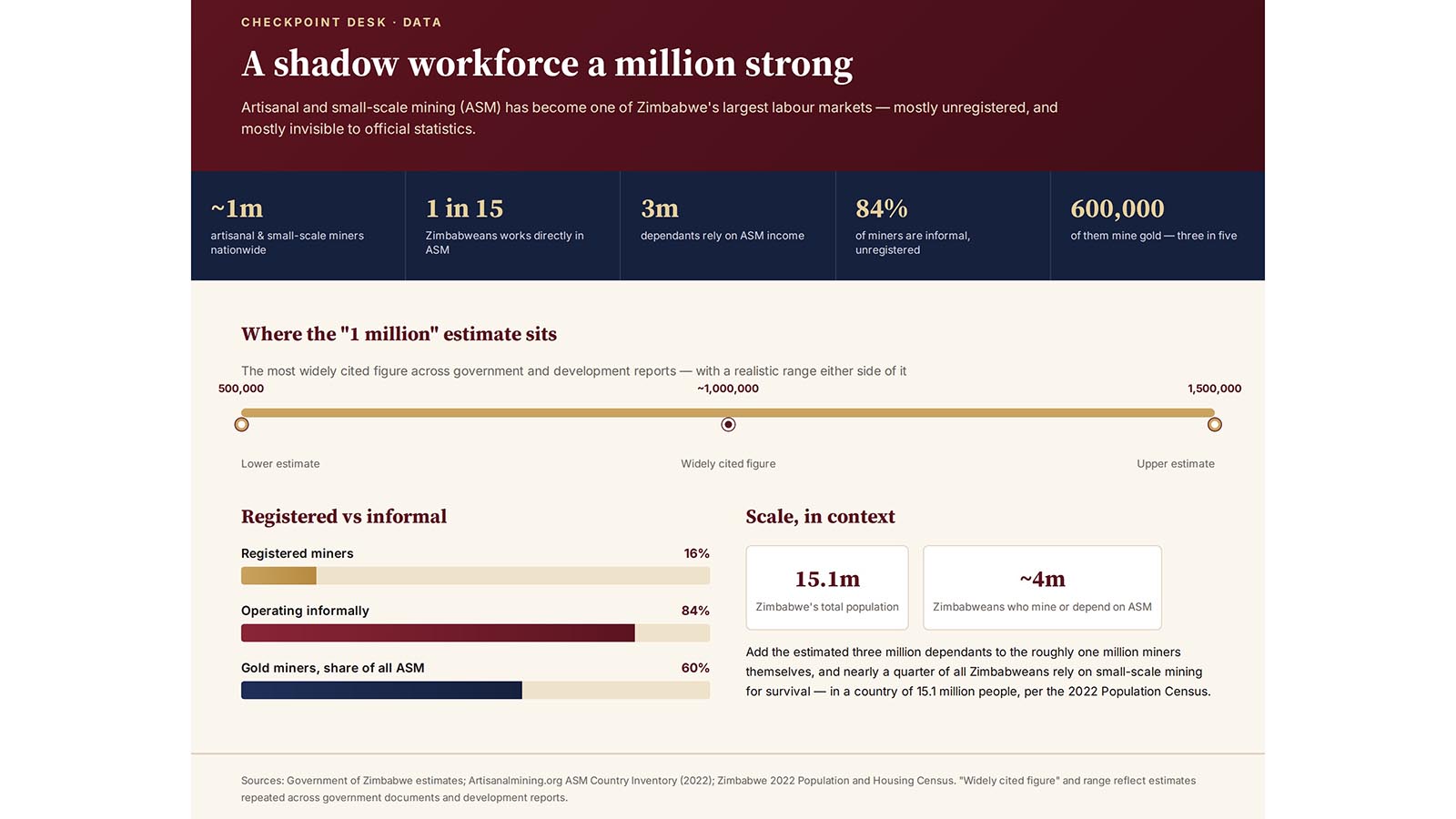
The most widely cited estimate — repeated across Government documents and development reports — puts the number of artisanal and small-scale miners in Zimbabwe at one million people, with a realistic range of between 500 000 and 1,5 million.
In a country with 15,1 million people according to the 2022 Population Census, that means roughly one in every 15 Zimbabweans works directly in artisanal and small-scale mining.
Add dependants — estimated at three million (according to Artisanalmining.org’s ASM Country Inventory, 2022) — and nearly a quarter of all citizens rely on small-scale mining for survival.
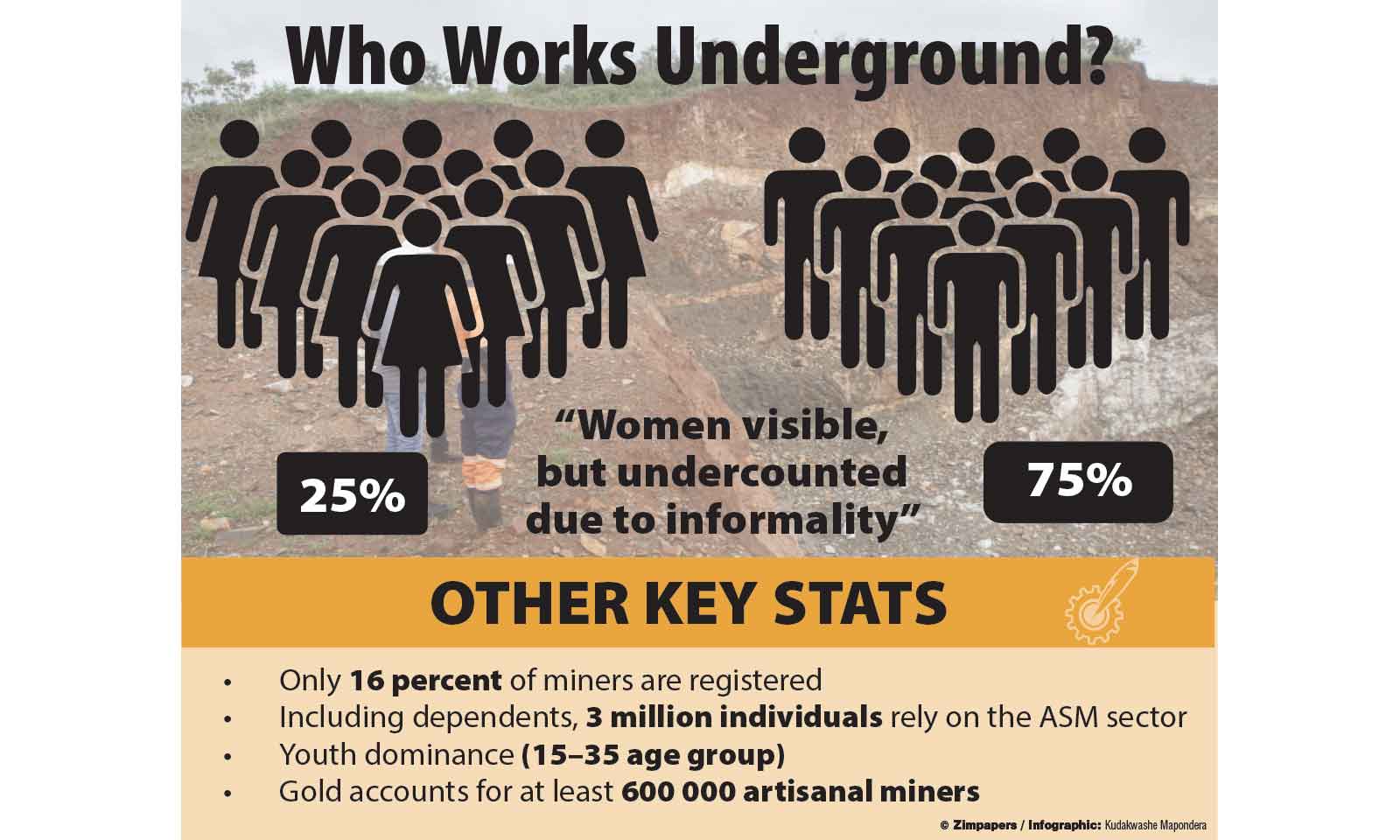
It is a sector both immense and elusive: only 16 percent of miners are registered, leaving 84 percent operating informally, according to the same source.
However, despite its size and disorder, ASM remains central to the rural economy and the country’s gold output. To understand ASM is to understand the economic trajectory of entire districts and increasingly, entire provinces.
A young, rural workforce
2022 national census data reveal a demographic profile that gives shape to the ASM workforce.
The country’s population is overwhelmingly young: 7,1 million people (47 percent) are under 18, while five million youth aged 15 to 35 form the core of the country’s potential labour force.
Across rural Zimbabwe, where 9,3 million people live, economic alternatives are scarce.
Labour force participation data from the Second Quarter 2025 Quarter Labour Force Survey (QLFS) confirms this divide.
Rural participation sits well below urban levels, but agriculture and mining dominate the work that exists there.
The Q2 2025 QLFS shows that in the informal sector — where artisanal and small-scale mining sits — self-employment work makes up 31 percent of male employment and 38 percent of female employment, underlining the heavy dependence on informal, self-directed livelihoods. For many rural districts, mining is simply the only viable employer.
Women are visible, but still undercounted
In Mazowe’s Jumbo area, 32-year-old single mother Ruth Makawa* (not her real name) spends her days crushing ore with a small group of women, hoping for a gramme of gold that might carry her household through the week.
“Some days the soil pays, some days it gives us nothing,” she told this publication. But, this is the only work that lets my children eat.”
One of the most striking insights from the ASM Country Inventory (2022) is its estimate that women account for roughly 25 percent of the country’s artisanal miners; about 250 000 women.
Earlier studies varied significantly: some placed women at one-third of miners, while a 2015 Pact study found women were just 11 percent in surveyed areas.
Census and QLFS data help clarify this.
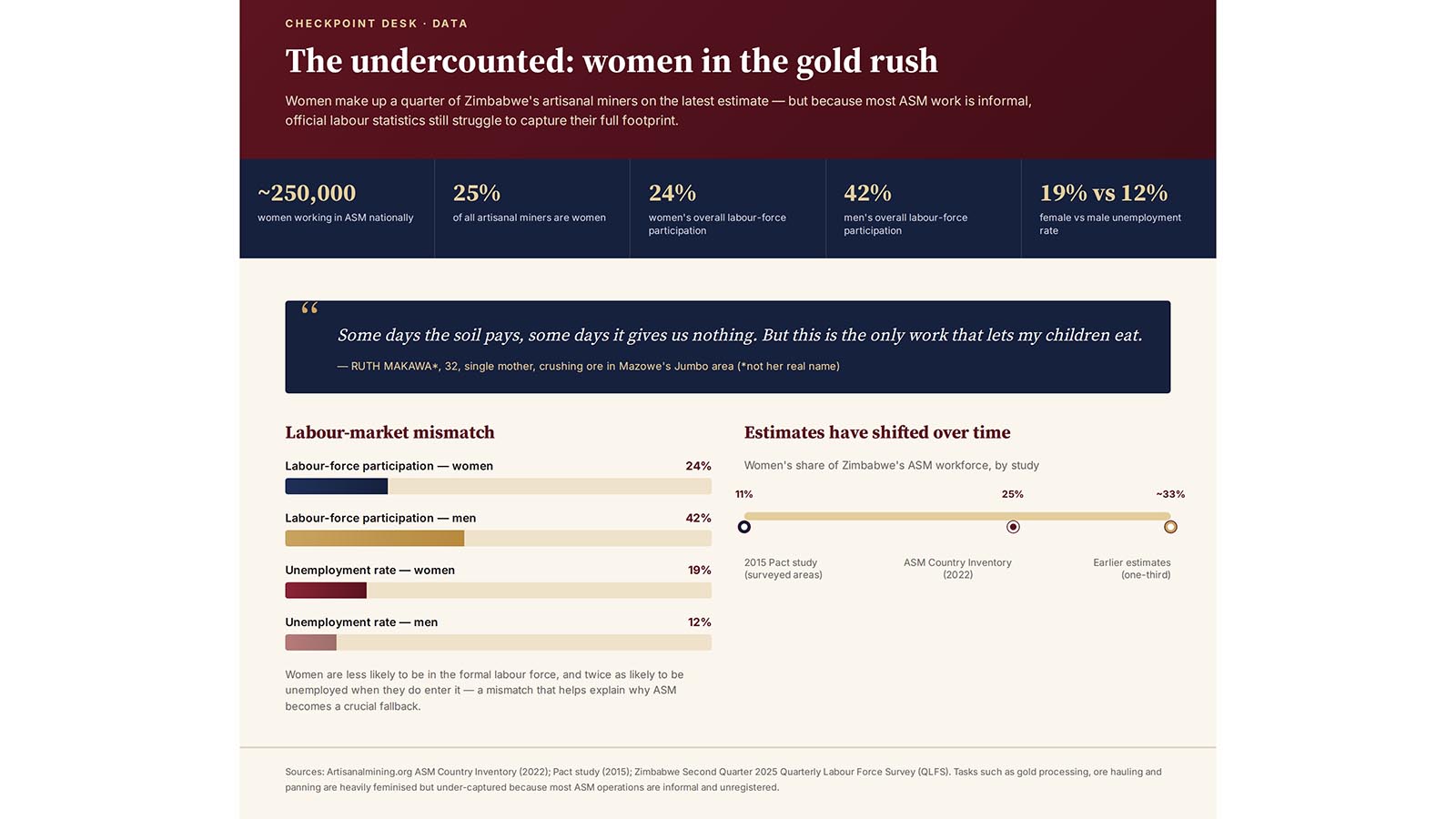
In the wider economy, women’s labour-force participation is only 24 percent, far below men’s 42 percent.
Women are also twice as likely to be unemployed when they do enter the labour force, with female unemployment at 19 percent compared to 12 percent among men.
This mismatch – low formal participation, but high presence in artisanal and small-scale mining – suggests that mining serves as a crucial fallback for women excluded from formal work.
Tasks like gold processing, ore hauling and panning are heavily feminised.
But, because most operations are informal and unregistered, official labour statistics struggle to capture women’s full footprint in the sector.
Gold drives the numbers
Although the country’s artisanal and small-scale mining sector includes diamonds and gemstones, the inventory makes clear that gold accounts for at least 600 000 artisanal miners; three in every five workers.
This concentration mirrors employment trends in the informal economy.
The Q2 2025 QLFS shows that informal-sector employment is dominated by manual, extractive and trade-based occupations.
Gold mining, with its low barriers to entry and high liquidity, provides immediate cash – rare in rural economies where formal jobs are limited and agricultural income is seasonal.
Districts shaped by migration and demographics
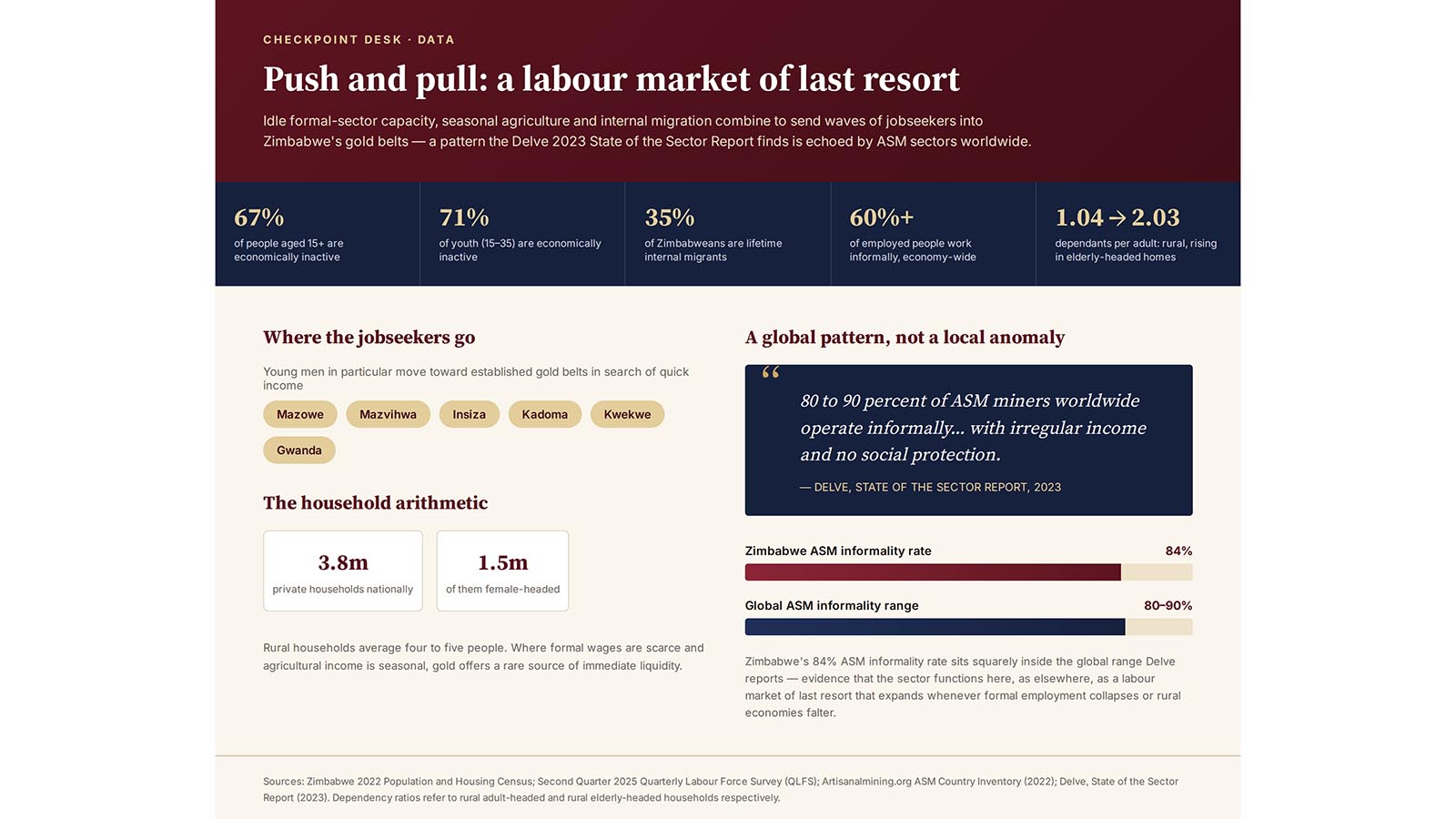
The census adds deeper context: 35 percent of Zimbabweans are lifetime internal migrants, moving mainly between rural districts.
This fluidity aligns closely with the economic behaviour described in the ASM inventory, where workers “enter and exit according to economic constraints”.
In practice, that means districts experiencing agricultural stress, job losses or drought often see spikes in artisanal mining.
Labour data reinforces this volatility. Among youth aged 15 to 35, 71 percent are economically inactive, with many drifting between schooling, informal work and unemployment.
The artisanal and small-scale mining sector absorbs these waves of jobseekers, especially young men, who move to gold belts in Mazowe, Mazvihwa, Insiza, Kadoma or Kwekwe in search of quick income.
A sector built on informality
The ASM Country Inventory (2022) notes that Zimbabwe had 200 mines in the late 1990s, of which around 30 percent were illegal.
Two decades later, the proportion has almost certainly increased as the one-million-strong artisanal and small-scale mining population operates mostly outside formal permitting.
Labour data shows the broader pattern: in 2025, informal employment dominates many industries, with over 60 percent of employed people working informally (according to QLFS summaries).
Although ASM-specific figures are not itemised in the survey, miners fall squarely into the categories with the highest informality: self-employment work, family labour and occupations lacking contracts or employment benefits.
In the census, the sheer scale of economic inactivity – 67 percent of people aged 15 and above – reveals the structural weakness that pushes Zimbabweans into artisanal and small-scale mining.
For many, mining is not necessarily a last resort. A broader global lens helps explain why Zimbabwe’s experience is not an outlier but part of a wider structural pattern.
The Delve 2023 State of the Sector Report notes that “80 to 90 percent of ASM miners worldwide operate informally… with irregular income and no social protection,” a situation that closely mirrors Zimbabwe’s 84 percent informality rate.
The report further observes that, despite the sector’s economic importance, “ASM is a vital contributor… yet miners are left out of existing social welfare and employment support programs,” leaving households to absorb the shocks of fluctuating earnings and unsafe working conditions.
Crucially, the Delve report finds that the industry globally “absorbs waves of jobseekers… entering and exiting ASM according to economic constraints,” a pattern identical to the internal migration flows seen in Mazowe, Kadoma, Gwanda and other Zimbabwean gold districts.
In effect, Zimbabwe’s artisanal mining surge reflects the same global dynamic: ASM functions as a labour market of last resort, expanding whenever formal employment collapses or rural economies falter.
Dependency and the household economy
The sector’s importance becomes clearer when viewed through household data.
According to the latest census, the country has 3,8 million private households, 1,5 million of them female-headed.
Rural household sizes average four to five people, and dependency ratios for rural adult-headed households stand at 1,04 dependants per adult, rising to 2,03 in elderly-headed rural households. These ratios matter: they show that households need multiple income streams to support themselves.
In regions where formal wages are rare, gold brings liquidity that agriculture cannot match.
The artisanal and small-scale mining sector’s inventory’s estimate of three million dependants supported by miners, fits squarely within these demographic realities.
What the data ultimately reveals
Looked at together, the three datasets create a rare, coherent picture of Zimbabwe’s artisanal and small-scale mining sector.
The sector is large (around one million miners, possibly more); informal (84 percent unregistered, with gold dominating); young and mobile (driven by internal migration and economic pressure); gendered (women are a significant presence, although their labour is undercounted), and economically central (supporting three million dependants and filling the gap left by formal job scarcity).
In a country where half the population is under 20 and where formal employment is comparably low, the artisanal and small-scale mining sector is not an anomaly; it is a structural reality.
A system that operates outside formal registers but inside nearly every rural district.
To map the sector is not merely to count miners; it is to trace how millions of Zimbabweans navigate a fragile economy, one pit, one riverbed and one gramme of gold at a time.