admin
admin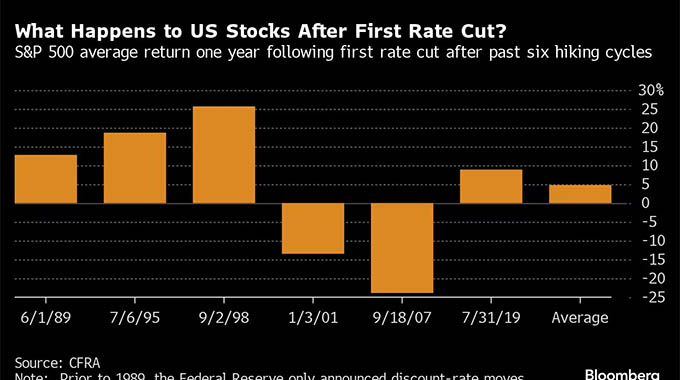
Traders are harking back on 1995, when Alan Greenspan led the Federal Reserve in pulling off a rare soft landing, for a playbook on trading the first interest-rate cut in four years.Like nearly three decades ago, bonds and stocks are rallying ahead of a critical Fed meeting.
But this time, the central question for Chair Jerome Powell is which approach — reducing rates by 25 basis points or 50 basis points — is most beneficial for the US economy.
To Kristina Hooper, chief global market strategist at Invesco, the US economy looks set to avert a recession as the Fed starts easing policy just ahead of the US election.
“Once the Fed starts to cut, there’ll be a psychological reaction to that,” she said. “That will be supportive.”
The S&P 500 Index and Treasuries, and gold have typically risen as the Fed starts lowering rates, according to Bloomberg News analysis of markets during the past six Fed easing cycles going back to 1989.
In the equity market, the S&P has rallied by an average 13 percent in the six months after the central bank started cutting — except for during the recessionary years of 2001 and 2007, the data show.
Short-term Treasuries, meantime, have usually outperformed their longer-term notes — a phenomenon known as yield curve steepening — during Fed easing cycles. Six months after the first cut, the 10-year and two-year yield gap often widened by an average of 44 basis points.
Gold delivered returns to investors during four of the past six Fed easing cycles. The dollar and oil were mixed.Of course, traders are far from certain going into the months ahead.
The Fed will be embarking on a rate-cutting path just before former President Donald Trump and Vice President Kamala Harris face off in the November election.
growth.Bloomberg



 Online Reporter