Lovemore Kadzura
Post Reporter
A BOLD expansion by Marymount Teachers’ College is bringing Science, Technology, Engineering, and Mathematics education directly to local communities, marked by the establishment of two new practicing secondary schools in Makoni and Chipinge districts.
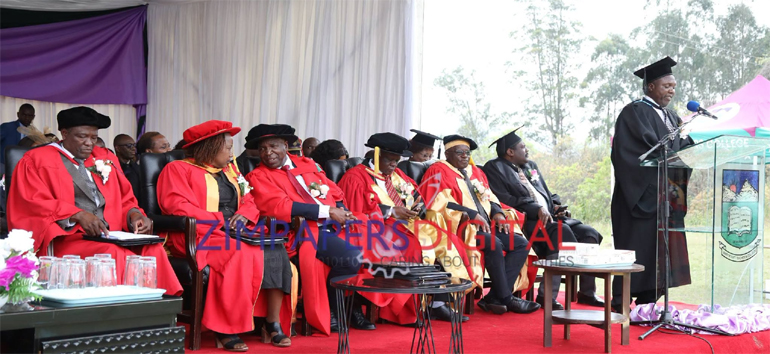
Speaking during the institution’s 2026 graduation ceremony, Marymount Teachers’ College principal, Mr Martin Mukwazhe, said the college is adapting to modern educational demands.
He emphasised that the expansion aligns with the national vision of prioritising science and technological education to supply skilled labour for the nation’s industrial development.
“The graduates we churn out need to be innovative, problem solvers and highly creative. That is what Zimbabwe, at the present juncture, is, yearning for. Our teachers need to be innovative and entrepreneurial in disposition.
‘‘This is what Marymount Teachers’ College has fully understood. “Our curriculum has been fully transformed in line with the new national priorities, especially that of driving the agenda for accelerating the production as well as commercialisation of goods and services.
“The Headlands Campus project is our success story number one for the Year 2026. We have managed to set a multi-purpose campus at our farm in Headlands. We now have a practicing school, which is already functional with an enrolment of 204 learners.
“We are targeting to increase our enrolment to between 300 and 400 learners next year. We are planning to enroll boarders next year with the aim of increasing our enrollment to 1 000 learners in 2028,” said Mr Mukwazhe, noting that construction of two classroom blocks and the refurbishment of five teachers’ houses have been completed.
“We have opened another practicing school in Chipinge, in Foroma area with an enrollment of 20 Form Ones.
‘‘At the site where it is located, we are planning to set up an Agricultural Research Institute. For the Diploma in Education (Secondary) Agriculture and Techno-Sciences, doors will be opened for the students in February 2027, for two programmes, Agriculture and Veterinary Services and Textile and Design Technology. We are also establishing an Agro-Industrial Park, which is at construction stage,” he added.
Mr Mukwazhe further highlighted that the college is actively implementing practical education models, achieving self-sufficiency in maize, poultry, and vegetable production, while broadening garment manufacturing and honey processing ventures.
“Our agricultural operations, both at the farm and here at the college have been increasingly scaled up. We have managed to double up our maize, poultry, piggery, rabbitry and vegetable production. As a result, we are now self-reliant with regards to meeting our food requirements. We are able to produce more and increase our revenue generation streams. Our garment manufacturing and honey processing portfolios have continued to grow,” said Mr Mukwazhe.
Higher and Tertiary Education, Innovation, Science and Technology Minister, Ambassador Fredrick Shava, commended the institution for preparing graduates to fulfill key national development goals.
He was represented by his deputy, Honourable Simelisizwe Sibanda.
“Skilled human capital is one of the key enablers of attainment of Vision 2030. In this, it is now national imperative that our higher and tertiary education curriculum must encompass a wide range of programmes to develop an array of skills. I commend Marymount Teachers’ College for rising to this call by successfully running core programmes under one institutional framework. We applaud the college for launching a STEM degree programme, accredited through the University of Zimbabwe. This is both a landmark achievement in teacher education, and also a bold and visionary step aligning our training programmes with demands of modern science, technology and innovation. Marymount has made history, and the ministry challenges other colleges to introduce STEM degree programmes in subsequent years, thereby expanding the human capital base of STEM teachers for the nation,” said Minister Shava.
Marymount expands STEM access with new campuses