

 Chronicle Editor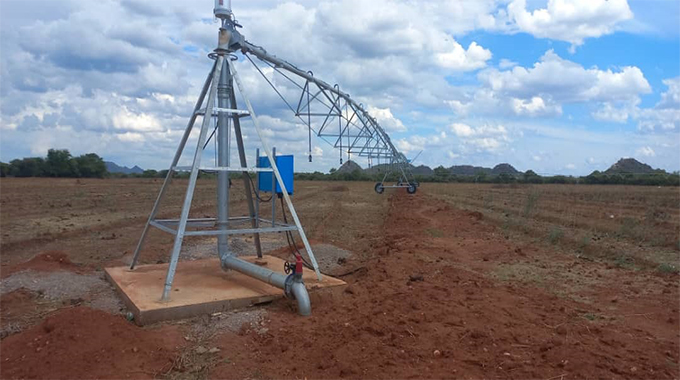
Sukulwenkosi Dube-Matutu, [email protected]
PLOT-holders at Masholomoshe Irrigation Scheme in Gwanda District have received a lifeline after the Government working with its partners moved in to rehabilitate the scheme which has been lying idle for years.
Farmers have been struggling to produce at the scheme due to water challenges after their supply dam silted forcing farmers to rely on rain-fed farming. The scheme relies on a flood and canal watering system.
The Ministry of Lands, Agriculture, Fisheries, Water and Rural Development in partnership with Green Climate Fund and the United Nations Development Programme (UNDP) under the Building Climate Resilience of Vulnerable Agricultural Livelihoods in Southern Africa programme is capacitating the scheme.
Two centre pivots have been installed to support the 39-hectare scheme. A 66-kilowatt solar-powered system has also been installed to pump water from Nkaze Dam to the scheme.
A new pipeline has been laid with an automatic weather station, automatic rain gauge, and river level gauging station installed at the irrigation scheme to help farmers access climate and weather information.
Next year, farmers said they will plant high-value crops such as paprika, green pepper, garlic, and Irish potatoes.
Established in 1969, the irrigation scheme has 131 individual plot holders. The transformation will see farmers operating as a unit.
Masholomoshe Irrigation Scheme chairperson, Mr Polite Moyo, said the Government interventions have rekindled their hopes of being productive.
“Because of our ecological region, we normally receive erratic rains, a situation that has been worsened by the effects of climate change. Irrigation farming therefore becomes critical in ensuring that we get income and be able to feed our families,” he said.
“The centre pivots that we have received are a great shift from our old system which resulted in loss of water due to leakages. We now have underground pipes that will ensure that water isn’t lost along the way.”
The irrigation scheme secretary, Ms Bhekinkosi Sibanda, said it required a lot of labour for them to use siphons to draw water.
She said they are also looking forward to operating as a unit, a move that will help improve production.
Another plot holder, Mr Petros Moyo said this summer season they failed to plant crops because of water challenges.
“Our harvest has been poor over the years because of water challenges. In the past, we were able to produce enough before the dam silted. We were no longer delivering grain to GMB,” he said.
In an interview during a visit to the irrigation scheme, UNDP Green Climate Fund project manager, Mr Rungano Benza said US$600 000 was invested in carrying out the feasibility study, and coming up with the designs and developing the infrastructure.
“We are trying to address issues of climate change adaptation and mitigation in this irrigation scheme. We have set up a solar-powered system to support pumping of water, and farmers will have access and produce throughout the year at minimal cost,” he said.
“This irrigation was using a flood system and a lot of water was being lost as it flowed through the canals. The new pipeline has helped to deal with leakages of water and micro catchment protection works have been done through contour ridges and other works to reduce the amount of silt that is deposited in the dam.”
Mr Benza said the centre pivot system will ensure efficient use of water unlike the flood system.
The Building Climate Resilience of Vulnerable Agricultural Livelihoods in Southern Africa programme contributes towards the Government’s achievements of priorities outlined in its National Determined Contributions (NDC) and climate change plans and strategies including strengthening management of water resources and irrigation in the face of climate change.
The programme, which started in June 2020 will run up until June 2027. The US$47,8 million project is being implemented in 14 districts in three provinces.
In Matabeleland South, the project is being implemented in Umzingwane, Mangwe, Insiza, Matobo, Gwanda and Beitbridge districts. — @DubeMatutu



 Blessing Chizhande
 Online Reporter