admin
admin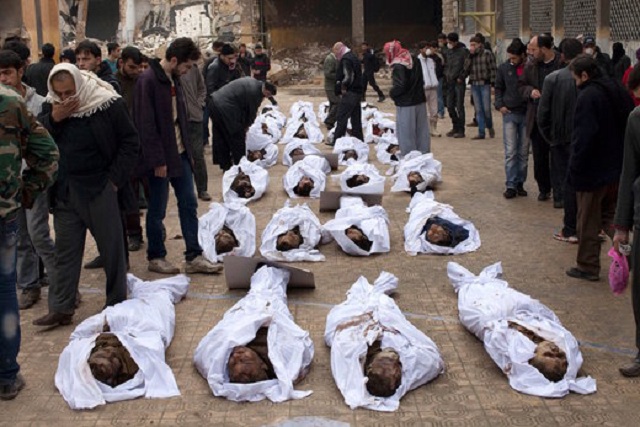

Nicolas J S Davies
How many people have been killed in the wars in Afghanistan, Iraq, Syria, Yemen or Somalia? On November 18, 2015, a UN press briefing on the war in Yemen declared authoritatively that it had so far killed 5,700 people, including 830 women and children. But how precise are these figures, what are they based on, and what relation are they likely to bear to the true numbers of people killed? Throughout the US-led war in Afghanistan, the media has cited UN updates comparing numbers of Afghans killed by “coalition forces” and the “Taliban.” Following the US escalation of the war in 2009 and 2010, a report by McClatchy in March 2011 was headlined, “UN: US-led forces killed fewer Afghan civilians last year.”
It reported a 26 percent drop in US-led killing of Afghan civilians in 2010, offset by a 28 percent increase in civilians killed by the “Taliban” and “other insurgents.” This was all illustrated in a neat pie-chart slicing up the extraordinarily low reported total of 2,777 Afghan civilians killed in 2010 at the peak of the US-led escalation of the war.
Neither the UN nor the media made any effort to critically examine this reported decrease in civilians killed by US-led forces, even as US troop strength peaked at 100,000 in August 2010, Pentagon data showed a 22 percent increase in US air strikes, from 4,163 in 2009 to 5,100 in 2010, and US special forces “kill or capture” raids exploded from 90 in November 2009 to 600 per month by the summer of 2010, and eventually to over 1,000 raids in April 2011. Senior US military officers quoted in Dana Priest and William Arkin’s book, Top Secret America, told the authors that only half of such special forces raids target the right people or homes, making the reported drop in resulting civilian deaths even more implausible.
If McClatchy had investigated the striking anomaly of a reported decrease in civilian casualties in the midst of a savagely escalating war, it would have raised serious questions regarding the full scale of the slaughter taking place in occupied Afghanistan. And it would have revealed a disturbing pattern of under-reporting by the UN and the media in which a small number of deaths that happened to be reported to UN officials or foreign reporters in Kabul was deceptively relayed to the world as an estimate of total civilian war deaths.
The reasons for the media’s reluctance to delve into such questions lie buried in Iraq. During the US military occupation of Iraq, controversy erupted over conflicting estimates of the numbers of Iraqis killed and details of who killed them. If more UN officials and journalists had dug into those conflicting reports from Iraq and made the effort to really understand the differences between them, they would have been far better equipped to make sense of reports of numbers of people killed in other wars. The critical thing to understand about reports on numbers of civilians killed in wars is the difference between “passive reporting” and scientific “mortality studies”.
In reality, the huge discrepancy between the results of these mortality studies and “passive reporting” was exactly what epidemiologists expected to find in a conflict zone like occupied Iraq. As Les Roberts and his colleagues have explained, epidemiologists working in war zones typically find that passive reporting only captures between 5 percent (in Guatemala, for example) and 20 percent of the total deaths revealed by comprehensive mortality studies. So their finding that passive reporting in Iraq had captured about one in 12 actual deaths was consistent with extensive research in other war-torn countries.
In the UK, Tony Blair dismissed the “Lancet survey” out of hand, claiming that, “Figures from the Iraqi Ministry of Health, which are a survey from the hospitals there, are in our view the most accurate survey there is.”
But in 2007, the BBC obtained a set of leaked documents that included a memo from Sir Roy Anderson, the chief scientific advisor to the UK’s Defence Ministry, in which he described the epidemiologists’ methods as “close to best practice” and their study design as “robust.” The document trove included emails between worried British officials admitting that the study was “likely to be right” and that “the survey methodology used here can’t be rubbished, it’s a tried and tested way of measuring mortality in conflict zones.” But the very same official insisted that the government must “not accept the figures quoted in the Lancet survey as accurate.”
Other mortality surveys conducted in Iraq have produced lower figures, but there are legitimate reasons to regard the work of Les Roberts and his colleagues as the gold standard, based on their experience in other conflicts and the thoroughness of their methods. Other surveys were conducted by the occupation government, not by independent researchers, inevitably making people reluctant to tell survey teams about family members killed by occupation forces. Some studies excluded the most war-torn parts of Iraq, while one was based only on a single question about deaths in the family as part of a lengthy “living conditions” survey.
The authors of the most recent study, published in the PLOS medical journal in 2013, a decade after the invasion, have acknowledged that it produced a low estimate, because so much time had elapsed and because they did not interview any of the more than three million people who had fled their homes in the most devastated areas. They made adjustments to compensate for such factors, but those adjustments themselves were deliberately conservative. However, their estimate of 500,000 violent civilian deaths is still four times the highest numbers passively reported.
Gilbert Burnham, a co-author of both the Lancet studies and the PLOS study, does not find the results of the three epidemiological studies incompatible, emphasizing that, “These represent estimates, and that’s what we’ve always said.”
In 2015, Physicians for Social Responsibility co-published a report titled Body Count: Casualty Figures After 10 Years of the “War on Terror,” with a new estimate of 1.3 million total war deaths in Iraq, Afghanistan and Pakistan between 2001 and 2011. This 97-page report meticulously examines and evaluates mortality studies and other evidence from all three countries, and the authors conclude that the studies published by the Lancet are still the most accurate and credible studies conducted in Iraq. But what can all this tell us about the figures cited by the UN and the media for civilian deaths in other war-torn countries since 2006?
As noted in Body Count, the only reports on civilian mortality in Afghanistan, including those published by the UN, are based on passive reporting.
To accept these figures as actual estimates of war deaths would be to believe that the most heavily bombed country in the recent history of warfare (over 60,000 air strikes in 14 years) has been a safer place to live than most Western cities, with only 5.9 violent deaths per 100,000 inhabitants per year, compared to 6.9 in Frankfurt and 48 in Detroit.
As the authors explain, “The problem in determining the number of killed civilians is the ‘passive’ research method itself. It can capture only a fraction of all cases . . . In order to get more reliable approximations, on-site research and scientific polls would be necessary. In Afghanistan, these simply do not exist.”
The authors of Body Count very conservatively estimate the number of Afghan civilians killed at 5 to 8 times the number passively reported, giving an estimate between 106,000 and 170,000. At the same time, they acknowledge the conservative nature of this estimate, noting that, “…compared to Iraq, where urbanisation is more pronounced, and monitoring by local and foreign press is more pronounced than in Afghanistan, the registration of civilian deaths has been much more fragmentary.”
If the ratio of actual deaths to passively reported deaths in Afghanistan is in fact somewhere between those found in Iraq (12:1) and Guatemala (20:1), the true number of civilians killed in Afghanistan would be somewhere between 255,000 and 425,000. As in Guatemala, the UN and Western reporters have little access to the remote resistance-held areas where most air strikes and special forces raids take place, so the true number of Afghan civilians killed could well be closer to the higher of these numbers.
Paradoxically, the Syrian government’s role as an “information victim” of US information warfare may have led to more comprehensive reporting of civilian deaths in Syria than in Iraq or Afghanistan, by the UN, the Syrian Observatory for Human Rights and other human rights groups. But even without Western political pressure to under-report civilian deaths (except in US-led air strikes), passive reporting in Syria is still just passive reporting. The ratio of actual deaths to the numbers being reported may be lower than in Iraq or Afghanistan, but even the most thorough passive reporting is unlikely to capture more than 20 percent of actual deaths. As in Rwanda, the DRC, Guatemala and Iraq, only serious, scientific mortality studies can expose the full scale of the slaughter endured by the people of Afghanistan, Syria, Libya, Yemen, Somalia and other war-ravaged countries.
The politically contrived controversy surrounding mortality estimates in Iraq has deterred the US corporate media from making any attempt to gain a more accurate picture of the scale of the slaughter in these other wars. This has left average Americans in almost complete ignorance of the human cost of modern war, and has served to shield our political and military leaders from accountability for appalling decisions and policies that have resulted in catastrophic losses of human life.
Deaths counted by “passive reporting” cannot be an estimate of total deaths in a war zone because they are fragmentary by nature. But serious researchers have developed scientific methods they can use to make realistic estimates of total war deaths. As with climate change and other issues, UN officials and journalists must overcome political pressures, come to grips with the basic science involved, and stop sweeping the vast majority of the victims of our wars down this Orwellian “memory hole”. — NEO



 Online Reporter