admin
admin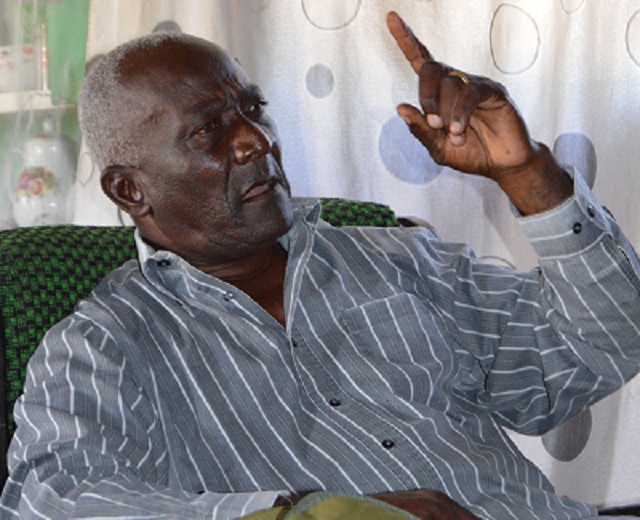

DESPITE putting his life on the block fighting for the emancipation of Zimbabweans from the yoke of colonialism, Cde Nicholas Gibson Nkomo, never a materialist man has retreated to his rural home of Kezi District where he finds comfort living among the down trodden.
Although Cde Nkomo, pseudo name Gilbert Khumalo was a member of the Zipra High Command and is currently a Zanu-PF Central Committee member he finds comfort in working from the village but still keeping an eye on the national interests of the country that he worked so hard to free from the Ian Smith regime. He probably is the kind of the Zimbabwean version of the Italian revolutionary and master of guerilla warfare Giuseppe Garibaldi who after helping his fellow citizens in fighting foreign rule and unifying the country never pursued self-aggrandisement.
For the record Cde Nkomo rose through the ranks in Zipra and at the time of the declaration of the ceasefire he was the deputy commander of the Northern Front which in his words stretched from the border with Botswana in Bulilima District right up to Nyamapanda Border Post. In the Northern Front he deputised Cde Rodwell Nyika (Retired Brigadier-General Collin Moyo) and set up his headquarters in the Gwampa Valley deep in the forests of Lupane with regional commanders across the front reporting to him.
After the announcement of the ceasefire Cde Nkomo became camp commander for St Paul’s in Lupane and later Entumbane in Bulawayo. In our Lest We Forget Column today Cde Nkomo relates his war exploits to our Assistant Editor Mkhululi Sibanda (MS). The interview took place at his rural home in St Anna in Kezi just a few kilometres from the late Vice-President Nkomo’s rural home of St Joseph. Below are the excerpts of the interview:
MS: Cde Nkomo in all the interviews we have had in this column with your colleagues in the struggle your name crops up all the time, so who is Nicholas Nkomo?
Cde Nkomo: I was born Gibson Nkomo on 7 July 1945 and assumed the name Nicholas when I was baptised just across here at St Joseph Catholic Mission in 1958. I then became Nicholas Gibson Nkomo. My family originally is from Gwambe village in Bulilima but my father, George Sigwili Nkomo and my mother Miriam Tshinki Mguni moved to Kezi when I was just a year old following an invitation by my aunt, my father’s sister who got married here. My parents loved this place and decided to settle here. So I grew up here like any other boy of that time herding our goats and cattle. For my education I did my Sub-A up to Standard 3 at St Anna School before moving to St Joseph for Standard 4 to 6 which I completed in 1961.
MS: Then when did you start your political activities?
Cde Nkomo: Since I was coming from Dr Joshua Nkomo’s area it was given that I would be consumed by the revolutionary spirit from an early age. In 1962 I then went to Bulawayo where I got into politics full-time as a member of the Zapu Youth Wing.
MS: Where were you employed at that time?
Cde Nkomo: I never looked for a job but just got into politics full-time. I will tell you something that you will not believe, in my entire life I have never worked for a corporate or an individual. I have never been formally employed in my entire life. The only employment that I have known is being a freedom fighter, fighting for my fellow Zimbabweans and the brief stint I had in the Zimbabwe National Army.
MS: So you spent your youthful days fighting the Rhodesians?
Cde Nkomo: I was into politics full-time as a member of IMP branch which stood for Iminyela-Mabutweni-Pelandaba.
I was later on picked from the branch to be part of Dr Nkomo’s security and so you see I had no time to get into employment full-time. Before that I had been the organising secretary for our branch. At that time Dr Nkomo was staying at his old house in Pelandaba Number S118.
MS: What sort of strategies were you using in fighting the Rhodesians and were they effective considering that you were not armed?
Cde Nkomo: Our strategies were simply to frustrate the whites. We would cut off telephone wires, throw stones at their cars and at times we were so daring that we would enter those places where blacks were not allowed in the city centre such as restaurants and order food. When they refused to serve us because we were black we would turn the tables and chairs upside down. On your question whether such strategies were effective, I will say they were because we measured our success through the reaction of the police. If there was a heavy deployment of the police we knew that we had been successful. We planned our strategies at farms where Nkulumane and Magwegwe suburbs are today.
MS: At that time who were some of the youths who were active who have gone on to make it in life or were outstanding in the liberation struggle?
Cde Nkomo: From our IMP we had people like Roy Tshuma, Kilikhiya Nyathi, Public Nkomo, Joseph Kunene and Norman Mabena who at one point was heavily tortured by the police. That man went through hell at the hands of the Rhodesians I tell you. From across in Mpopoma there were comrades like current Vice-President Phelekezela Mphoko, late National Heroes Retired Major-General Jevan Maseko and Colonel Masala Sibanda. There were girls as well who were very active and the one who stood out was Molly Mpofu, that one behaved like a man. The situation was tough as we were in and out of prison. At times the party would organise that we flee to places outside Bulawayo such as Harare and other towns where we would lie low until the heat cools off.
MS: So you were always on the run?
Cde Nkomo: Yes, of course and the police didn’t hesitate to apply the dreaded Law and Order Maintenance Act (Loma) in a bid to kill our spirits but we never wavered as the revolutionary spirit was upon us. The unfortunate thing is that there were overzealous black police officers serving the racist interests of the Rhodesians such as Mkhethwa Ncube, Dave Skuza and Amos Nkomo.
MS: Then when did you leave the country to join the armed struggle?
Cde Nkomo: I was supposed to leave in 1964 but some party officials said I should delay a bit and look after the Nkomo family in terms of providing security. It was easy for me to look after the family without being noticed as a security personnel because I shared the name Nkomo and also I came from the same rural area as Dr Nkomo, so from outsiders I was part of the family. However, I finally left the country towards the end of 1969. We used a truck that was for goat traders and we passed through this village coming from Bulawayo and a from a distance I could see the fire at my parents’ homestead as it was in the evening. Our journey was organised by the party as during that time it was the party that was recruiting those who were going for military training. The party even gave us money, the Botswana pulas.
MS: When you left Bulawayo how many were you and if you could kindly tell us the names of those people if you still remember them.
Cde Nkomo: We were five. I was with Abel Nyathi, Jonathan Dube, Linos Katerere and Albert Marufu. When we got to Botswana we got a lift that took us to Francistown where we reported to the police who took our finger prints. We were later taken to the party premises which was called the Zimbabwe House or White House. We met party officials, Elliot Moyo and a Maphosa. We stayed there for sometime as it was not possible for us to proceed to Zambia for military training because at that time Zapu was facing serious internal problems. It was when the political leadership was at odds with each other, remember the Chikerema and the Froliz period. However, staying there was not easy as the Rhodesians were trying to infiltrate us by sending their spies on the pretext that they were going for military training, so we were always vigilant.
MS: So when did you eventually leave for Zambia?
Cde Nkomo: It was after some time in 1970 when we were flown to Lusaka. On our arrival in Zambia we taken to Nkomo Camp which used to be an ANC facility and that place was on the western side of Lusaka. However, we were later moved to Emagojini because there were security concerns about the Nkomo Camp, it was felt that it was not safe. We only started military training in 1973 and this delay was caused by the internal problems that the party was facing at that time.
MS: Where did you do your training?
Cde Nkomo: From Zambia we were taken to Morogoro in Tanzania where we did our military training. Our instructors there were Sam Fakazi who was the camp commander and others were comrades such as Ben Dubhu Mathe (Retired Brigadier-General Tshile Nleya), Stanley Gagisa, Enoch Tshangane (late Major-General Jevan Maseko) and Retired Colonel Eddie Sigoge. We were around 50 when we did our training because at that time few people were coming forward to join the armed struggle. Our training which was very rigorous went on until 1974. Some of the comrades in my group were Todd Mpisi who was later on to become commander at the front especially in areas around Tsholotsho, Khwela and Magwaza who is now doing trade union activities in Bulawayo.
MS: After completing your training where did you go?
Cde Nkomo: We were deployed straight to the front but at that time we were stationed across the Zambezi River in Zambia. The reason why we were swiftly deployed is that forces were needed at the front. Our operation area was the PWA where there were comrades like Christopher Sibanda and Sakupwanya. We will regularly make incursions into the then Rhodesia through the Deka area to hit targets in areas around Hwange. Our camp was along the Ngwemanzi River near the Zambezi River. We will also go for reconnaissance missions across.
MS: Any battles of note during that period?
Cde Nkomo: Yes, there were many but the outstanding which is still etched in my mind was when we crossed and attacked a Rhodesian camp along the Zambezi River. What a battle we had that day, sawaphoxha amabhunu lawana (we hit them hard). We inflicted serious damage on those Rhodesians, making killings and destroyed their camp.
During that battle we also took away three ancillary staffers (batmen) of the Rhodesians whom we later on sent for military training in our camps. They told us everything about the enemy. However, after suffering such losses on that day the Rhodesians were angry and crossed to Zambia on a revenge mission. In that resultant contact we lost one of our senior combatants, uCde Sakupwanya. However, that incident gave us the zeal and hardened us to fight on for the freedom of our country.
Next week we continue our interview with Cde Nkomo relating to us how in 1977 he and his troops closed the Bulawayo-Victoria Falls Road after ambushing the Rhodesian forces, the deployment of larger groups into operational areas, his promotion to the rank of deputy frontal commander, setting up of his headquarters in the Gwampa Valley and the Turning Point era which was the laying of the ground for the deployment of conventional forces. Don’t miss your favourite copy of Sunday News.


 Online Reporter