admin
admin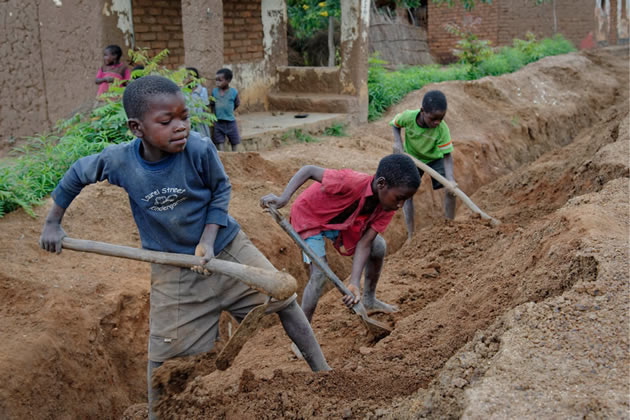
 Leonard Ncube Victoria Falls Reporter
ABOUT half of the country’s children aged between five and 14 years are child labourers and more than 90 percent of them work for no pay. Matabeleland South province tops the list of child exploiters.
According to the Zimbabwe National Statistics Agency (Zimstat) 2014 Labour Force and Child Survey (LFCLS) report, child exploitation is rife in the agriculture, hunting and fishing industries where 96,2 percent of them are employed in economic and non-economic activities.
It said 55 percent of the exploited children were from households in which their guardians earned less than $100 per month.
“About 96,2 percent of children in economic child labour were working in agriculture, hunting and forestry industry and 2.9 percent in the wholesale and retail trade. A total of 91,2 percent of those in economic child labour were own account workers on communal, resettlement and peri-urban farming,” reads part of the report.
“The majority of children on economic child labour (92,1 percent) were not paid at all while 37 percent of those who were paid gave all their earnings to parents or guardians through their employer. Only 15.1 percent spent the money for themselves.”
The report added: “Three quarters of children were working to help in household enterprise while 13.9 percent worked to supplement household income. For those in non-economic child labour, 1.16 percent were employed as child minders, 0.64 percent care for the sick and 0.55 percent are in housekeeping jobs.”
Rural children are the worst exploited as 50, 6 percent are child labourers compared to 4,64 percent in urban areas. Matabeleland South tops the child exploiters’ list at 73,2 percent while the Metropolitan provinces of Bulawayo and Harare have the lowest cases at 8,2 and 7,3 percent respectively.
Matabeleland North was at 58, 9 percent, Masvingo 67,49 percent, the Midlands 64,97 percent, Mashonaland West 39,3 percent and Mashonaland East 51,32 percent.
Mashonaland Central and Manicaland were pegged at 64,99 and 57,27 percent respectively.
According to Zimstat, child labour results in school drop-outs where 33.3 percent had left school for work while 62.8 percent were attending school with four percent having never been to school. 2.7 percent of those between the ages of 12 to 17 years were already married.
The survey was conducted on children between the ages of five and 14 years as those above 15 and below 18 are sometimes regarded as ready for work.
Out of the country’s 14 million population, 6,6 million were said to be aged 17 years and below, but there were no figures for the five to 14 years age group.
Zimstat said working children were defined as those involved in either economic or non-economic activities.
According to the report, economic child labour is when children aged five to 14 years are involved in activities of supply of labour for production of goods and services for sale or working for at least 21 hours per week for the family while non-economic child labour is where the same age group works for at least 35 hours per week.
The damning report was presented at a workshop aimed at disseminating findings of the Multiple Indicator Cluster Survey (MICS) that was carried out to monitor living conditions in the country.
The survey culminated in the compilation of three reports on the country’s labour force, child labour and migration.
This survey’s findings are key in the formulation of social and economic policies and can also be a baseline for the Zim-Asset programme, added the report.



 Online Reporter