Online Reporter
Theseus Mauruki Shambare
MATABELAND North and Matabeleland South provinces are set for a major irrigation boost, with 338 hectares under rehabilitation through five strategic irrigation schemes financed under the Grain Levy as Government ramps up efforts to shield drought-prone communities from the projected 2026/27 Super El Niño-induced dry spell.
According to an by the Agricultural Marketing Authority (AMA) progress report, Matabeleland North and Matabeleland South account for five irrigation schemes covering a combined 338 hectares.
The 45-hectare Hlauke Irrigation Scheme in Matabeleland North has reached 98 percent completion, with farmers already irrigating while final works are being completed ahead of official handover.
Rehabilitation of the 180-hectare Bubi-Lupane Irrigation Scheme has reached 70 percent completion, with all three centre pivots already operational following refurbishment of pumping units.
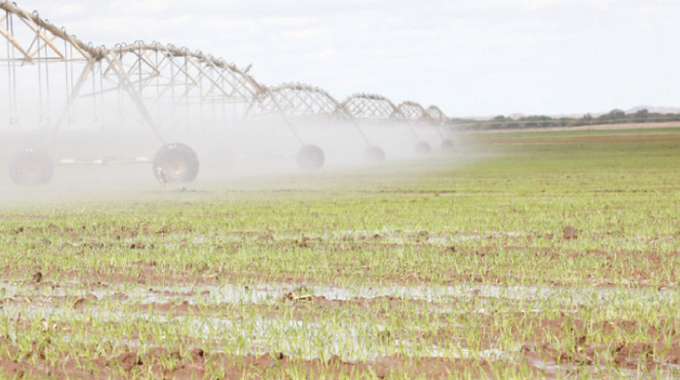
In Matabeleland South, the 50-hectare Mtshabezi Irrigation Scheme is 74 percent complete, while the 32-hectare Portbury Irrigation Scheme has reached 95 percent completion, with commissioning preparations now underway. Procurement has also commenced for the 21-hectare Billi and 10-hectare Homme irrigation schemes.
With recurrent droughts continuing to threaten agricultural production in Matabeleland, the rehabilitation programme is expected to expand year-round irrigation farming, improve household food security and strengthen rural livelihoods, positioning communities to better withstand the forecast El Niño-induced dry spell.
The irrigation projects form part of a nationwide programme being implemented by AMA, which is rehabilitating 24 irrigation schemes covering 1 796 hectares under the Agricultural Marketing Fund to enhance food security, improve agricultural productivity and strengthen climate resilience.
The Agricultural Marketing Fund is financed through the Grain Levy introduced under Statutory Instrument 87 of 2025. Collected by AMA on imported grain, the levy was established to fund strategic agricultural investments, including irrigation rehabilitation, market development and initiatives aimed at reducing Zimbabwe’s dependence on grain imports.

The accelerated rollout comes as Government intensifies preparations for the anticipated Super El Niño weather phenomenon, which meteorological experts say could bring below-normal rainfall across Southern Africa during the 2026/27 summer cropping season.
Last week, President Mnangagwa urged farmers to adopt climate-smart agriculture by planting early maturing and drought-tolerant crop varieties to safeguard household food security.
“I, therefore, urge us to plant early maturing and drought-resistant crops to bolster household food security,” said the President.
He said Government would continue implementing measures to mitigate the impact of the expected drought while encouraging provinces to work closely with agriculture, mechanisation and water authorities to strengthen climate-smart farming and agro-processing initiatives.
Permanent Secretary in the Ministry of Agriculture, Mechanisation and Water Resources Development Professor Obert Jiri said irrigation expansion remains one of the key pillars of Government’s drought mitigation strategy.
“We now have the summer plan, which we are busy implementing. In terms of our summer programme, we are targeting 1,8 million hectares of maize and more than 500 000 hectares of traditional grains, together with other strategic crops that we normally produce,” said Prof Jiri.
“We are planning on five fronts and of course, the sixth front is coordination and early warning.”
He said the strategy also focuses on strengthening the Strategic Grain Reserve, expanding Pfumvudza/Intwasa and traditional grain production and promoting climate-smart seed varieties suited to different agro-ecological regions.
More than US$3,2 million and ZiG29 million have already been invested in irrigation development through the Agricultural Marketing Fund.
AMA marketing and public relations manager Ms Tina Nleya said the programme was delivering tangible results across the country, with Matabeleland among the priority regions.
“So far, we have managed to rehabilitate 24 irrigation schemes covering 1 796 hectares of land and Matabeleland provinces have been prioritised to ensure we leave no place behind. Most irrigation schemes are between 60 and 100 percent complete,” she said.
“This should be completed within the next few months and, after that, a third tranche of funding will be released to further develop other irrigation schemes.”
Ms Nleya said the Grain Levy has created a sustainable financing mechanism for irrigation development while enabling AMA to aggregate production and secure structured markets for farmers.