


 Vusumuzi Dube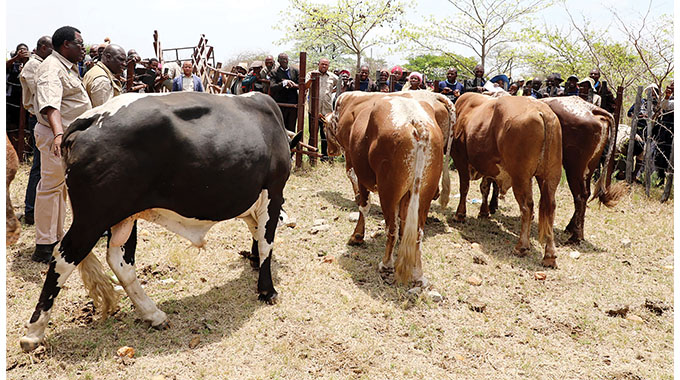
Judith Phiri, Business Reporter
OVER 640 000 small-scale farmer households in Matabeleland South Province have been assisted to improve livestock management through agroecology and climate-smart interventions.
The Government working in partnership with the European Union (EU) has rolled out the Enhanced Resilience for Vulnerable Households in Zimbabwe (ERVHIZ) programme in six districts in the province. The programme seeks to enhance nutrition, enhance early warning systems and ensure health through provision of clean water, sanitation and hygiene. ERVHIZ is funded by the EU through United Nations International Children’s Emergency Fund (UNICEF) and Food and Agriculture Organisation (FAO) which are the implementing partners.
In a post on Twitter, FAO Southern Africa said of the 64 790 small-scale farmer households, 38 266 were female-headed. Responding to the questions from the Sunday News, FAO sub-regional coordinator for Southern Africa, Mr Patrice Talla said the ERVHIZ irrigation thematic area was targeting to establish approximately 18 by 15 hectares crop production hubs for bio-fortified crop production in the province.
“This is a combined total of 270 hectares. This will be done through the development of new schemes and in some cases modernisation of old schemes, using technology such as solar-powered drip irrigation systems and center pivot irrigation. These systems have high water application and energy efficiencies, they are also non-labour intensive and reduce significant nutrient losses through leaching than the traditional methods of irrigation like flood systems,” said Mr Talla.
He said the total irrigation schemes finalised and selected so far were 15 in districts such as Beitbridge being six, three for Gwanda being three and two in Matobo, Insiza and Bulilima respectively. Mr Talla said Matabeleland South is in agro-ecological zones four and five which are characterised by low rainfall and prolonged dry spells, meaning viable crop production and horticulture could only be under irrigation.
“Utilising solar systems will ease the burden on farmers for paying electricity bills and buying diesel for pumping. This reduces significantly the operational cost and also improves system reliability. Farmers will only now be contributing nominal fees for the operation and maintenance as well as security of the Solar plants. Farmers also benefit from high energy and water application efficiencies, reduced nutrient leaching and non-labour intensive semi-autonomous systems,” he added.
He said the farmers will also have improved access to sustainable markets through practicing market-driven crop production, competitive produce pricing and functional marketing committees active at market research that informs production. Mr Talla said the project which was expected to run until August 2024, will see farmers have access to technology, markets, crop diversification and resilient infrastructure, among other measures that will assist them to build resilience and increase productivity in the face of climate change.
He said the project’s goal was to contribute to the well-being of households in vulnerable situations in the face of economic and climate-induced shocks and stresses in Zimbabwe, while it was well aligned with various Government interventions and initiatives under the National Development Strategy 1 (NDS 1).


 Online Reporter