Tendai Gukutikwa
Post Reporter
TUCKED away in Sakubva, the oldest suburb of Mutare, lies a crumbling evidence of neglect and desperation – the Matida Hostels.Built during the colonial era to house male migrant workers, the hostels have long outlived their original purpose.
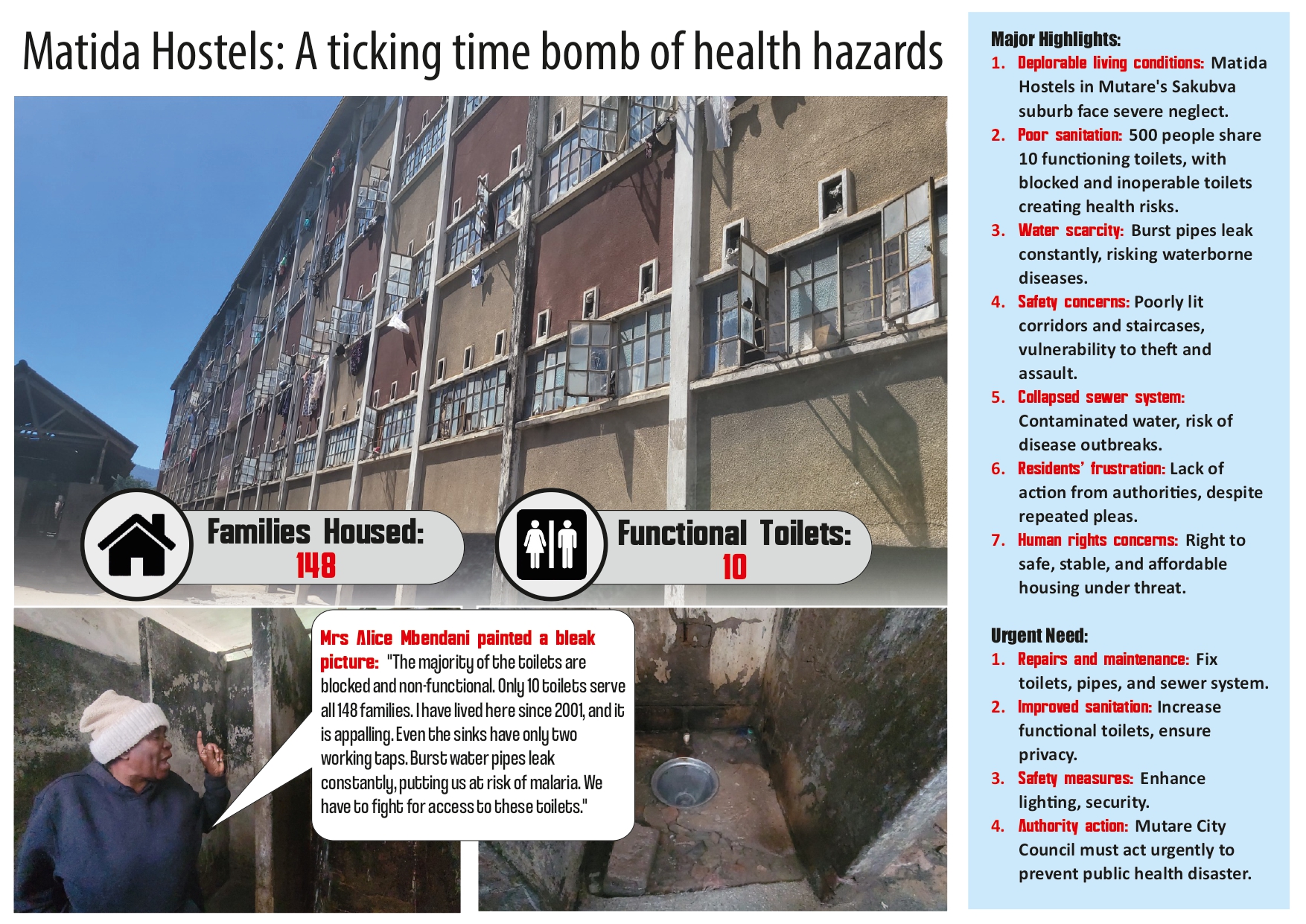
Today, 148 families call the hostels home, with many having known no other life without its walls.
However, those walls are now on the verge of collapse, harbouring a potential public health disaster.
A recent visit by The Manica Post revealed the heart-wrenching conditions residents endure.
From rusted, collapsing railings to broken water and sewer pipes, the once-functional structure is now a shadow of its former self.
Residents spoke candidly about their struggles, frustrations, and fears of looming disease outbreaks, including cholera, dysentery, malaria, and the relentless bed bug infestation.
For the residents of Matida, access to proper sanitation is a daily struggle.
A staggering 500 people are forced to share just 10 functioning toilets, with only four designated for women and six for men.
The ratio is both inhumane and dangerous. The remaining toilets are blocked and inoperable.
This dire situation has created a breeding ground for diseases like cholera, dysentery and malaria.
Long-time resident, Mrs Alice Mbendani painted a bleak picture: “The majority of the toilets are blocked and non-functional. Only 10 toilets serve all 148 families. I have lived here since 2001, and it is appalling. Even the sinks have only two working taps. Burst water pipes leak constantly, putting us at risk of malaria. We have to fight for access to these toilets.”
Ms Susan Dzobo, a neighbour of Mrs Mbendani, shared similar concerns.
What was once a safe haven has transformed into a hazardous environment.
She emphasised that the poorly lit corridors and staircases exacerbate the situation, leaving residents vulnerable to theft and assault.
“The hallways are extremely dark, and we have had enough of people stealing from each other. You cannot even walk with your phone without fear of it being snatched. We are worried that lack of lighting could lead to physical harm, including rape. Now, we also have to worry about falling ill from preventable diseases,” said Ms Dzobo.
Another resident, Mr Difficult Samupindi, spoke about the collapsed sewer system, which he described as a silent killer.
He recounted an incident where first-floor residents were forced to drink water contaminated with sewage leaking from upper floors.
Mr Samupindi took matters into his own hands to address the issue.
“I have had to repair the sewer pipes countless times due to contaminated water. We have pleaded with the council, but they only send engineers who inspect the area and leave without taking action. We feel like we are living on borrowed times. About five years ago, we were told that new pipes were procured, but there was no progress since then.
“Mutare City Council officials have a duty to act, and they must do so now. This is not just about fixing pipes or toilets; it is about restoring faith, dignity, and safety to the hundreds of families who call Matida Hostels home,” he said.
Residents expressed frustration with the silence from responsible authorities.
Contacted for comment, Mutare Town Clerk, Mr Blessing Chafesuka, expressed concern over continued acts of vandalism of toilets by residents who share communal toilets in Sakubva.
“We have been repairing these communal toilets regularly, but unfortunately, residents continue to vandalise them and steal fittings, particularly water pipes. A case in point is the Sakubva Beit Hall toilets, where we were forced to deploy security guards during renovations because pipes were being stolen even as the work was in progress,” he said.
Mr Chafesuka, however, noted that long-term solutions are being pursued under the Sakubva Urban Renewal Project, which aims to significantly improve the quality of life for residents in areas such as Matida Hostels.
“In the long term, residents of Matida Hostels are expected to benefit from the Sakubva Urban Renewal Project. Once the project reaches that phase, the building will be assessed to determine whether it can still be renovated or if it must be demolished.
“Meanwhile, we have already initiated the home ownership process in Sakubva, as our ultimate goal is for every resident to have their own home and no longer rely on shared facilities like communal toilets,” he said.
Mr Matanga Nechaziva, part of a community-based organisation maintaining public toilets in Sakubva, described a cycle of futility and exhaustion.
“We face a significant challenge with water scarcity. People disregard the fact that upstairs toilets are non-functional and use them anyway. As CBOs, we are forced to clean them regularly. I carry buckets of water from the first floor to the fourth floor to clean the toilets. Once they are clean, people start using them again, despite being non-functional. All floors rely on the first floor for water. We clean to keep people healthy and prevent diseases. Each time the rainy season approaches, the threat of waterborne diseases like cholera hangs over Matida Hostels. Stagnant water from burst pipes, combined with overflowing toilets and poor drainage, creates a perfect storm for spreading of diseases.
“We do not want these residents to become statistics in a preventable public health disaster,” he said.
A concerned resident who refused to be named sad a years ago, council promised to replace the system, leaving residents waiting in limbo.
A home should be a sanctuary, providing dignity, privacy, and safety. International and local law recognises the right to safe, stable, and affordable housing as a basic human right.
However, in Matida, this right is under threat.
Residents feel their rights have been stripped away, despite paying US$26 monthly rentals to the local authority.
“We pay our rent, but what do we get in return? No running water, safe toilets, or clean living spaces. People come here and collect news, but it seems authorities at council do not even read the news. They do not care about us. It was never like this. The hostel used to be good, but now we are living in a deplorable state with poor sanitation, yet we are paying US$26 every month,” said Mbuya Chido Shamboko, visibly frustrated.
Beyond the plumbing issues, the structure itself is decaying.
Rusting rails threaten the building’s stability, and one strong wind or rainstorm could bring parts of it down.
Children play nearby, oblivious to the danger.
Residents fear that if left unattended, Matida Hostels will collapse, not just physically, but also in dignity, health, and human worth.