


 Sundaymail Editor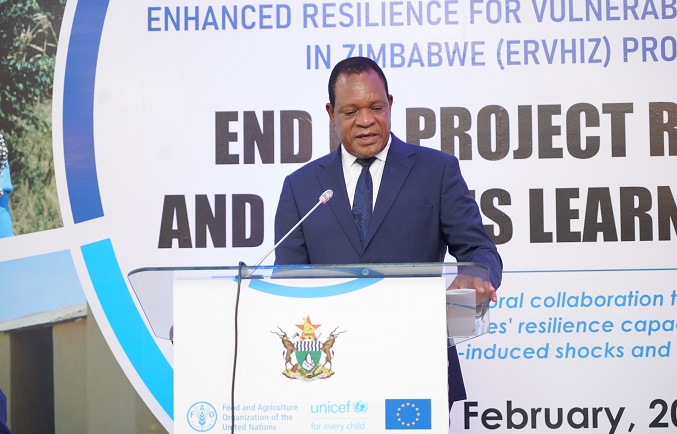
Theseus Shambare in MATOBO
MATOBO district has long wrestled with the escalating challenges of climate change. Wells, once reliable lifelines, ran dry and rivers dwindled to mere trickles, casting a shadow of doubt over the prospect of fruitful harvests.
Yet, from this backdrop of adversity, a remarkable story of transformation has emerged, centred around the revitalised Lingwe Piped Water Scheme (LPWS) in Ward 8.
Four years ago, the Enhanced Resilience for Vulnerable Households in Zimbabwe (ERVHIZ) project, funded by the European Union and implemented through a collaborative effort between the Government, the Food and Agriculture Organisation (FAO) of the United Nations and the United Nations Children’s Fund (UNICEF), arrived, not as a fleeting act of charity, but as a catalyst for lasting change.
Operating in the challenging agro-ecological regions 4 and 5, ERVHIZ sought to empower communities to build a sustainable legacy, one precious drop of water and one carefully nurtured seed at a time.
“Before, we were at the mercy of the Tshatshane sand river,” recalled Mrs Sibusisiwe Nyathi, a respected community leader and mother of five, her voice carrying the weight of past struggles.
“Diarrhoeal diseases were common and our livestock suffered terribly. We lived in constant fear of the next dry spell.”
The ERVHIZ project brought a lifeline to the community.
Utilising innovative sand abstraction technology (with inline chlorination) and solar-powered systems, the rehabilitated LPWS now delivers clean, reliable water to 216 households across Zamadube, Lingwe and Matshina villages.
This technological advancement, coupled with community training, ensured long-term operation of the system.
“It is like a miracle,” said Headman Matshina, Mr Midas Ndebele, his voice resonating with gratitude.
“We have water at our doorstep and our children are healthy. We can finally plan for the future, knowing we have a reliable water source.”
The LPWS also breathed new life into the Lingwe cattle dip-tank, a vital resource for the community’s livestock.
“We were losing cattle to tick-borne diseases,” lamented Mr Trymore Dube, a local farmer.
“But now, with regular dipping, our herds are healthy and our livelihoods are secure.”
The refurbished dip-tank, one of 40 rehabilitated across Matabeleland South, now serves 200 cattle owners and a total census of 1 223 cattle.
“This project has saved our animals and our community,” said Mrs Nokuthula Ncube, a member of the livestock development committee.
“We are grateful for the training we received on disease management, which has empowered us to take control of our livestock’s health.”
Perhaps the most visible symbol of Matobo’s transformation was the one-hectare Lingwe nutrition garden.
“This garden is our sanctuary,” said Mrs Evis Dube, a member of the garden committee, as she tended rows of vibrant vegetables.
“It is where we grow our food, share our knowledge and build our community.”
The garden, a testament to the integrated approach of the ERVHIZ project, directly benefitted 50 households.
It also reached 250-300 indirect beneficiaries.
“We grow biofortified maize, carrots, beans and a variety of vegetables. We use the produce for cooking demonstrations, household consumption and to sell at the market,” she said.
Mrs Ndlovu, a mother of three, said the garden had become her employer.
“The income from the garden has been a lifeline,” she said. “We use the proceeds to pay school fees, buy groceries and contribute to our community fund.”
The garden is more than just a source of food; it is a hub of learning and empowerment.
“We have regular meetings where we discuss nutrition, sanitation and sustainable farming practices.
“We are learning from each other and building a stronger community, and can help each other through difficult times,” said Mrs Martha Banda.
In an interview during a two-day event to mark the end of the four-year ERVHIZ project, Lands, Agriculture, Fisheries, Water and Rural Development Minister Dr Anxious Masuka commended the collaboration that exists between the Government, the European Union (EU) and the development partners.
He said the project in Matobo was an example of being resilient to climate change.
“I am really impressed with the collaboration we have with our partners and the EU. ERVHIZ is a testament of unity.”
The success of the ERVHIZ project lies in its focus on sustainability.
The garden operates under a committee and constitution, with members required to make monthly financial contributions to ensure its continued operation.
While the project achieved remarkable success, challenges such as fluctuating market prices for produce and the need for ongoing maintenance of the water infrastructure were noted, highlighting the importance of continuous community engagement and support.
“We are committed to making this garden a success for generations to come,” said Mrs Banda, a garden committee member.
The impact extends far beyond domestic needs.
The LPWS also provided water to two bustling business centres and Lingwe Primary School, which is about 13 kilometres from the water source, where enrolment surged from 210 to 223 learners.
“The difference is remarkable,” said Mr Ferdinand Namathe Ndlovu, the school’s headmaster.
“Clean water and improved sanitation have created a conducive learning environment. Our pass rates have skyrocketed, especially for girls.”
Indeed, the numbers spoke volumes.
Girls’ pass rates soared from a dismal 33 percent in 2023 to an impressive 57 percent in 2024, while boys saw an increase from 9 percent to 29 percent.
“It is not just about academics,” Mr Ndlovu said. “It is about dignity. Our children are attending school regularly and they are thriving, and are able to focus on their studies.”
Mr Taungana Ndoro, the director of communications and advocacy in the Ministry of Primary and Secondary Education, said the Lingwe pipe water scheme should be replicated in other rural schools.
“As the ministry, we have said each one of our 10 700 schools should have fresh water facilities within the premises of the school,” he said.
“This is one such example; water is now accessible within the premises of the school. This is the strategy that we are doing in all our schools in rural and remote areas. We want them to have fresh and clean water within the premises of the school.”
“What impresses me most is its alignment to our vision where we expect communities to be resilient, see agriculture as business while moving away from depending on donor handouts.
“Today we see an empowered community, an industrialised community, that is the Zimbabwe we want,” said Dr Masuka.
The goal, he said, was to ensure that every household had access to clean water, nutritious food and the tools they needed to build a resilient future.
In Matobo, the dust is settling and a vibrant green landscape is emerging.
Whispers of despair have been replaced by songs of hope, a testament to the power of resilience and the transformative impact of a project that empowered communities to cultivate their prosperity and fight the menace of climate change.


 Online Reporter