Chronicle Editor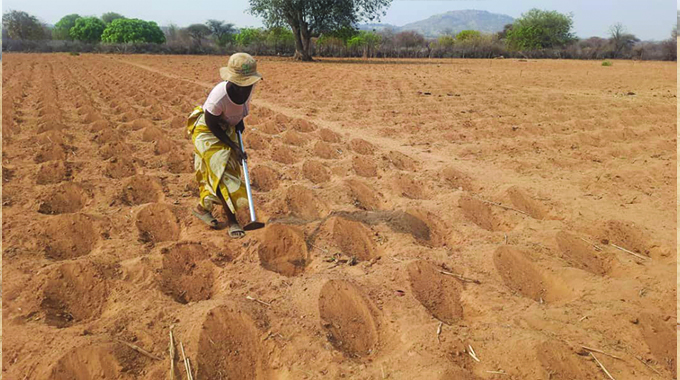
Sukulwenkosi Dube-Matutu, [email protected]
MS Proper Nkomo (52) from Sigodini Village in Matobo District has assumed a leading role in educating fellow farmers on soil conservation farming and the adoption of the Pfumvudza/Intwasa programme, which has boosted her production as a communal farmer.
A member of Divine Hope Farmer Field School, which has 35 lead farmers, Ms Nkomo is mentoring 10 other farmers and uses her homestead as a demonstration plot.
A farmer field school is a group-based learning process where farmers carry out experimental learning activities that help them understand the ecology of their farming areas and suitable best practices. These activities involve simple experiments, regular field observations and group analysis.
The knowledge gained from these activities enables participants to make locally specific decisions about farming management practices.
The Government initiated the Pfumvudza/Intwasa programme a few years ago to counter the effects of low rainfall caused by climate change. The model has helped the country attain food security in the last three seasons, at the same time boosting farm incomes as subsistence farmers are converted to small-scale commercial growers.
Farmers in dry areas have been urged to grow traditional grains to increase the chances of good harvesting and this farming season more farmers took heed of this advice. Ms Nkomo said each year they start digging their holes in June.
“As members of Divine Hope Farmer Field School, we have been equipped with knowledge on soil conservation farming and climate-smart agriculture.
“We have been equipped on how to improve our yields even during lean seasons. We use basins, we establish infiltration pits, use ripping, potholing among methods all in a bid to preserve water,” she said.
“We use both dead and living mulch to retain our soil’s fertility considering that we will be producing year in and year out. These methods help us to control the flow of water as we reduce the movement of water and allow it to spread in the field and then it’s absorbed by the soil. Once it’s in the ground, our methods help to store the water underground.”
Ms Nkomo said the conservative farming model helps conserve the seed as they place a certain number of seeds in a basin. They also conserve mulch by placing it in basins rather than placing it across the entire field even in spaces that do not have a crop. She said this has helped to use little resources while ensuring that their harvest is good.

Ms Nkomo said as lead farmers they must share this knowledge acquired with other farmers.
“We are a group of 35 lead farmers and each member has 10 followers. This has helped us to spread this crucial information to others. We have also managed to influence farmers who are not within our groups as they have seen what we do and the positive effects,” she said.
“We have learned that in farming we have to plan. In June we start digging our basins bit by bit. In August we start preparing our mulch while we continue preparing our basins. In September the mulch will be ready and we apply it to the basins. Everything is done following specific timelines and a sequence.”
Ms Nkomo said one of the major tips she has shared with her follower farmers is the adoption of traditional grains as they are drought-resistant and healthy. She said each farmer also produces fodder to sustain their livestock.

The gains that Ms Nkomo have made through selling their produce have helped start various income-generating projects such as goat rearing. They have also started Internal Savings and Lending Schemes (ISALs) as well as secured a hammer mill, which they use to process feed for fellow villagers at a cost.
Ms Moreblessing Ncube who is a member of the Mgijimi farming group said education on climate-smart agriculture has helped bring the much-needed development to their community, especially for women.
She said the programme has become an eye-opener to them on how they can produce while protecting their environment and conserving their soil, which is a crucial natural resource.
Agritex extension officers have said sensitising farmers has yielded good results as three-quarters of farmers in the ward have adopted traditional grains.
λ Full story on www.chronicle. co.zw
The Government through the Ministry of Lands, Agriculture, Fisheries, Water and Rural Development in partnership with the Green Climate Fund and the United Nations Development Programme (UNDP) under the Building Climate Resilience of Vulnerable Agricultural Livelihoods in Southern Africa programme has rolled out the farmer field schools concept to promote peer to peer learning. Over 230 farmer field schools have been established under the programme.
Participating farmers have received farming equipment such as seed, fertiliser and farming equipment. They have also been assisted with training which have helped to capacitated them.
The programme started in June 2020 and will run up until June 2027 being implemented in 14 districts in three provinces. In Matabeleland South, the project is being implemented in Umzingwane, Mangwe, Insiza, Matobo, Gwanda and Beitbridge. — @DubeMatutu



 Online Reporter