Online Reporter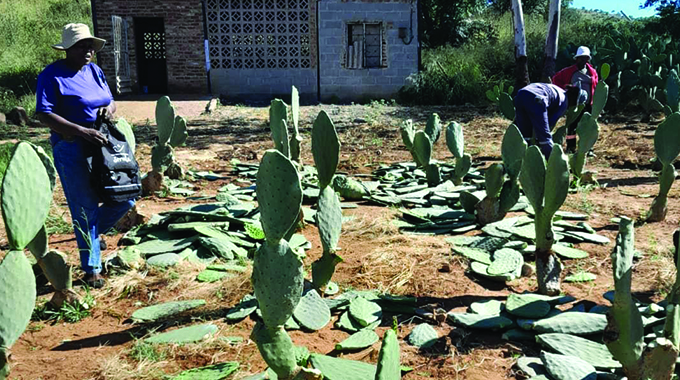
Sukulwenkosi Dube-Matutu, [email protected]
MATOPOS Research Institute has launched a project to cultivate various spineless cactus varieties for livestock feed, as part of efforts to mitigate the effects of climate change on animal production.
The institute is characterising 16 cactus varieties and has partnered with other institutions and farmers in this initiative.
To date, seed has been distributed to farmers in the Matobo, Insiza, Mutoko and Rushinga districts, as well as to institutions such as Esigodini Agricultural College, Gwanda State University, Great Zimbabwe University and Makoholi Research Institute.
In an interview, Mr Givious Sisito, Chief Research Officer in the Department of Livestock Research at Matopos Research Institute, said the cactus project falls under the Climate-Smart Agriculture initiative, offering a sustainable solution to the challenges faced by farmers due to climate change.
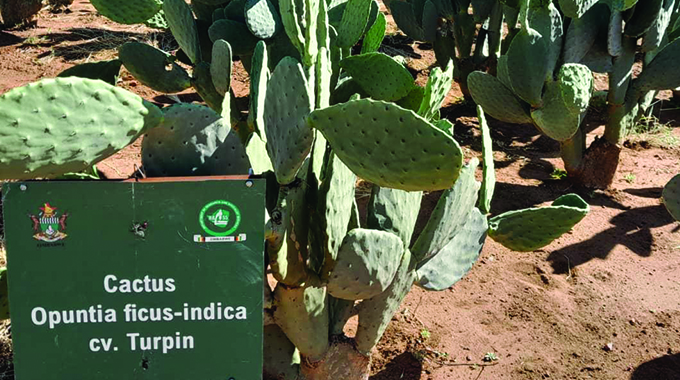
He said the institute is supporting farmers with seed to scale up production. Cactus cultivation began in 2016 with the “Algerian variety” and in 2022, the institute imported 16 new varieties from South Africa. Two hectares at the institute have been allocated for the characterisation of the plant.
Cactus is considered a valuable feed source for livestock, particularly in arid and semi-arid regions. The plant provides a readily available source of water and energy, especially during dry seasons when other feed options are limited. It is rich in water, making it a crucial hydration source for livestock in dry areas.
Unlike many other forages that require storage, cactus is an evergreen crop and can be fed to animals throughout the year. It is well-suited to dry conditions and can survive prolonged periods of drought, providing a reliable feed source when other options are unavailable.
The flattened stems, known as cladodes, can be cut and fed directly to animals, reducing wastage and enabling controlled feeding.
“We have about 16 cactus varieties under characterisation and all show promise in terms of water content. Approximately 90 percent of the cactus is water, with the remaining 10 percent consisting of starch and other components.
“One of the challenges in livestock production is that animals expend a lot of energy and lose weight searching for water. By feeding on cactus, which is abundant in water, animals can meet their hydration needs more efficiently.
Research shows that animals consume more water through feed than they do through drinking, and cactus offers this advantage,” said Mr Sisito.
Mr Sisito said the adoption of the cactus plant would play a key role in helping farmers sustain livestock in dry areas. The plant can be grown during the dry season and does not require much water.
He also noted that cactus has uses beyond livestock feed. It can be processed into beverages, medicines and food for human consumption.
“Farmers can continue growing their usual crops but should dedicate a portion of land to cactus. It thrives in all soil types and can also serve as a natural fence around fields,” he said.
Addressing farmers from Ward 17 in Gwanda District recently, Matopos Research Institute research officer Ms Obey Daga, urged farmers to adopt the cactus plant to mitigate the impact of climate change.
She said research has shown that cactus has a high herbage yield and is available at the research institute at an affordable cost. Farmers involved in experimental trials have received the seed free of charge.
“Cactus provides both water and essential nutrients for livestock. Ideally, it should be planted between May and October. It can be harvested after six months, but for better yields, farmers should wait a year to allow the root system to develop fully,” she said.
“When fed to livestock, cactus can replace up to 50 percent of their daily water requirements. For example, a goat that typically needs five litres of water per day may only require 2,5 litres when fed cactus, the rest being supplied by the plant.”
Ms Daga added that cactus does not require irrigation or fertilisation. It grows well under normal conditions and maintains high production potential. — @DubeMatutu