

 Online Reporter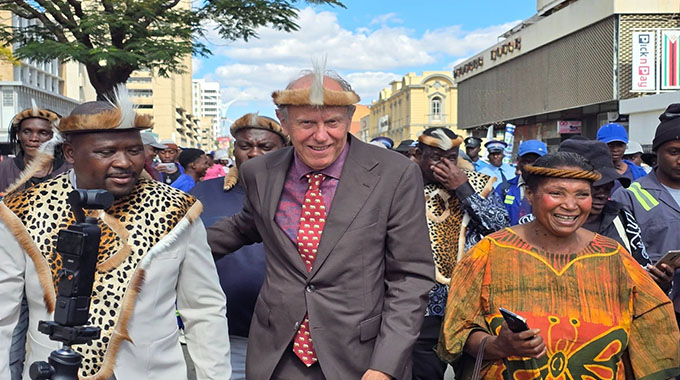
Bruce Ndlovu and Gift Moyo
At the annual Bulawayo Day celebrations held at the Large City Hall yesterday, Bulawayo Mayor Councillor David Coltart called on residents to continue upholding the city’s reputation as the nation’s most culturally vibrant and deeply rooted community.
Addressing a packed gathering following a colourful city-wide carnival parade, Mayor Coltart said the pride of Bulawayo was evident in the unity and energy displayed as residents marched through the streets and converged at the historic venue.
“The pride that we have in our city is palpable as shown when we all marched all the way through the city and ended up here. As we gather today at this historic event, we need to remember that this is not merely an annual fixture, but rather a profound moment of reflection, gratitude, and collective pride in the great culture and people of our city,” said Mayor Coltart.
For him, Bulawayo’s history is not simply something to be preserved in museums and memory. It is an asset that can help drive economic renewal.
“As we reimagine the history of this city, we need to understand that tourism can be a driving force in revitalising our economy. We need people flying in from China, Japan, America and Europe flying in to visit as we celebrate.
“As we all listened to the amazing dance ensemble that entertained us today, I know people from throughout the world that would come to Bulawayo that would pay good money to come and listen to them, to see these historical artifacts we have in significant numbers,” he said.
Across the globe, cities have transformed their heritage into economic engines, attracting visitors eager to experience unique histories, architecture and culture. According to Mayor Coltart, Bulawayo, with its wealth of historical sites, cultural traditions and artistic talent, possesses many of the ingredients needed to do the same.
“I have just been to London recently and believe that we have far more to offer than a city like that. Yet thousands of people travel from around the world to a city like that. We need to exploit this rich culture to boost tourism and it is for this reason that council in 2009 resolved to have the Bulawayo Arts Festival annually,” said Coltart
The route taken by participants, for Coltart, told a story about the city and the many chapters that have shaped its character.
“The carnival that we have seen today has become part of the traditions to mark Bulawayo Day. Visiting sites like King Lobengula’s regimental parade ground, Inxwala, walking along Joshua Nkomo Street, making a turn on the stature of Father Zimbabwe, the late Dr Joshua Nkomo, all of this is very symbolic and it serves as recognition of different timelines in the history of our city. Timelines that we take pride in as we celebrate the history of this city,” he said.
The mayor, however, raised concern over the state of some of the city’s heritage sites and cultural landmarks, saying urgent attention was needed to preserve Bulawayo’s historical identity as the cultural capital of Zimbabwe.
“We’re celebrating 132 years of modern-day Bulawayo. The history of our great city goes back way deeper. One of the speakers spoke about King Mzilikazi coming here in 1840, as well as how Lobengula established ko’Bulawayo merely just five kilometres from here. I want to use this occasion in particular to reflect on that and to think about the pride that we have in that history and how that is reflected.
“It’s safe to say that we have a lot of work to do. Driving recently to ko’Bulawayo, it is not in a great state. We allowed it to burn down and have not rebuilt it. As the cultural pride of the nation, we must do better to revitalise and maintain these heritage sites,” said Mayor Coltart.
His remarks were met with applause from attendees, who echoed his call for the preservation and restoration of the city’s historical landmarks as part of safeguarding Bulawayo’s cultural legacy.
While the throng of young and old made the journey from one cultural landmark to another, the Bulawayo Day celebrations’ ability to bring together the many strands that make up the city’s identity were laid bare.
In a single afternoon, participants reflected on the legacy of King Lobengula, paid homage to Father Zimbabwe Dr Joshua Nkomo and celebrated the enduring spirit of Highlanders Football Club. They witnessed traditional dancers preserving ancient customs while imagining a future in which those same cultural expressions could attract visitors from across the world.


 Bongani Ndlovu