Online Reporter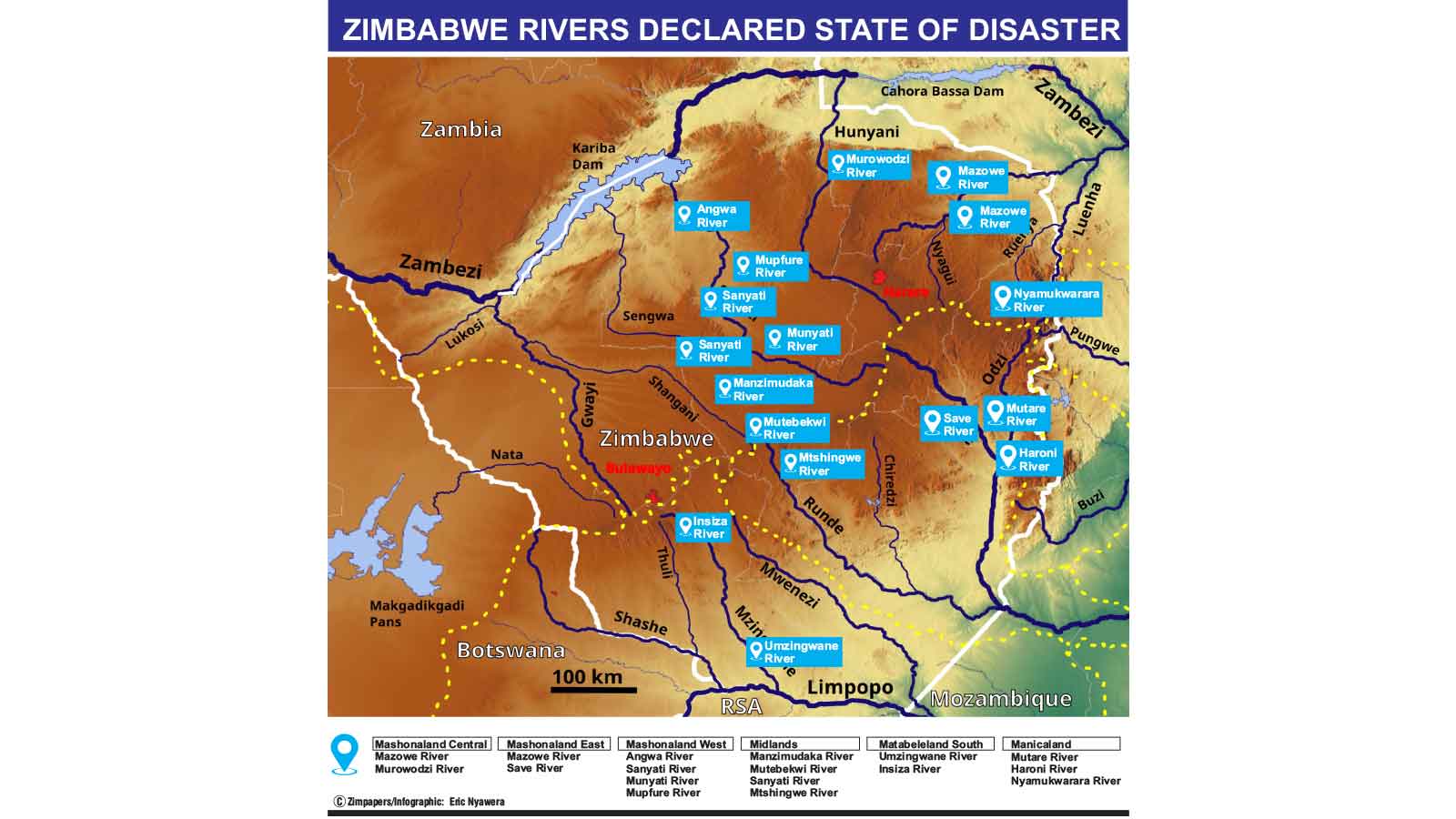
Theseus Mauruki Shambare
AT Mazowe Dam, water did not just suddenly disappear.
It withdrew slowly.
Along the exposed shoreline, cracked earth now marks where water once reached.
Irrigation pumps sit idle more often.
Even recreational spaces that once defined Mazowe’s identity have changed character — zipline rides no longer feel suspended over abundance, and the canopy walkway no longer offers sweeping views above a full reservoir, but over a retreating strip of water and widening stretches of exposed land.
What was once leisure over water has become movement over absence.
A tour operator at the site, who declined to be named, said the change is now part of the experience itself.
“The attraction has not disappeared; the water that defined it has,” he said.
In the dry season, the silence is broken only by the metallic hum of machinery struggling to draw water from a system under strain.
This is no longer just environmental change; it is climate stress made visible.
And it now sits at the centre of a national emergency.
The Government last week declared a State of Disaster on 17 rivers across the country following degradation linked to illegal mining, land-use pressure and increasing climate variability across key catchments feeding the country’s water systems.
The declaration — made under the Civil Protection Act, through the Civil Protection (Declaration of State of Disaster: Emergency Riverine Ecosystems Rehabilitation) Notice, 2026 — marks a shift in how Zimbabwe is now responding to river degradation: from routine environmental management to emergency intervention.
But it is in Mazowe where the meaning of that shift becomes visible.
Mazowe as the warning sign
Mazowe Dam is a warning sign.
Its shrinking shoreline reflects a wider hydrological crisis unfolding across Zimbabwe’s river networks, where climate variability, land degradation and human activity are now interacting at scale.
Hydrological research across Southern Africa shows a consistent trend: Rainfall is becoming more erratic, with intense downpours separated by longer dry spells.
The Intergovernmental Panel on Climate Change (IPCC) has warned that “climate variability and extreme rainfall events increase erosion and reduce the reliability of water-dependent systems in Sub-Saharan Africa”.
In Mazowe, this is no longer theory; it is visible in how the system behaves.
Rain falls in violent bursts that strip soil from unprotected land.
That soil is carried into tributaries feeding the dam. It settles. It accumulates. It reduces capacity.
Then comes the dry spell, which exposes a system that cannot hold what it once held.
Hydrologists describe this as a breakdown in catchment regulation capacity — the system’s ability to slow, store and release water in balance.
Mazowe no longer moderates extremes; it amplifies them.
The upstream breakdown no one sees
Upstream of Mazowe Dam, river systems feeding the reservoir have been steadily reshaped by land disturbance and alluvial mining.
Riverbanks have lost vegetation cover.
Natural channels have been altered.
Soil structure has weakened.
When it rains, loosened sediment is swept downstream into tributaries feeding the dam.
Over time, Mazowe becomes less a reservoir of water and more a trap for sediment.
A water governance specialist, Engineer Geoffrey Gundudza, who has worked in the catchment, described it as a structural shift in function.
“Once sediment loads increase, dams stop functioning as storage systems and start functioning as accumulation points,” he said.
This is where climate and human activity intersect.
Climate determines intensity. Land use determines vulnerability.
Mazowe sits exactly at that intersection.
The declaration of a State of Disaster on 17 rivers is, therefore, a legal and operational reset of how river systems will now be managed.
It allows the Government to mobilise emergency contractors for rehabilitation works, accelerate removal of illegal mining structures, intervene directly in degraded river systems and restore catchments feeding strategic infrastructure such as irrigation dams.
This is a shift from fragmented enforcement to coordinated emergency restoration.
Agriculture, Mechanisation and Water Resources Development Minister Dr Anxious Masuka said the declaration reflected growing concern over how unchecked river degradation was now directly threatening agriculture, water security and wider ecosystem stability across Zimbabwe.
“I am humbled by the President’s bold magnanimity to eliminate this scourge of degradation of rivers from alluvial mining activities to allow ecosystem restoration for agriculture, industry and the environment. For example, areas proximal to Mazowe and Mwenje dams have had to reduce the area under irrigation for winter wheat due to alluvial mining activities and diversion of river systems,” said Dr Masuka.
“In Umzingwane, alluvial mining activities threatened supply of water to Bulawayo, while Mutare River is choked and diverted, thus interrupting water flow. We must act with alacrity, with purpose and boldly to ensure the President’s directive is fully implemented in the short time frame available.”
His remarks reinforced what Mazowe now visibly represents — that river degradation is no longer an isolated environmental concern, but a growing national systems risk touching agriculture, urban water supplies and long-term climate resilience.
Chief director for Agricultural Engineering, Mechanisation and Farm Infrastructure Development Engineer Edwin Zimunga said the scale of degradation had forced a rethink in approach.
“We are now dealing with a complex situation, not isolated environmental incidents,” he said.
For Mazowe, he said, this means the dam is no longer being treated as an isolated infrastructure issue, but as part of a failing catchment system requiring upstream and downstream intervention.
Agriculture under pressure
The most immediate impact of declining water systems is being felt in agriculture.
Permanent Secretary in the Ministry of Agriculture, Mechanisation and Water Resources Development Professor Obert Jiri said water depletion and catchment degradation are now directly threatening agricultural productivity.
“Water is the backbone of agriculture. When our water sources are compromised through siltation, catchment degradation and climate variability, it directly affects production, food security and the livelihoods that depend on agriculture,” said Prof Jiri.
The Government, he said, was working with water authorities to strengthen catchment protection and improve management of irrigation-dependent systems.
But, on the ground, uncertainty is already reshaping farming decisions.
Smallholder farmer Mr Farai Magofa, who depends on irrigation schemes linked to Mazowe, said planning had become increasingly difficult.
“We no longer plan with confidence. We plan with uncertainty. Sometimes the water is there. At other times it is not,” he said.
Some farmers have reduced planting areas, adjusted crops and shifted away from water-intensive production systems.
Agricultural experts warn this shift has long-term implications for food security and rural livelihoods.
When water systems fail, production systems contract.
Mazowe’s transformation is not limited to agriculture.
Even recreation — once a defining feature of the dam — has been reshaped.
Zipline operators and canopy walkway guides now adjust operations based on changing shoreline conditions.
Where once the experience was defined by water depth and continuity, it is now defined by exposure — movement over increasingly visible terrain.
The thrill remains, but the environment that gave it meaning has changed.
Mazowe is no longer experienced as abundance.
It is experienced as transition.
A regional system under shared pressure
While Zimbabwe’s declaration focuses on 17 rivers, hydrologists caution that these systems are part of wider transboundary catchments across Southern Africa.
This gives the crisis regional significance.
At ongoing Southern African Development Community (SADC) meetings in Victoria Falls, ministers and technical experts are discussing climate resilience, food security and shared water governance frameworks.
SADC deputy executive secretary for regional integration Mr Fahari Marwa said: “Water security in Southern Africa is interconnected. What happens in one catchment has consequences beyond national borders.”
This situates Mazowe within a broader regional reality, where climate stress is no longer local, but networked across river basins.
Climate change as a risk multiplier
Scientific consensus increasingly frames climate change not as a single cause, but as a multiplier of existing pressures.
In Mazowe, those pressures include increasing rainfall variability, land degradation, mining-induced sedimentation and reduced catchment resilience.
The IPCC describes this interaction as “risk stacking”, where multiple stressors combine to accelerate system failure.
Mazowe is a textbook case of this convergence. Along the Mazowe corridor, the river remains central to competing livelihoods.
Farmers depend on irrigation water.
Artisanal miners depend on riverbeds.
Local economies depend on both.
This creates a structural tension between immediate survival and long-term ecological sustainability.
“The river has become both an economic system and an ecological system. That duality makes restoration complex,” said Prof Jiri.
Rehabilitation must, therefore, extend to livelihoods, enforcement and long-term land-use change.
Mazowe Dam is no longer simply a reservoir; it is a system signal. Its shrinking shoreline, sediment build-up and fluctuating inflows reflect a wider breakdown in catchment resilience across Zimbabwe and the region.
Even recreation now operates over visible environmental change — where water once defined the landscape, absence now defines experience. The system no longer suggests permanence. It reflects transition.
The declaration of a State of Disaster marks a shift from environmental degradation to emergency climate governance.
But Mazowe Dam shows what that declaration is responding to — not theory, but lived reality.
It shows that climate change is not only about extreme events.
It is about slow withdrawal — of water, of certainty and of system stability.
As SADC advances discussions on climate resilience and transboundary water management in Victoria Falls, Mazowe stands as a grounded reference point — a system already living the consequences of what policy now seeks to prevent.
Its message is clear: Resilience is not built when systems begin to fail.
It is built long before the water begins to retreat.