Online Reporter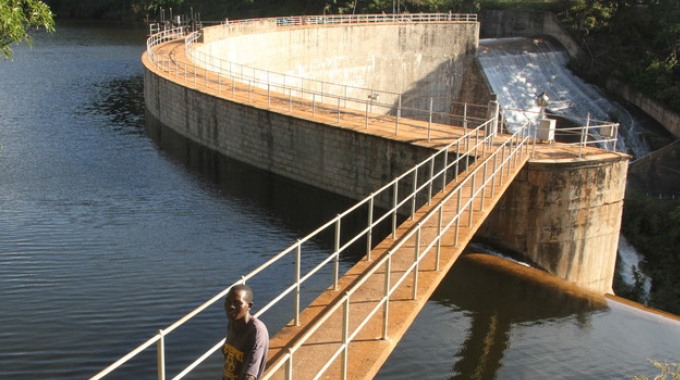
Theseus Shambare, Features Writer
At sunrise, Mazowe Dam glimmers faintly under the morning light, its vast surface broken by mudflats and silt where fish once thrived.
For decades, this reservoir in Mashonaland Central sustained commercial citrus estates, fishing co-operatives and countless smallholder plots.
Today, its shrinking waters whisper of neglect and the compounded pressures of climate change.
But drought alone did not empty Mazowe.
Upstream, unsustainable artisanal mining has scarred the land, sending torrents of silt into the reservoir.
What should have been a 35-year storage lifespan has been cut drastically short, with tonnes of mud clogging the dam’s belly.

“The dam is dying, not because it rains less, but because of how the catchment is treated,” laments 66-year-old farmer Mr Muzondiwa Nyandoro, pointing at sandbanks where he once cast his nets.
“It was built for the community, but mining upstream has destroyed everything.”
Mazowe’s story is a cautionary tale.
Building dams is one thing; keeping them viable is another.
Without sustainable land-use practices in surrounding catchments — from responsible farming to regulated mining — even the biggest dams become shallow ponds, incapable of buffering the shocks of climate change.
Zimbabwe is heating faster than the global average, with temperatures up by nearly 2°C since the early 1900s and rainfall falling by as much as 20 percent in recent decades.
Extreme droughts, such as the 2015/16 El Niño and the 2024 failed rains, have left millions hungry.
According to the World Food Programme, 3.5 million Zimbabweans needed food assistance this year alone.
In this new reality, water is everything.
Government has recognised this urgency.
Its flagship adaptation programme — drilling boreholes in every village — seeks to tap underground aquifers, ensuring communities have reliable water even when skies fail.
Across provinces, solar-powered boreholes now anchor nutritional gardens, livestock troughs and village water points.
Yet engineers warn that boreholes alone are not enough.
“Groundwater is critical, but it must complement surface water,” explains Engineer Edwin Zimunga, Acting Chief Director for Water Resources, Development and Utilisation in the Ministry of Lands, Agriculture, Water, Fisheries and Rural Development.
“Reliance on underground water only is risky. That is why the Government is scalling up the construction of weirs and small dams, which are cheaper, quicker to build and easier for communities to manage. At the same time, authorities are working tirelessly to reclaim degraded land and preserve soil in catchments. Protecting the soil ensures that both underground and surface water sources remain viable for generations.”
The Government has set an ambitious target to construct 50 new small dams and weirs while maintaining existing farm dams as part of its preparations for the anticipated 2025/2026 La Niña summer crop-ping season.
Living the climate shift
Across Zimbabwe, farmers are already adjusting to this harsh new normal.
Their voices reveal both pain and resilience.
In Mudzi, 54-year-old widow Mrs Ruvimbo Mupandawana recalls the heartbreak of failed rains.
“The clouds deceive us. Crops are planted in November when the first rains fall, but by Christmas the fields are dry and bare. Last year, I harvested three buckets of maize from five acres. Now, only sorghum and millet are planted — crops my grandmother used to grow. They survive where maize fails, but even they struggle under these worst temperatures.”
In Chivi, farmer Mr Tawanda Manyati, 37, has adapted through irrigation.
“The solar borehole supports the nutrition garden. Without it, my children would be hungry. The borehole produces tomatoes, onions and spinach even when the sky refuses to give rain. But there is concern that underground water may also run out if everyone pumps without care,” he said
In Matobo, Mr Nkosilathi Dube, 61, has seen his herd shrink.
“In the past, I kept over 60 cattle. Droughts reduced them to 18. Each year, carcasses are buried when grazing lands turn to dust. Fodder crops are being planted, and goats kept because they need less water. It is painful, but adaptation is necessary for survival,” said Mr Dube.
In Honde Valley, young banana farmer Ms Precious Gweshe, 29, sees opportunity in adaptation.
“Water from a small dam built by the community with Government support keeps bananas green even when it is dry. Buyers come from Mutare every week. Climate change is real, but with water, prosperity is possible,” she said.
In Mwenezi, part of the Pikinini-Jawanda Irrigation Scheme, 40-year-old farmer Ms Loveness Gondo expresses cautious hope.
“Maize used to die every January. With centre pivot irrigation powered by solar pumps, harvests are possible in April and again in August. For the first time, families are fed and surplus is sold. This is what adaptation means to us,” she said.
These voices echo the same refrain: climate change is no longer an abstract concept. It is a lived reality, reshaping traditions, diets and livelihoods.
Balancing Surface and Underground Water
The adaptation thrust is clear: Zimbabwe cannot bet on a single solution.
Boreholes anchor survival, but experts say they must be complemented by surface water investments.
That is why Mazowe’s decline is both tragic and instructive.
Siltation has reduced storage capacity by nearly 30 percent in some reservoirs nationally, making them increasingly unreliable in times of drought.
At Mazowe, upstream mining is the chief culprit.
The irony is painful: while millions of dollars are spent on dam construction, thousands of tonnes of topsoil and gold-panning debris choke those very investments.
As Chief Director of Agricultural Engineering, Mechanisation, Farm Infrastructure Development and Soil Conservation directorate, Engineer Edwin Zimunga notes: “More dams must be built, but they must also be protected.
Catchment protection, reforestation, and enforcement against illegal mining are non-negotiable. The Government is working tirelessly to reclaim land, restore degraded soil, and ensure water sources remain viable.”
A regional crisis, a local response
Regionally, Southern Africa has been declared a climate hotspot by the Intergovernmental Panel on Climate Change (IPCC).
Warming here is projected at twice the global average.
Droughts have already affected over 150 million people in the SADC region since 1980, while cyclones like Idai in 2019 exposed the destructive fury of floods.
Without urgent action, the World Bank warns, climate change could drive 86 million Africans into internal displacement by 2050.
In response, SADC protocols on climate change emphasise transboundary water management, catchment conservation and gender-sensitive adaptation.
Zimbabwe has aligned its strategies with these frameworks while pursuing its own National Development Strategy 1, which targets 350 000 hectares under irrigation by 2025.
Experts stress that infrastructure must walk hand-in-hand with governance.
The lesson from Mazowe
As the sun sets on Mazowe, children splash along the shrunken shoreline, their laughter echoing across cracked mudflats.
The dam, though diminished, remains a lifeline.
Its story is both a warning and a roadmap: climate change will test Zimbabwe’s resilience, but how the nation manages its water — from the biggest dam to the smallest borehole — will decide its future.
Mazowe teaches that dams alone are not enough.
They must be guarded against siltation, mining, and poor land-use practices.
Boreholes must be drilled wisely, ensuring aquifers are replenished.
Weirs and small dams must be built closer to communities, spreading risk and widening resilience.
Only then can Zimbabwe turn its climate story from one of loss into one of adaptation and hope.
In the end, water is survival.
And survival, in this warming century, will depend not just on the dams built, but on how they are cared for.