Online Reporter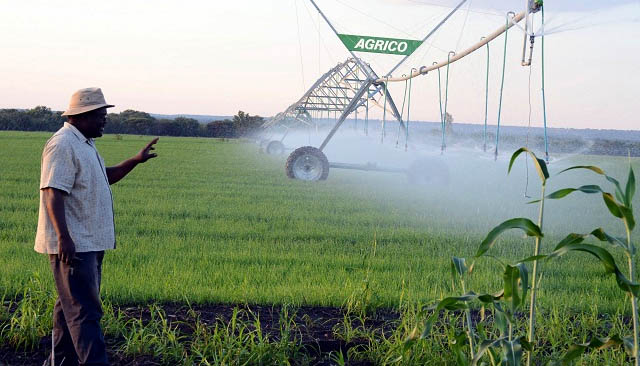
Patience Maturure
Agriculture Reporter
Mazowe may contribute the largest tonnage of winter wheat to the national production this season after the district put a total of 16 000 hectares under the grain crop.
Lands, Agriculture, Fisheries, Water and Rural Development permanent secretary Professor Obert Jiri revealed this during a media tour at Nyombwe Farm in Mazowe yesterday.
“Mazowe is commanding over 16 000 hectares of wheat, which is the highest across all the districts in the country and Zvimba is the second wheat producer.
“So we are really appreciative of what the farmers did in hitting the goal for us to become wheat self-sufficient in this country,” he said.
The Government is seeking opportunities to access regional markets, driven by a surplus in wheat production.
Enquiries have already been received from Mozambique and Rwanda.
“With the next harvest coming in three months’ time, we know that we have another surplus, you know, wheat in our storage facilities.
“We can now think of exporting the wheat. Even before the drought, we had inquiries, particularly from Mozambique and Rwanda, who really wanted our wheat,” he said.
Prof Jiri said wheat farmers exceeded expectations, surpassing the 120 000-hectare target that was set in March, with over 122 142 hectares currently accounted for.
“We are still looking at some improvement in terms of accounting for all the acreage. We should see an upswing in terms of that, but we are really thankful to our farmers who surpassed the target that we had set in March.
“As we do our wheat monitoring visits, the Mazowe district tops in terms of the area they have planted,” he said.
Prof Jiri said farmers were now concentrating on the application of top dressing, with most of the wheat planted in May now transitioning from late vegetative growth to the early stages of reproduction.
“We are now continuing to monitor the wheat and ensure that we achieve the next target, which is the wheat yields that we are chasing now. Our target is to surpass 600 000 tonnes, which is very achievable.
“We have the bulk of our wheat planted within the window period of May 1 to 31, and so we expect that crop to give us over 5,5 tonnes per hectare, which is our target in terms of yield to more than 600 000 tonnes,” he said.
Prof Jiri said about 24 percent of the wheat crop was planted in June.
He said information coming from the farmers indicated that “we can compensate for the late planting by applying fertiliser”.
“We are assured that even the late-planted crop will be able to give us a good yield. Of course, the late-planted crop will need to be adjusted, particularly in terms of the irrigation measures,” he said.
Prof Jiri said last year, wheat reserves supported the nation’s food needs, distributing a significant portion to those in need through the social welfare programme.
Ministry of Defence permanent secretary, Mr Aaron Nhepera, who owns Nyombwe Farm in Mazowe and planted 60 hectares of winter wheat, expressed gratitude for the support farmers received from the Government.
“Last season, we achieved 5 tonnes per hectare, but with the good agronomic practices we are learning from extension officers, we expect to hit 7 tonnes,” he said.
“We thank the Government for the Land Reform, the inputs-support scheme, and access to knowledge, which have enabled us to succeed. Currently, I am gradually weaning myself off the schemes to make way for new entrants,” he said.