admin
admin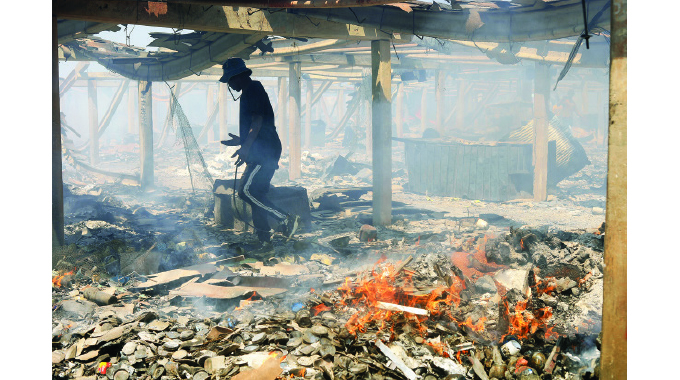
Innocent Mujeri-Herald Correspondent
The devastating inferno that recently swept through Mbare Musika, leaving traders and vendors with nothing but ash and rubble, has reignited conversations about the need for comprehensive solutions to protect this crucial marketplace.
As the economic backbone for many Zimbabweans, Mbare Musika represents more than just a trading hub — it is a lifeline for families and communities.
The losses sustained in this fire go beyond the immediate destruction of goods; they also symbolise the fragility of informal trade systems in the face of disaster.
It is imperative that stakeholders, including Government, city council, and traders, take proactive steps to prevent such incidents in the future.
The causes of the fire are still under investigation, but the damage done is clear.
Hundreds of traders lost their stock, their livelihoods disrupted overnight.
The inferno not only raises concerns about fire safety in public spaces, but also highlights the lack of disaster preparedness among traders.
Given the significance of Mbare Musika in Zimbabwe’s economy, this disaster should serve as a wake-up call for all stakeholders to reconsider the way markets like these are managed and how traders can protect their investments.
One of the most practical and effective ways to prevent financial ruin in the aftermath of such disasters is through insurance.
Unfortunately, many traders at Mbare Musika and other informal markets do not insure their goods.
This is partly due to a lack of knowledge about insurance options, but also because of the perception that insurance is expensive and inaccessible to small-scale traders. However, with the right education and policies in place, traders can be encouraged to see insurance as a necessary safeguard against unforeseen disasters like fires.
Micro-insurance policies tailored specifically for small-scale traders could provide a viable solution.
These policies would offer affordable coverage, allowing traders to protect their goods and investments from fire, theft, and other risks.
Insurance companies, in collaboration with Government and local councils, should launch awareness campaigns targeting informal traders, educating them on the importance of insuring their goods and how they can access affordable coverage.
Micro-finance institutions and insurance providers could also create packages that include both financing options and insurance, making it easier for traders to purchase stock with built-in protection.
Additionally, Government could offer subsidies or tax incentives to insurance companies that provide coverage to informal traders.
This would not only lower the cost of insurance but also encourage more traders to sign up for these schemes.
By insuring their wares, traders would have a safety net, allowing them to rebuild their businesses quickly after disasters without relying solely on external aid or starting from scratch.
Lack of proper infrastructure at Mbare Musika has long been a concern.
Many of the market’s selling bays are made from highly flammable materials, which only exacerbated the situation during the fire.
To prevent future incidents, the Harare City Council should prioritise constructing safer, more durable selling bays that are resistant to fire and other hazards.
Modernising Mbare Musika should include constructing fire-resistant market stalls, installing fire hydrants at strategic locations, and providing wider paths between stalls to allow easier access for emergency vehicles in case of future fires.
The council could also introduce a tiered structure where vendors could pay a small monthly fee to contribute to the maintenance of these facilities, ensuring that the infrastructure is continuously upgraded and well-maintained.
The city council must also enforce building codes and regulations in informal markets like Mbare Musika to ensure that temporary structures are not only safe but also designed to minimise the spread of fire.
The use of non-flammable materials and adherence to fire safety standards must be prioritised.
In doing so, authorities can ensure that the market is better prepared to handle disasters while minimising the loss of property and life.
While building safer structures is essential, it is equally important to raise fire safety awareness among traders.
Basic fire safety knowledge, such as how to use fire extinguishers, identify fire hazards, and safely store flammable materials, can go a long way in preventing fires from escalating.
Regular fire safety drills should be conducted in large markets like Mbare Musika to ensure that both traders and customers know what to do in case of an emergency.
The Harare Fire Brigade, in collaboration with local authorities, can play a pivotal role in providing training on fire prevention, first aid, and how to respond during a fire outbreak. Additionally, fire alarms and sprinkler systems should be installed where possible, providing early warning in the event of a fire.
The involvement of local communities in fire safety initiatives is also crucial.
Traders’ associations, market committees, and neighbourhood groups should take the lead in organising fire safety workshops and advocating for the installation of essential fire-fighting equipment.
By making fire safety a communal responsibility, markets can become safer spaces for everyone.
Another contributing factor to the Mbare Musika fire could have been poor security and lack of surveillance, which may have allowed potential arsonists to start the fire unnoticed.
To address this, market authorities should enhance security measures in and around the marketplace. This can include installing CCTV cameras to monitor activities in the market, particularly after hours when the risk of break-ins and arson is higher.
Having security patrols during both day and night can also help deter criminal activities that may lead to fires or other types of disasters.
Additionally, assigning a dedicated security force to monitor the market’s perimeters can reduce incidents of illegal activities and give traders peace of mind knowing that their goods are being watched.
Preventing future fires at Mbare Musika requires a multi-faceted approach that involves collaboration between Government, city council, traders, and other stakeholders. Traders should be empowered to take control of their safety, whether through insurance, fire safety awareness, or participating in market improvement initiatives. However, the burden should not rest solely on the traders.
Local authorities have an obligation to ensure that marketplaces are well-structured, equipped with proper fire safety measures, and protected from hazards.
The Harare City Council should work closely with the Ministry of Local Government, the private sector, and international development agencies to secure funding and technical expertise for the modernisation of Mbare Musika.
Public-private partnerships could be an effective model for ensuring that the necessary investments are made to safeguard the market and the people who depend on it.
The recent fire at Mbare Musika is a tragedy that underscores the vulnerability of informal markets in Zimbabwe. It is however, an opportunity for reflection and change.
By encouraging traders to insure their goods, improving the market’s infrastructure, raising fire safety awareness, enhancing security, and fostering collaboration among all stakeholders, Zimbabwe can prevent similar disasters in the future.
The goal should not only be to rebuild Mbare Musika but to make it a safer, more resilient marketplace that protects both traders and customers from the risks of fire and other disasters.
As one of the country’s most important economic hubs, Mbare Musika deserves an investment in safety and sustainability, ensuring that it remains a lifeline for many years to come.


 Online Reporter