Talking Farming Ronald Veremu
THE livestock industry in Zimbabwe continues to face rising feed costs, particularly for protein ingredients used in poultry, pig, fish and dairy feeds.
Traditionally, protein sources such as soya-bean meal, fishmeal, blood meal and sunflower cake have been used in commercial feed formulations. However, increasing demand, climate-related production challenges and import dependence have made these feed ingredients increasingly expensive.
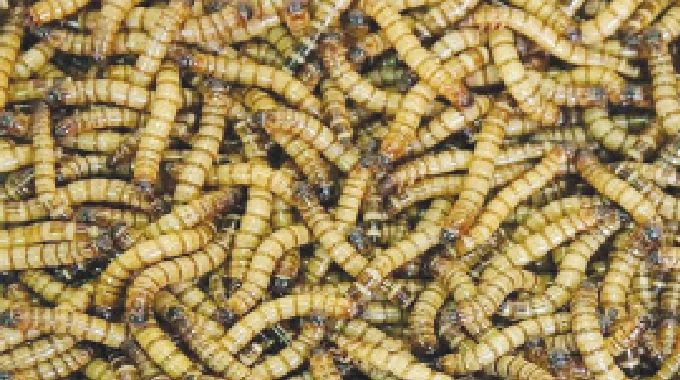
As a result, researchers and feed manufacturers are exploring alternative protein sources that are affordable, sustainable and locally available. One of the most promising innovations is the use of mealworms as a livestock feed ingredient.
A mealworm is the larval stage of the insect Tenebrio molitor, commonly known as the yellow mealworm. Although often referred to as a worm, it is actually the immature stage of a beetle. Mealworms have been commercially produced in North America and Europe for decades and are
increasingly gaining attention worldwide as a sustainable source of protein for both human food and livestock feed.
Researchers have identified mealworms as an efficient converter of low-value feed materials into high-quality protein.
The larval stage is the most valuable stage for livestock feeding. At this stage, mealworms contain high levels of protein, energy and essential amino acids required for animal growth and production.
The larvae can be fed fresh but they are more commonly dried and ground into mealworm meal before being incorporated into commercial feed formulations.
Mealworm meal is usually mixed with other feed ingredients during feed manufacture. It can be used in poultry, fish, pig and other livestock feeds as a partial replacement for conventional protein sources. In small-scale production systems, dried mealworms can also be offered directly to poultry as a protein-rich supplement.
However, the greatest commercial potential lies in incorporating mealworm meal into balanced livestock rations formulated by feed manufacturers.
The primary value of mealworms lies in their use as a protein ingredient in feed formulation.
Research has shown that mealworm meal can successfully replace conventional animal protein sources in poultry diets without negatively affecting bird performance.
Researchers at Matopos Research Institute evaluated mealworm larvae meal in broiler diets and found that it could replace blood meal at high inclusion levels without reducing growth performance or carcass yield.
This opens opportunities for feed manufacturers to formulate poultry and livestock feeds using locally produced insect protein rather than relying entirely on conventional protein ingredients.
Zimbabwe has struggled to meet its national demand for soybeans, resulting in periodic imports from neighbouring countries. Researchers have therefore been investigating mealworms as a sustainable alternative protein source capable of reducing dependence on imported feed ingredients.
While mealworm meal may not completely replace soya-bean meal in all feed formulations, it can significantly reduce reliance on expensive imported protein sources such as fishmeal, blood meal and soybean products. For livestock producers, lower feed costs translate into improved profitability and greater competitiveness.
Protein ingredients constitute a significant component of feed manufacturing costs. Increased local
production of mealworms could help Zimbabwe reduce imports of certain feed proteins while
strengthening local feed supply chains. The development of insect-based feeds also aligns with
national efforts to promote climate-smart agriculture, import substitution and value addition
within the agricultural sector.
Researchers have highlighted mealworms as a practical alternative protein source that can
contribute to feed security and livestock productivity.
Zimbabwe is already making significant progress in this field. Scientists at Matopos Research
Institute have been conducting advanced research on mealworm production and utilization in livestock feeds. The institute has successfully developed and registered mealworm-based starter,
grower and finisher diets for poultry. Research has demonstrated that mealworm protein can be
used effectively in broiler feed formulations, providing a viable alternative to conventional protein
ingredients. This work places Zimbabwe among the leading African countries exploring insect-
based livestock feeds.
Mealworms offer several advantages for Zimbabwean farmers and feed manufacturers which
include high protein content and good amino acid profile, efficient feed conversion and rapid
growth, low land and water requirements compared to conventional protein production, ability to
utilize agricultural by-products and crop residues, potential to reduce feed production costs and
reduced dependence on imported protein ingredients.
One particularly attractive feature is that mealworms can be reared using relatively inexpensive
feed materials such as maize bran and wheat bran. Research has also shown excellent growth and
survival when mealworms are fed wheat bran-based diets.
As Zimbabwe’s livestock sector seeks affordable and sustainable feed solutions, mealworms present
an exciting opportunity. Continued research, commercial production and private-sector investment could help transform insect protein from a niche innovation into a mainstream feed ingredient.
With feed costs remaining the largest expense in livestock production, mealworms may soon become an important component of Zimbabwe’s strategy to improve livestock productivity, reduce import dependence and strengthen national feed security.
n Ronald Veremu is an independent livestock and agriculture development specialist. He writes in his own capacity.
Feedback: [email protected] Cell: +263 772 898 722