daniel chigunwe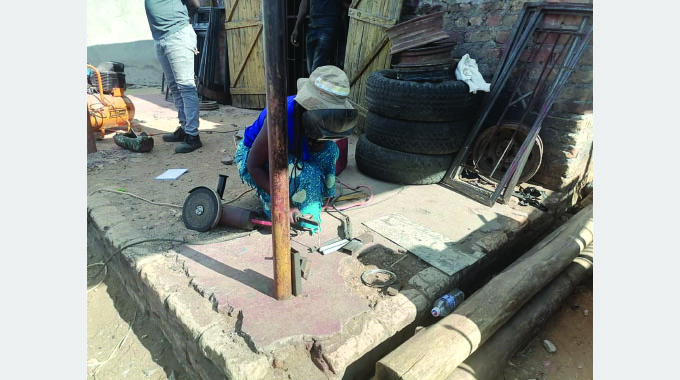
Lynn Munjanja recently in Mudzi
Clad in a blue vest, khaki hat and blue wrapping cloth, popularly known as “zambia”, Julianna Nhire, from the Mudzi District of Mashonaland East Province, exudes confidence as she stands next to a welding machine, the tool of her trade.
Julianna opened up to The Herald last week in Mudzi where she had just finished demonstrating how she operates to members from the Zimbabwe Resilience Building Fund (ZRBF).
Looking at her, one gets the impression of a woman who has broken through the proverbial glass ceiling to reach her dreams, through iron and steel. In spite of her femininity, as indeed her apparel informs, she wields power over the menfolk around her, debunking the notion that macho means masculinity.
Endearingly known to everyone at Nyamande Business Centre (Ward 15), where she operates from, and its vicinity, simply as Julianna, the 36-year-old married mother of two embodies resilience, determination and strength as she welds pieces of iron, zinc and steel, among other metals, into tailor-made fabrications.
She is under the Donebest Youth Enterprise, comprising nine members, and she is the only woman. Donebest was established in 2018 with support under the ZRBF-BRACT (Building Resilience through Improving the Absorptive and Adaptive Capacity for Transformation of Risk Communities in Mudzi District.)
Making a mark in a trade considered a male domain, she deserves the moniker, Lady of Steel; metaphorically and literally, for clothing is only a gender issue. Among her products are scotch carts, wheelbarrows, rakes, ploughshares and other plough components, braai stands, and many others.
Julianna is one of those strong women who have gone beyond societal perceptions to create a niche for themselves in their chosen terrains.
To such women marriage is not a barrier even, as society would rather have it appear.
“Society has a way of allocating roles based on gender, outlining trades considered ideal for women, and those into which they cannot venture because of their perceived dangers,” she says.
Owing to societal demarcations regarding occupations, men get jobs that are considered to be highly skilled, while women are relegated to less accomplished manual trades. Cultural traditions also play into the division of work along gender lines.
For instance, most men would rather not work in the catering sector as they may have been socialised to believe that cooking is suitable for women. While the majority of women shun welding considering it a male territory, Julianna ventured into the field due to the hardships she was facing at home.
The Lady of Steel believes that women are capable of doing anything as long as they put their minds and hearts into it.
“Women empowerment is important, since nowadays it is all about putting bread on the table. With determination nothing is impossible. If I can do it, then it means any other woman out there can do it,” Julianna says.
Juliana’s day begins at 4am, with womanly and motherhood chores that include preparing her children for school; and it ends at 6pm.
However, all has not always been smooth sailing for her in her work because of gender stereotyping.
“Sometimes my male workmates try to give me special treatment since I am a woman,” she says. They believe that I may be affected by the hard labour.”
She says she is now being given an equal amount of work because she has proven that she is equal to the task.
However, her family has remained a pillar of support to her. Her husband and children appreciate her work which is yielding a decent income, hence, bettering the family’s quality of life.
“My husband is appreciative of my work, because I am now able to help him fend for our family” she reveals. “Initially, these projects were introduced to us by the Zimbabwe Resilience Building Fund as a way of empowering communities, so that people are able to fend for themselves. I decided to join the training, and my life has since been transformed. I am very grateful for that.”
Julianna reveals that before she ventured into welding life was tough for her family.
“My children were always chased away from school because of school fees arrears,” she says.
“At one point I almost gave up because I had no money. My husband was not getting enough money to take care of all our needs. He couldn’t give me any spending money. As a result, we were always fighting, and our marriage was falling apart.”
Julianna says that is how she also discovered the importance of money in marriage because it makes life easier.
“Now that I am working, everything is okay. I earn between about US$80 and US$100 monthly. We have teamed up now and built a house. We also bought some livestock,” she says beamingly.
Passmore Kadiki, a workmate, praises Julianna, saying she is a hard-working woman who does not let anything get in her way.
“I have worked with Julianna for about six months now, and I have never heard her complain,” he says.
“She is a hard worker who has defied all odds. Her story is inspiring, and I wish many other women could do the same.”
Another colleague, Joseph Masakasa, says working with Julianna is quite enjoyable because she performs her duties well without giving them any problems.
“Julianna is exceptional and responsible. She performs her duties to perfection,” Masakasa says.
Memory Masukume, an elderly woman from the Mudzi community, says the Lady of Steel has been an inspiration to the community because most women are now embracing the fact that there are no jobs specifically meant for men.
“Women around here are now coming out of their cocoons after hearing of Julianna’s story,” she says.
“I am proud of her because that is the spirit of womanhood among us.”
Masukume says in the first days, as a community, they were shocked to see Julianna welding door frames as it is considered a male trade, but they are now used to it.
Pamela Maphosa, a close friend, says she is proud of the woman that Julianna has become.
“My friend has made me proud because right now all eyes are on her,” Pamela says.
“She used to face challenges with sending her children to school since her husband’s salary couldn’t meet the family’s requirements.
“Now her family is well-catered for. I’m really happy for her. She is an inspiration to us all.”
Councillor Jasper Masango from Charewa Village says the project has been beneficial to the community as it is helping to fight the dependency syndrome.
“We used to lack knowledge, but our community can now fend for itself after we got training,” says Cllr Masango.
“Projects have also been beneficial. In this case, people no longer have to travel long distances to the city, so that they can buy window frames and burglar bars.”
Donebest Youth Enterprise, of which Julianna is a member, testifies among the youths that resilience is much about thinking differently and adapting to challenging situations.
“The nine-member group believes that tangible results are attainable through unity of purpose.
The BRACT programme aims to ensure that households and communities’ livelihoods are able to withstand existing and future shocks and stresses and achieve well-being outcomes.
The consortium consists of five technical partners namely: Christian Aid (Consortium Lead); Bio-Innovation Zimbabwe (BIZ); Community Technology Development Organisation (CTDO); Nyahunure Community Trust (NCT) and Silveira House (SH).
The BRACT project was designed to improve the Absorptive, Adaptive and Transformative resilience capacities for 17 035 households (8 058 in Mutoko and 8 977 in Mudzi), who are currently participating in the project.
This translates to about 69 636 individuals benefiting from the programme.
Targeted households are those that exhibited high poverty levels at the same time being vulnerable to drought. At least 37 percent of the participating households are female-headed.



 Online Reporter