Online Reporter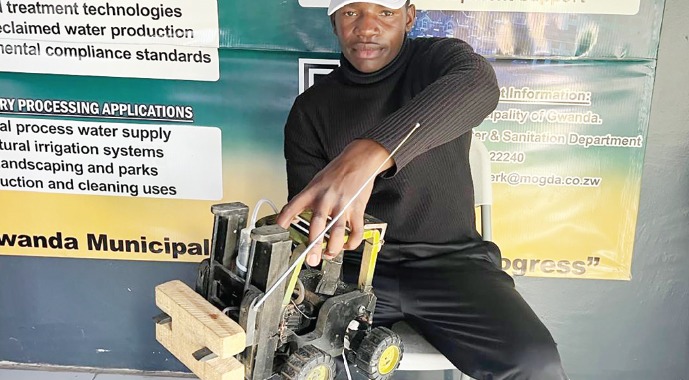
Sukulwenkosi Dube-Matutu, [email protected]
ACROSS Zimbabwe, a new generation of young people is proving that some of the country’s biggest challenges can be solved with local ideas, local talent and local resources.
From solar-powered systems designed to keep the lights on during power cuts to innovative machinery aimed at reducing labour costs, young innovators are embracing science, technology and innovation as tools for transforming communities and creating opportunities. In Matabeleland South, this spirit of invention was on full display at the recently concluded 68th Matabeleland South Agricultural Show, where learners and students showcased solutions they believe can help drive the country’s future.
Their projects reflected a growing national shift towards innovation, entrepreneurship and industrialisation, as Zimbabwe works to build a knowledge-based economy under Vision 2030.
For years, many young Zimbabweans have been encouraged to pursue employment after completing their studies. However, a new mindset is emerging, one that challenges young people to become creators, manufacturers and problem-solvers rather than job seekers alone.
This approach has been reinforced by Government policies that promote science, technology and innovation as key drivers of economic growth. The transition from the traditional Education 3.0 model to Education 5.0 has placed greater emphasis on innovation and industrialisation, encouraging schools, colleges and universities to develop practical solutions that can be commercialised.
Innovation hubs established at universities across the country are helping students turn ideas into products, while continued investment in science laboratories, computer facilities and teacher training is exposing more learners to scientific and technological subjects from an early age.
The impact of these efforts is increasingly becoming visible.
At this year’s Matabeleland South Agricultural Show, held from August 20 to 22 under the theme “Unlocking New Opportunities through Collaboration”, young exhibitors demonstrated how innovation can tackle everyday challenges faced by ordinary Zimbabweans.
Among the standout innovators was 17-year-old Ayanda Sibindi, a Form Four pupil at Gwanda High School.
Motivated by the hard work involved in moving heavy goods, Ayanda developed a model wooden forklift powered by hydraulic energy and a lithium battery. His invention was designed to provide a cheaper, more environmentally friendly alternative to conventional machinery.
Explaining how the model works, Ayanda said: “I invented a wooden forklift which uses hydraulic power to function. My invention has syringes which act as hydraulic pistons and a 20-volt lithium battery to power the wiper motor. To control the lifting process, I’m using a syringe.”
Though still a prototype, the project demonstrates how young minds are applying scientific principles to solve practical problems.
Ayanda believes the concept has significant potential if given the necessary support and investment.
“This invention is crucial in our day-to-day activities, and I would like to see it develop from being just a model to a real forklift that can carry heavy loads.”
To turn the model into a full-scale machine, he says he requires materials such as stainless steel, eight 12-volt lithium batteries and 16 wiper motors. He hopes an investor will eventually help bring the project to life.
The young innovator also believes Zimbabwe can use its own natural resources to develop sustainable energy solutions.
“Fuel energy is now expensive, unlike water, which is a natural resource. We mine lithium as a country, and we can use it to produce our batteries,” he said.
A short distance away, another innovation was attracting attention from visitors.
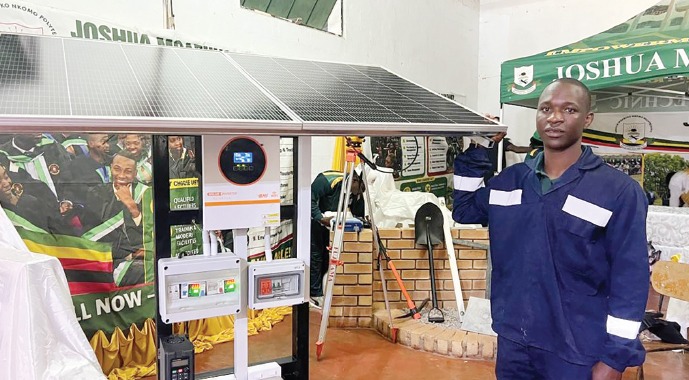
Learners and lecturers from Joshua Mqabuko Nkomo Polytechnic displayed a portable 3.2 KVA solar-powered system designed to provide reliable electricity in areas without access to the national grid.
The system uses a 25-volt battery that stores solar energy during the day, allowing users to power appliances after sunset. While the exhibition model utilised 150-watt solar panels, the final version can be equipped with more powerful 550-watt panels. It also includes a 3.2 KVA inverter and safety protection devices.
For communities, small businesses and event organisers who often depend on costly diesel generators, the innovation offers a cleaner and potentially cheaper alternative.
Electrical Power Engineering student Mr Nigel Machacha said portability was one of the system’s biggest advantages.
“This is just like any normal solar system which you can have at home, but the difference is that it can be transported to any location. It can support a PA system of any size, lighting system, refrigerators, among other appliances,” he said.
Beyond domestic and business use, the system could also play an important role in agriculture, particularly during periods of drought when farmers need reliable power to pump water.
Mr Machacha said the technology could help improve productivity while reducing dependence on expensive fuel-powered equipment.
The innovations showcased at the agricultural show demonstrated that solutions to many of Zimbabwe’s challenges may already be emerging from classrooms, workshops and laboratories.
Matabeleland South Agricultural Show Society president Ms Sheron Dewa said it was encouraging to see young people using such platforms to showcase their creativity and entrepreneurial potential.
“The theme for this year was ‘Unlocking New Opportunities through Collaboration,’ and we want to see young people leveraging opportunities to unlock sustainable markets and establish partnerships to facilitate growth and expansion of their businesses,” she said.
She noted that innovation has the power to create jobs, improve livelihoods and stimulate economic growth, particularly when young people receive the support needed to develop their ideas.
“If we empower the youth, then they can significantly contribute to the country’s development agenda.”
Government is seeking to strengthen that contribution through initiatives such as the National Youth Empowerment Strategy 2026-2030, which encourages young people to establish businesses and manufacture products rather than rely solely on formal employment.
At the same time, the Zimbabwe Digital Skills Development Programme aims to equip 1.5 million young people with skills in programming, data science and application development, helping prepare them for opportunities in an increasingly digital economy.
For innovators such as Ayanda and Nigel, the agricultural show was about much more than displaying projects.
It was an opportunity to prove that young Zimbabweans have the ideas, determination and creativity needed to solve real-world problems.
Their inventions may still be in the early stages, but they offer a glimpse of a future where local innovation drives economic growth, strengthens communities and creates opportunities for generations to come.
In Matabeleland South and beyond, that future is already beginning to take shape, one bright idea at a time.