Chronicle Editor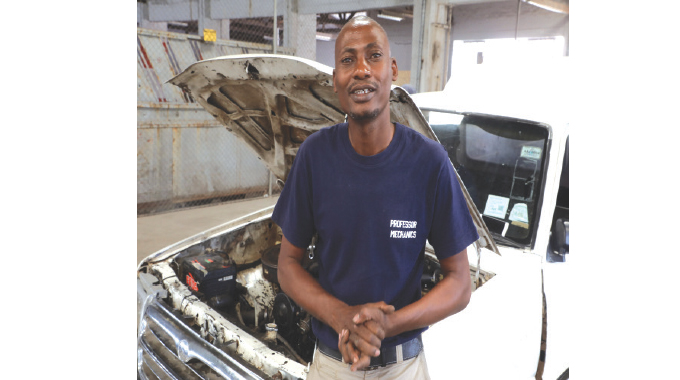
Bongani Ndlovu, Chronicle Reporter
IN October 2020, Mr Professor Wedzerai Dube decided that it was time to formalise his business Professor Mechanics because he wanted to grow his company that specialises in diesel and petrol engine repairs, maintenance and tune-ups.
Indeed, it was not the business located in the country’s former industrial hub of Belmont in Bulawayo that was going to grow, but his resilience.
Like many mechanics, when he left Bulawayo Polytechnic in 2004 after a four-year course in motor mechanics, he did odd jobs on the side, while gaining experience at his formal employers.
Motor mechanics is a skills-based course that teaches one to be self-sufficient and not to rely on formal employment for too long, and that’s what drove Mr Dube to start his own venture.
Mr Dube, who had a nomadic life in the frontline years, was born 40 years ago in Mberengwa in the Midlands Province and did his primary schooling at Mpandashango Primary School in the same district.
He went to three schools for his secondary education; Gwanda High, Chrome Secondary in Shurugwi and Musume High in Mberengwa.
After completing his O-levels, he enrolled for a motor mechanics course at Bulawayo Polytechnic College in 2001.
After successfully completing the course, he worked for a number of established companies that include Puzey and Payne Zimbabwe, Nissan Clover Leaf Zimbabwe, Automaton Technology Zimbabwe and Magwegwe Motors in Bulawayo.
After gaining enough experience, he decided to go it alone and set up his own mechanic business in 2012.
He worked alone using contacts and relations he had built while still in formal employment to build a customer base.
Soon business was booming for Professor Mechanics and he could no longer cope on his own and so he hired some newly-qualified mechanics.
Today Professor Mechanics has a staff complement of six mechanics, one of whom is a woman.
In 2020, Mr Dube felt it was time to grow his company by formally registering to compete for bigger contracts to fix and maintain engines from Government and non-governmental organisations (NGOs), which only deal with registered companies.
“We thought of growing bigger so that we reach other organisations in the formal sector such as the Government system so that we can work on their vehicles and NGOs. All these need proper documents, no matter how good you are, they need registration documents so that they can do business with you,” said Mr Dube
He said although his plan was well thought-out, as a business he had no idea how the Covid-19 pandemic was going to affect the company.
“It was a major blow because we had a major setback for our company. We were forced to close shop at a time some customers had a chance during the Covid-19 lockdowns for them to bring their cars for service. But then because of the regulations, we were not allowed to work and this greatly affected our business,” said Mr Dube.
He said he was forced to retrench some mechanics due to poor cash inflows and that skills flight left a gap at Professor Mechanics.
“We remained afloat, but it was a big challenge. We had to retrench some workers and that was a setback as far as skills are concerned. Ours is a labour-based company, so in such a scenario when you retrench senior workers, you will be compromising on your skills and quality output.”
Mr Dube said as an emerging small to medium enterprise, their major challenge is equipment, as they believe that they have the right skills to fix engines.
“We do not have enough equipment, like rams and big jacks to lift cars. At one point towards the end of last year, there was a break-in at our premises and thieves stole some of our tools,” he said.
He appealed to Government to assist them acquire heavy duty equipment to complement the skills set they have already assembled as a business.
He recalled a time he was flown to South Africa to attend to an engine following recommendation from a client he had previously assisted.
“In 2016 I was called to attend to an engine in Pretoria for a Toyota Noah Vox. I was flown there after some mechanics there failed to fix the engine. They had fancy equipment, but could not diagnose the problem. I fixed the engine and until today, that engine is still running,” said Mr Dube.
Running such a business has been challenging, but it is all mechanics’ wish to be self-sufficient.
Mr Dube said as mechanics, they were taught to be self-sufficient and when he started working in 2005, he saw that a salary was not enough and had to do something on the side using his skill.
“Some of us tradesmen realise that the remuneration that you get from a company is not a living wage. You are also trying to develop the skills that you would have learnt at school as we are trained to start our own businesses and employ people,” said Mr Dube.
Looking into the future, Mr Dube wants to build an empire and draws inspiration from Old Mutual.
“We want to emulate Old Mutual, the insurance company,” he said.
“We want to leave a legacy, an inheritance for our families and workers. We don’t know the owner of Old Mutual.
Maybe the person who started it is now deceased, but the organisation is still running and that’s our aim. We want to grow big.”
He is working on opening a branch in Gwanda.
He lamented the high rentals building owners charge and appealed to the Government to assist SMEs with affordable workshop space that doesn’t eat too much into their bottom line.
As a parting shot, Mr Dube advised drivers not to damage their engines by following some simple basic rules before they drive off.
“The major cause of engine damage is the driver’s negligence or having no clue about the car they are driving. When you are driving, the oil light can illuminate on the dashboard, meaning there could be starvation of oil in the lubrication system in the engine. This may cause the engine to knock.
When driving without water in the radiator, you can starve the cooling system then the car overheats and causes it to cease, which is called engine seizure. There is also what we call engine detonation caused by oil leaks in the engine,” said Mr Dube.
“Lastly, there is formulation of sludge caused by the use of different oils. You need to know what type of oil to put in your engine. Check tyre pressure, check battery terminals if they are connected properly if the positive terminal is loose it can touch anywhere on the car while on and cause a fire.
“Put the key on to see if the temperature light and oil light go on. Check that the electrical system is working, check the water and oil levels and if those are okay then start your car. When the engine light is on then visit your mechanic.”
— Follow on Twitter @bonganinkunzi



 Online Reporter