Online Reporter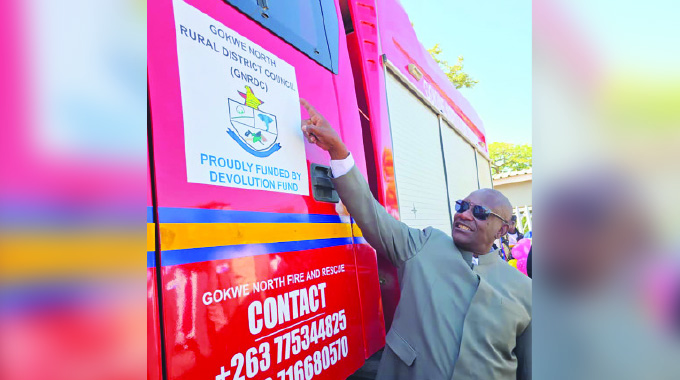
Patrick Chitumba
NINE rural local authorities in the Midlands Province have received fire tenders under a government initiative aimed at strengthening emergency response capabilities, thanks to a partnership between Zimbabwe and Belarus.
The state-of-the-art fire-fighting equipment was procured through the Second Republic’s engagement and re-engagement policy, spearheaded by President Mnangagwa. This development comes amid a rise in fire-related incidents across the country, prompting the Government to prioritise civil protection and disaster preparedness in rural areas.
To date, Chirumhanzu, Vungu, Tongogara, Zibagwe, Runde, Mberengwa, and Gokwe North Rural District Councils (RDCs) are among the beneficiaries, with their fire tenders already commissioned and operational.
Commissioning the latest tender for Gokwe North Rural District Council recently, Minister of State for Provincial Affairs and Devolution, Owen Ncube, described the gesture as a milestone in rural infrastructure development and disaster response.
“This development attests to the tangible impact of the New Dispensation’s bold and strategic policy decisions as we march towards the attainment of an upper-middle-income society ahead of 2030,” he said.
Minister Ncube highlighted that the provision of fire tenders is part of a broader strategy to build resilient communities, in line with United Nations Sustainable Development Goal 11, which focuses on sustainable, safe, and inclusive cities and communities.
“Furthermore, this showcases the New Dispensation’s people-centred development thrust of improving livelihoods through strengthened civil protection, which aligns with the United Nations Sustainable Development Goal 11,” he said.
For the first time in the country’s history, Minister Ncube noted, all RDCs are receiving fire tenders — demonstrating that the mantra of “leaving no one and no place behind” is being fully implemented.
The minister praised the developmental momentum in Gokwe North, where several high-impact projects have been rolled out using devolution funds. These include the construction of Nyamazengwe Clinic, the Semuchembo Piped Water Scheme, Nyamuroro Primary and Secondary Schools, staff housing at Madzivazvido and Masosoni Clinics, and a council guest lodge.
He also commended the procurement of essential service delivery equipment such as a drilling rig, grader, tipper truck, backhoe loader, and tractors.
“Such achievements have only been possible through the implementation of devolution programmes, which continue to empower local authorities to address grassroots needs,” said Minister Ncube.
Education infrastructure has also been enhanced in the district, with the development of model schools like Budiriro Primary — already commissioned — as well as Nenyunga, Chirisa, and Kushinga Primary Schools, constructed by ADRA in partnership with the RDC.
Further aligning with Vision 2030 and the Heritage-based Education 5.0 model, Gokwe North is benefitting from projects promoting the production of goods and services, innovation hubs, and rural industrialisation. The district is also reaping the rewards of Rural Development 8.0 initiatives, including solar-powered boreholes, irrigation schemes, mechanisation, village business units, and input support under the Presidential Inputs Programme.
“The Presidential War Veterans Fund, housing, borehole drilling, and village business units programmes, among others, have also improved livelihoods in the district — all thanks to the implementation of devolution-funded programmes financed by the Second Republic,” said Minister Ncube.
He applauded the political and traditional leadership, the corporate sector, and local stakeholders for their continued support of Government programmes, noting that collective effort is key to sustaining progress.
Despite the challenges posed by illegal sanctions imposed on the country, Minister Ncube said the Second Republic’s open-for-business mantra and inclusive development model are laying the groundwork for sustainable growth and improved livelihoods.