

 Chronicle Editor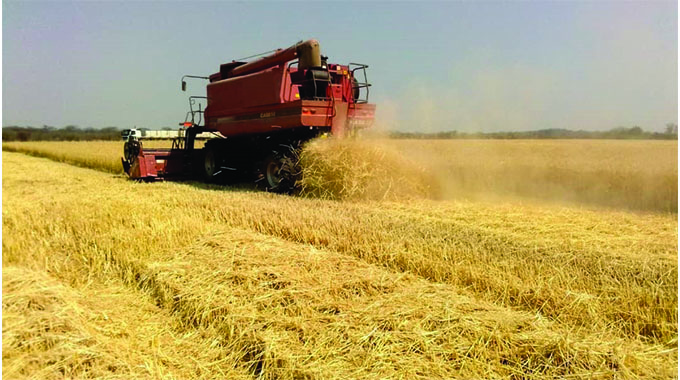
Patrick Chitumba, [email protected]
ABOUT 70 percent of winter wheat crop in the Midlands province has reached the flowering stage while the remainder is at grain filling stage as the province anticipates a bumper harvest this season.
Farmers in the province this year successfully put over 10 000 hectares under winter wheat, an increase from the previous year’s 9 000 ha.
Last year, the province harvested about 36 000 tonnes of wheat. Winter wheat is mainly grown in Sherwood block and farms around the Kwekwe district. There are also some irrigation schemes in Mberengwa, Lower Gweru and Shurugwi which contribute to the provincial target.
One of the leading farmers, Mr Douglas Kwande of Douglas and Claris Kwande (DCK) Investments which own DCK Farm in Kwekwe has put 750 ha under wheat and the crop is now germination stage.
At Sherwood Park Estate in Kwekwe, Mr Daniel Burger has a flourishing crop of 280 ha and is expecting to harvest an average of 9 tonnes per hectare. Last year the farm averaged 8,5 tonnes per hectare.
At Precabe Farm, which is owned by the First Family, over 600ha was put under winter wheat.
Zimbabwe produced 375 000 tonnes of wheat in 2022, against a national demand of 360 000 tonnes and the Government is targeting to increase the production levels to 408 000 tonnes this year.
Last year’s production made Zimbabwe and Ethiopia the only two wheat-secure nations on the continent. Farmers are already responding to the Government’s initiatives as they have ramped up preparations for the farming season.

The bulk of the planting was done under the Government-guaranteed CBZ Agro-Yield programme, while the other hectares were funded by private contractors and through the Presidential Winter Wheat Scheme.
Sherwood Park Estate manager Mr Simbiso Magasa said the crop was doing exceptionally well.
“The winter wheat crop is doing well at the farm because we planted it on time. We are still expecting to harvest an average 9 tonnes per hectare up from last year’s 8,5 tonnes per hectare,” he said.
DCK farm manager Mr Duncan Magaya said the first crop is almost at the maturity stage as it has reached 130 days.
“The first crop planted early is at the drying stage and we should be harvesting soon. Then the second crop planted after we harvested the maize crop is at 100 days and we are anticipating a bumper harvest,” he said.
Seedco sales agronomist, Mr Ronnie Chigombe said the winter wheat crop in the province is generally doing well.
“The winter wheat in most of these farms is doing well and we are anticipating a very good yield,” he said.
Midlands provincial agronomist, Mr Innocent Dzuke, said 70 percent of the crop is at the flowering stage while 30 percent is at the grain filling stage.
“The crop condition is generally good in the province. Quelea birds are being managed and we had a spraying team that sprayed chemicals two weeks ago and the situation is under control,” he said.
Farmers from Gokwe South managed to put 74ha, Mberengwa 442 ha, Shurugwi 108 ha, Gweru 459 ha, Kwekwe 8063 ha, Zvishavane 136 ha and Mvuma 753 ha.
Zimbabwe is optimistic that this year’s winter wheat production will surpass last year’s yield of 375 000 tonnes following various interventions implemented by the Government and the private sector to bolster production.
This season, Government is well prepared to support wheat better than in the previous seasons as it is working closely with important stakeholders such as Zesa and Zimbabwe National Water Authority (Zinwa) to ensure that there is an uninterrupted power supply, and enough water for irrigation during the winter wheat cropping season.
The country is earmarking to produce another record harvest this season and become self-sufficient.
In addition to local initiatives to support production, Zimbabwe received a chunk of the US$25,5 million African Development Bank (AfDB)’s fund to boost wheat and food production and avert potential food shortages.

Government has also increased the targeted wheat hectarage of 85 000 ha to 90 000 ha with the aim of increasing productivity for the 2023 winter wheat cropping.
Equipment such as tractors and combine harvesters has also been acquired and it will be administered through AFC and CBZ banks.
The wheat crop is supported through private contractors, the Government’s National Enhanced Agricultural Productivity Scheme (NEAPS), the Presidential Wheat Support Scheme, and self-financed growers.
CBZ Agro-Yield is targeting at contracting 20 000ha at a projected average yield of 4,8 tonnes per hectare, with the estimated production set at 96 000 tonnes.



 Online Reporter
 derick.khumalo