Online Reporter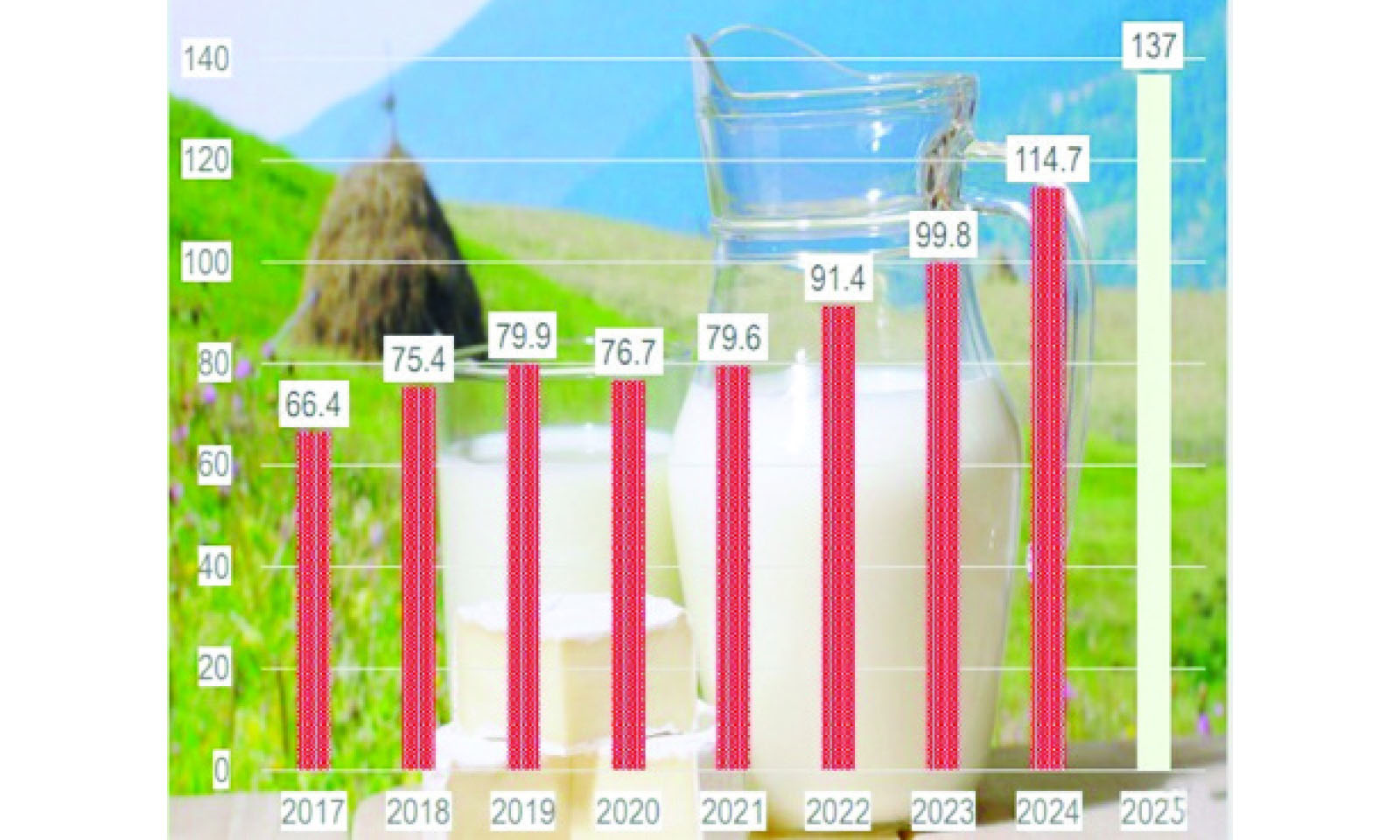
Precious Manomano
Herald Reporter
Milk production is expected to exceed the 115 million litres produced last year as the Government continues to work closely with stakeholders in the industry to meet the national target of 150 million litres.
Currently, Zimbabwe requires 131 million litres of milk to achieve self-sufficiency, and efforts are ongoing to meet this demand. There are ongoing efforts and strategies by the industry to boost milk production and reduce imports.
The latest figures from the Dairy Services Unit (DSU) reveal that milk production has risen from 98 013 780.0 litres during the same period last year to 105 711 720.0 litres this year, indicating an increase of 7 697 940 litres.
This upward trend is further supported by the statistics showing that milk intake by processors also rose significantly, reaching 98 237 620.0 litres compared to 90 453 530.0 litres last year.
Professor Obert Jiri, Permanent Secretary for Lands, Agriculture, Fisheries, Water and Rural Development, said the statistics signified the Government’s thrust for import substitution and growth in the dairy sector.
The increasing milk production can be attributed to several factors, including an upsurge in dairy farming adoption by local farmers and robust support from the Government.
The national herd has also been boosted through the importation of heifers, which accelerates growth from the local breeding stock, enhancing productivity throughout the sector.
Mr Edward Warambwa, National Chairman of the Zimbabwe Association of Dairy Farmers (ZADF), said while they remained optimistic about achieving positive growth in milk output by 2025, they anticipated that this year’s figures may fall slightly short of the projected annual target of 15 per cent.
“Nonetheless, we are confident that, through the collaborative efforts of stakeholders across the dairy industry, we can revitalise the sector and still see meaningful progress. The commitment from the Government, farmers, extension officers, and industry partners gives us hope for continued growth, despite the challenges posed by the delayed rains,” he said.
Mr Warambwa said they expected production to maintain its upward trajectory in the last quarter, driven by the coming rainy season, which will enhance both pasture and water availability.
“We have observed significant improvements in dairy management practices among producers, thanks in part to the nutrition guidelines provided by extensionists throughout the country. These advancements will help ensure not only increased milk output but also improved quality as we move forward.
“The quality and availability of pasture have been affected by the dry conditions. However, with the light showers received recently in some areas around the country, we anticipate an improvement in pasture conditions in the coming weeks.
“Most dairy farmers have managed the feed situation well, as many have stockpiled reserves in the form of hay and silage,” he said.
While some farmers are dependent on concentrates available on the market, Mr Warambwa said these could be costly, posing a threat to the viability of their operations.
“Overall, we believe that with the expected rainfall, both milk output and quality will improve,” he said.
Mr Cloudious Burira, Vice Chairman of the Mashonaland West Region for the Zimbabwe Association of Dairy Farmers (ZADF), expressed optimism regarding the future of milk production.
“High milk production is inevitable following various measures implemented by the Government to boost production,” he said.
He commended the assistance the sector was receiving from the European union to increase production.
“Field officers were all over the regions educating farmers on ways to boost milk production. We were also educated on how to prepare farm feed formula,” he said.
The Government’s commitment to supporting national herd growth is evident through various initiatives, including ensuring access to hybrid semen and vaccines, promoting pasture development, and prioritising power supply to dairy farmers to maintain essential cold chains.
The Presidential silage programme, aimed at targeting 1 500 smallholder dairy farmers, has provided each household with a standard input package for one hectare of silage, significantly enhancing productivity within the dairy sub-sector.
Under the Livestock Recovery Growth Plan, the Government envisions milk production rising to 150 million litres and expanding the dairy herd from 39 980 to 60 000 by 2025.