


 Vusumuzi Dube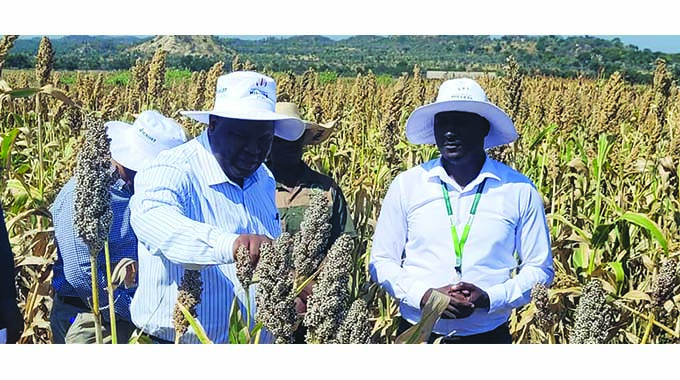
Yoliswa Dube-Moyo
Features Editor
For many rural communities across the country’s low rainfall areas, the cultivation of crops that require a lot of water remains problematic.
Year in, year out, many have failed to realise meaningful harvests due to failed crops as a result of moisture stress.
This has often resulted in a number of food insecure households requiring grain bailout from Government.
Even with persistent failed harvests, some still insist on growing maize and other crops that do not do well in arid and semi-arid regions as they struggle to let go of traditional practices despite the challenges presented by climate change.
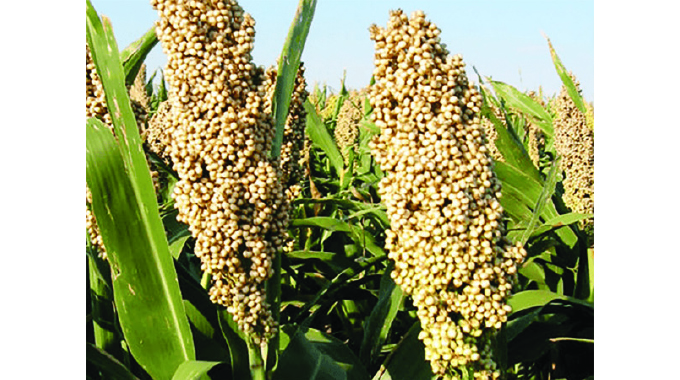
However, it has since been proven that the cultivation of small grains in low rainfall areas is the panacea to addressing food shortages, improving nutritional health, promoting sustainability and creating streams of income.
Many farmers in Matabeleland South and Matabeleland North provinces who have embraced the cultivation of small grains continue to record good harvests.
They realise enough to feed their families and still have surplus for the market.
Within the semi-arid environments of Zimbabwe, millets are becoming the new “maize,” because of their ability to adapt to climate change induced droughts.
This year, the country joins other nations in marking the International Year of Millets, which was endorsed by members of the Food and Agriculture Organisation of the United Nations (FAO) and its governing bodies and declared at the 75th Session of the UN General Assembly (UNGA) in March 2021.
The International Treaty works with farmers and policy-makers around the world to take care of the seeds and other plant material that form the basis of our food from plants.
Through its Benefit-Sharing Fund (BSF), the International Treaty supports vulnerable and marginalised farming communities in developing countries to conserve and sustainably use crop diversity, to ensure food security and adaptation in the face of climate change.
It contributes to farmers safeguarding millets and other crops around the world. It also calls on nations to protect and promote farmers’ rights, and is the first legally-binding international instrument to do so and to explicitly acknowledge the enormous contribution of indigenous communities and smallholder farmers towards the plants that feed the world.
Food and Agriculture Organisation of the United Nations Sub-regional Coordinator for Southern Africa and FAO Representative in Zimbabwe, Eswatini and Lesotho, Dr Patrice Talla said the focus on millets could not be timelier.
“They offer valuable solutions in the face of climate change and the need for nutritious foods. They are climate resilient, nutrition rich, resistant to pests and diseases, and have the ability to grow on arid lands. Millets are, therefore, an ideal solution for countries to increase food security or food self-sufficiency with the potential for everyone to attain better production, better nutrition, a better environment, and a better life,” said Dr Talla.
As such, he said, the International Year of Millets is a global opportunity for us to direct policy attention to the nutritional and health benefits of millets and their suitability for cultivation under adverse and changing climatic conditions, and to deepen our determination to accelerate progress on the Sustainable Development Goals.
“The International Treaty on Plant Genetic Resources for Food and Agriculture of the FAO and, in particular, the International Treaty’s Benefit-Sharing Fund (BSF) supports agricultural programmes in developing countries, including those supporting the diversification of food crops in the face of changing climate, growing populations and the need for nutrition. That includes the (re-) introduction of traditional crops, such as millets, which have valuable benefits for all,” said Dr Talla.
The International Treaty’s BSF provides a bridge between all actors in the agricultural diversity food chain. It brings together farmers, plant breeders, civil society, research institutions and other stakeholders to solve local and global agricultural challenges.
To date, the BSF has supported 80 projects in 67 developing countries around the world, including Malawi, Zambia and Zimbabwe. The BSF functions with major contributions from the European Union, Italy and Norway, among others.
In Zimbabwe, the BSF has made significant contributions to household food security and resilience.
“In marginal and low rainfall regions of Zimbabwe, women farmers are now increasingly relying on millets (such as finger millet, pearl millet and sorghum) to ensure food and nutrition security for their families and for income generation.”
Dr Talla said FAO fully supports Zimbabwe’s sustained promotion of small grains through input support for programmes such as Pfumvudza/Intwasa, and encourages relevant value chain players in the food and agriculture sectors to complement government efforts to consider millets as a strategic crop.
In addition millets offer opportunities for strengthening food security and bolstering economic growth.
Matabeleland South acting provincial agricultural officer Mr Mkhunjulelwa Ndlovu said short season varieties were ideal as they ripen quicker.
He said the short season varieties include sorghum (Marcia and SV4), pale millet (hybrid seeds), maize (300 series), sugar beans and sunflower.
Statistics show that there has been an increase in the number of people suffering from diet-related illnesses such as type II diabetes and hypertension as a result of poor diet. According to research, the quality of carbohydrates people consume contributes to the risk of diet related non-communicable diseases.
Agriculturalists note with concern the practical disappearance of indigenous crop and vegetable varieties. They also say fewer crop species are feeding the world than 50 years ago, raising concerns about the resilience of the global food system. They warn that loss of diversity means more people are dependent on a few key crops, leaving them more exposed to harvest failures. Higher consumption of energy-dense crops could also contribute to a global rise in heart disease and diabetes, they added.
Speaking at the 2023 International Year of Millets field day held at Matopo Research Station last week, Permanent Secretary in the Ministry of Lands, Agriculture, Fisheries, Water and Rural Development, Dr John Basera said millet production is expected to be at 280 966 metric tonnes up from the 100 metric tonnes realised in the 2021/22 season.
“The country saw an increased hectarage for millet this farming season from 523 753 hectares during the 2021/22 season to 533 628 hectares this season. Pearl millet production is expected to be at 71 221mt which is 61 percent more than the 44 143mt produced last farming season. Finger millet production is expected to be 18 610mt, a massive 250 percent from 5 321mt realised last season. The country is expecting total food crops production of 3,2 million tonnes, up from two million tonnes achieved in the 2021/22 season,” said Dr Basera.
He said there must be an improved seed system so that smallholder farmers and the market have the right seeds to positively contribute to the strategic grain reserves in the country.
“The challenge going forward is for us to fully exploit the potential of cereals to address climate change and food security related issues,” said Dr Basera.
He said there is need to climate proof agriculture and one way of doing this is through growing of drought tolerant crops such as millets.
According FAO, the diversity of cultivated crops declined by 75 percent during the 20th century and a third of today’s diversity could disappear by 2050. Agricultural experts say the world’s agro-biodiversity is disappearing at an alarming rate and for several major crops, up to 90 percent losses in variety over the past century have been reported.
“There is a need to promote the consumption and growing of small grains as these are better equipped to thrive under adverse weather conditions and are more suitable for long-term storage.” – @Yolisswa



 Bongani Ndlovu
 Online Reporter