Online Reporter
Tapiwanashe Mangwiro
The ongoing Zimbabwe Agricultural Show yesterday became a platform for a frank discussion on the long-standing conflict between mining and agriculture, with senior Government officials and international partners calling for a new era of cooperation to safeguard food security while driving economic growth.
Deputy Minister of Lands, Agriculture, Fisheries and Rural Development, Davis Marapira, said while mining remains vital to the economy, generating jobs and foreign currency, its destructive impact on land and water bodies cannot be ignored. He urged the sector to adopt strict environmental rehabilitation practices to ensure that agriculture, the backbone of national food security, does not suffer irreparable harm.
“Mining contributes a lot to our society in terms of cash inflows, employment and foreign currency,” said Deputy Minister Marapira.
“But where mining activities take place, there is serious damage left behind, which at times wipes out the benefits we thought we had gained. We must demand that once minerals are extracted, the land is restored to its original condition. That way, we leave a clean environment for the next generation.”
The Deputy Minister lamented the degradation of rivers, dams and natural pools due to haphazard mining methods, warning that the country’s fisheries and irrigation projects were under severe threat.
“It is very difficult today to restock our dams with fish because they are heavily silted. The type of mining taking place has eroded our capacity to sustain aquaculture and water security.
“We want to mine, but mine efficiently and responsibly, in a way that leaves the environment productive for agriculture,” he said.
Agriculture remains the mainstay of Zimbabwe’s rural economy, employing nearly two-thirds of the population and anchoring the nation’s food security and export potential.
However, encroachment by mining operations in fertile regions has increasingly sparked tensions with farming communities, who often bear the brunt of pollution, displacement and reduced yields.
In a show of solidarity, in a speech read on his behalf, the Chinese Ambassador to Zimbabwe, Zhou Ding, assured the gathering that China stands ready to work hand-in-hand with Zimbabwe to ensure mining and agriculture reinforce each other rather than compete.
He said Environmental, Social and Governance (ESG) principles would remain central to China’s investment cooperation with Zimbabwe.
“The question before us is, how do we ensure that mineral resources drive economic growth and deliver lasting well-being for our people, while protecting this beautiful land?” he asked.
“ESG goes beyond corporate responsibility. It is tied directly to sustainable development and the welfare of our people.”
Ambassador Zhou drew inspiration from President Xi Jinping’s guiding philosophy that “Lucid waters and lush mountains are invaluable assets,” saying China had placed ecological civilisation at the core of its development strategy.
“Through massive investments in green energy, land restoration and environmental technology, China has made its skies clearer, its waters cleaner and its mountains greener. The quality of life for our people has improved dramatically, and we want to share those lessons with Zimbabwe,” he said.
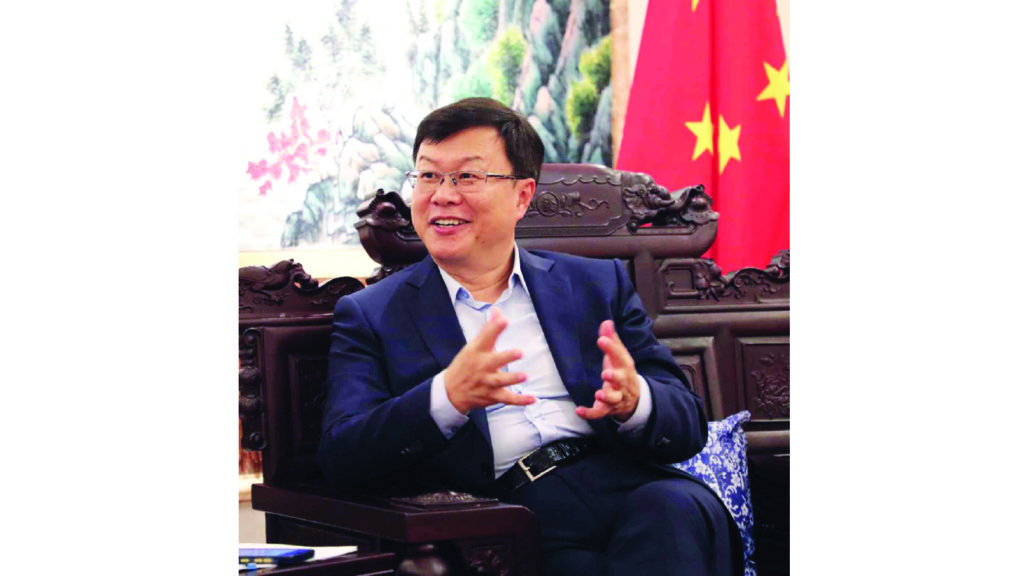
The Ambassador said Chinese mining companies operating in Zimbabwe were already demonstrating a strong commitment to ESG principles, through investments in renewable energy, community facilities and land rehabilitation.
“In every discussion with companies, every site visit and consultation with investors, we insist they abide by Zimbabwe’s laws, respect local culture and actively uphold their social responsibilities,” he said.
“Many of our firms are investing in solar power to cut dependence on fossil fuels and are committing to land rehabilitation rather than leaving behind open pits. Communities in mining areas are also benefiting from schools, clinics and support to farmer associations, ensuring mining leaves a positive and lasting impact.”
He stressed that Chinese firms see Zimbabwe as a “home away from home” and are committed to building stronger bonds through responsible investment and community development.
The Government has repeatedly stated that mining and agriculture should not be seen as competing sectors, but as complementary pillars of Zimbabwe’s economic growth. The Second Republic’s drive towards Vision 2030 places emphasis on sustainable development that uplifts rural communities while ensuring that resource extraction brings lasting national benefits.
Deputy Minister Marapira said inclusive dialogue between miners, farmers and regulators was the only way forward.
“We do not want a situation where agriculture suffers because of mining. We need all parties around the table to find solutions that allow both sectors to thrive,” he said.
Ambassador Zhou added that China–Zimbabwe relations were anchored on trust and shared responsibility.
“Our cooperation in ESG is one of the pillars of our comprehensive strategic partnership. Through continual joint efforts, we will achieve even more fruitful outcomes,” he said.
As Zimbabwe navigates its path towards becoming an upper-middle-income economy by 2030, balancing the short-term foreign currency gains from mining with the long-term stability of agriculture remains critical.
The message from the ESG conference was clear: mining and agriculture must no longer be adversaries, but partners in building a greener, more inclusive and prosperous Zimbabwe.
“Let us work hand-in-hand and deepen cooperation,” Ambassador Zhou concluded. “Together, we can build a sustainable future that truly benefits both our peoples.”