Sikhulekelani Moyo, [email protected]
ZIMBABWE’S mining industry is on course for its best year ever, with mineral exports expected to surpass US$10 billion in 2026 and gold deliveries projected to reach a record 50 tonnes, Mines andMining Development Minister Dr Polite Kambamura has said.
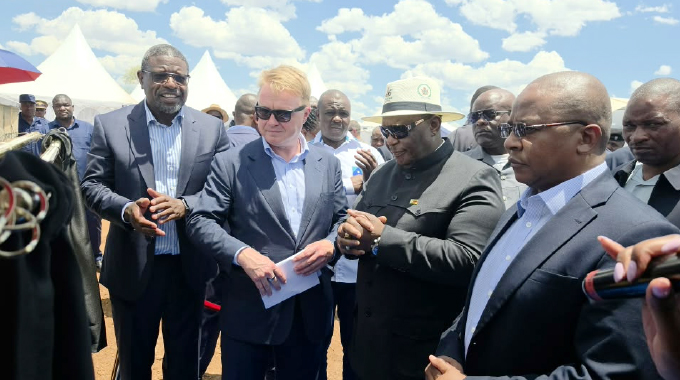
Speaking at the ground-breaking ceremony for the Bilboes Gold Project in Bubi on Friday, where Vice-President Constantino Chiwenga was Guest of Honour, Dr Kambamura said the project marked a turning point for both the mining sector and his ministry, moving from years of studies and approvals to actual mine construction.
“These communities have been walking over this ground without knowledge of the potential underneath,” he said.
“Today marks a historic moment where we have broken ground on the commencement of this mine development project. We look forward to coming back here in late 2028 to see a change of pace in this area.”
Dr Kambamura said mining remained one of the strongest pillars of the Zimbabwean economy, with mineral exports continuing to grow significantly.
“In 2025, our mineral exports reached US$8,5 billion. At the end of September this year, we reached US$9,93 billion. Come December this year, we are looking at not less than US$10,1 to US$10,4 billion, which is a dream that we have been dreaming for the past five years,” he said.
“This year we will realise that dream.”
On gold production, he said 46,7 tonnes were delivered to Fidelity Gold Refinery last year, while the target for this year was 50 tonnes.
“At the end of October this year, we are around 42 tonnes, which means the 50-tonne target is achievable,” he said.
“With the coming in of this project in three years, we look forward to this project contributing significantly to gold deliveries to the Government.”
Dr Kambamura said the Government was targeting first gold production at Bilboes in October 2028, with full production expected in 2029.
At full capacity, the mine is expected to produce approximately 200 000 ounces of gold annually, equivalent to about 6,2 tonnes.
“This is significant,” he said.
He described Caledonia Mining Corporation as one of Zimbabwe’s largest gold producers, with the potential to become a major player in the region.
Dr Kambamura said mining was a long-term business, noting that exploration for sulphide ores at Bilboes began in the late 1990s and early 2000s, when Anglo American ceased gold production in Zimbabwe.
The work, supported by successive phases of investment, culminated in the first definitive feasibility study in 2020.
“Government recognises the time and commitment that such an undertaking demands and my ministry will continue to provide security of tenure, consistency and predictable regulation in support of responsible long-term mining investments,” he said.
He said the ministry’s role was now shifting from facilitating project approvals to ensuring that the mine was developed safely, responsibly and in accordance with Zimbabwean laws.
Dr Kambamura said Bilboes was also significant because of the technology required to process its predominantly sulphide ores, which could not be effectively treated through conventional cyanidation alone.
Caledonia is investing in bio-oxidation technology at the processing plant, which he described as a practical example of value addition.
“This US$600 million investment speaks volumes to the openness that Zimbabwe needs for business,” he said.
“Caledonia, you have shown the world that this can be done in Zimbabwe.”
Dr Kambamura recalled that at this year’s Mining Indaba in Cape Town in February, the Government had been engaging investors to fund or support the project.
“The patriotism exhibited and shown by Caledonia is worth talking about. They stood with the country; they stood with the investment, saying truly Zimbabwe is open for business,” he said.
“What you have done today has demonstrated to the world that you are not just talking mere words, but you have implemented what you were saying, that truly the investment climate in this country is attractive.”
He urged other investors who were still watching from the sidelines to follow Caledonia’s example and consider opportunities in Zimbabwe.
“I would like to urge our other investors who are just looking over the fence to come and learn from Caledonia, to come and invest money in Zimbabwe, to come and make money in Zimbabwe,” he said.
“If companies, listed companies like Caledonia, are making it in Zimbabwe, you can also make it.”
Dr Kambamura said a project of this scale carried significant responsibilities, particularly in ensuring workplace safety, responsible mining, environmental protection and sensitivity to the communities in which it operated.
He said the Government would increasingly consider the Environmental Sustainability Index and the Community Social and Economic Investment Index when assessing applications for the renewal and extension of mining rights.
“I would like to urge the Caledonia team and their contractors to continue working constructively.
We know production schedules matter, we understand capital budgets matter, but neither matters more than ensuring that every employee and contractor returns home safely at the end of the day,” he said.
“Environmental responsibility must be treated with the same seriousness. The management of land, water and tailings, progressive rehabilitation and planning for mine closure must be viewed along the way.”
He said his ministry was responsible for administering mining rights fairly, ensuring consistent regulation and facilitating exploration, investment, value addition and local beneficiation.
Dr Kambamura said the Government hoped to return to the area towards the end of 2028 to witness the development of new infrastructure, housing and other economic investments benefiting local communities, alongside the commencement of gold production.
However, he said the Government would also assess whether the project had been developed safely, complied fully with the country’s laws, facilitated skills transfer and created genuine opportunities for local businesses.
“Today we break ground on a project that has taken decades to reach this stage. Our collective responsibility now is to turn that promise into performance,” he said.
He congratulated Caledonia Mining Corporation and all those who had contributed to the project, urging the company to maintain high standards of responsible mining and ensure that the mineral resource benefited host communities, the country and the investor.