Sikhulekelani Moyo [email protected]
FOREIGN Affairs and International Trade Minister Professor Amon Murwira has described non-Pan-Africanism as an “abominable illegality”, arguing that Zimbabwe’s Constitution obliges the country to embrace Pan-Africanism in its foreign policy.
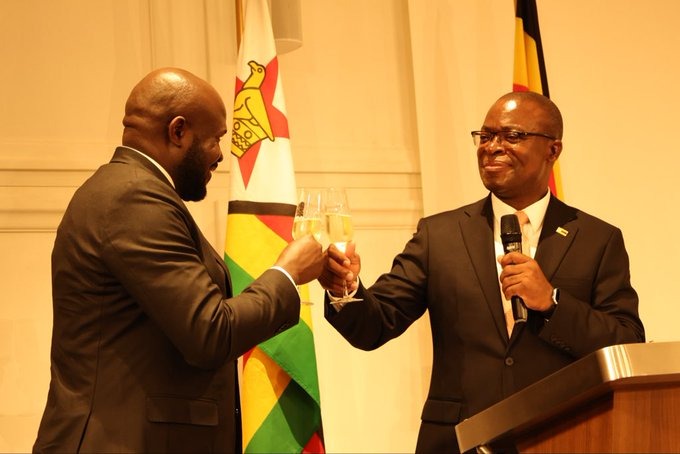
Prof Murwira made the remarks on Saturday when he was Guest of Honour at a diplomatic reception in Harare marking the 64th anniversary of Uganda’s independence.
He said Zimbabwe’s foreign policy was guided by the Constitution and national values, particularly Ubuntu, which he described as the principle that “you are because I am”.
Prof Murwira cited Section 12 of the Constitution, which outlines the principles guiding Zimbabwe’s foreign policy, including the protection of national interests, respect for international law, peaceful co-existence and the peaceful settlement of international disputes.
“This is because Section 12 of our Constitution codifies these values. In terms of Section 12 subsection 1 of the Constitution, Zimbabwe mandates that our foreign policy be founded on the primacy of the pursuit of our national interest in peace through respecting international law, through pursuing peaceful co-existence with other nations and where disputes occur internationally to pursue solution through dialogue,” he said.
He said Section 12(2) further required Zimbabwe to promote regional and Pan-African cooperation and integration.
“Furthermore, related to this, Section 12 subsection 2 of the Constitution obligates this State of Zimbabwe to be Pan African, in this country, it’s illegal to be non-Pan African. This is the Supreme Law of the Land. If you are non-Pan African, you are practicing an abominable illegality. So, this is codified in our Constitution, and I repeat, it’s unlawful in Zimbabwe to be non-Pan African,” he said.
Prof Murwira said Zimbabwe sought to promote Ubuntu beyond its borders, placing human dignity at the centre of its international relations.
“You are because I am. We take this from our deep roots and we want to elevate it to rest of world, so that we have an alternate way of relating. Ubuntu elevates human dignity above everything else,” he said.
He said Zimbabwe pursued a “mature, stable and predictable foreign policy”, adding that its commitment to human dignity extended across Africa and beyond.
“To this end, Zimbabwe pursues mature, stable and predictable foreign policy, where values of human dignity are supreme, wherever those humans are in Africa and beyond and this position you can be assured will not change.”
Prof Murwira said the country’s diplomatic doctrine of “Friend to all and enemy to none” was rooted in Ubuntu and mutual understanding.
“My pleasure should be your pleasure, my pain should be your pain,” he said.
He said Zimbabwe favoured dialogue and partnerships over confrontation, drawing on the continent’s history of colonialism and the need to uphold human dignity.
“Through this, we then pursue active and proactive diplomacy and pursue non-judgmental partnerships learning from painful history of Africa. We cannot and we will not pursue judgmental relationships, we have been judged for centuries and sometimes handled as chattels, therefore we cannot pursue a philosophy that does not respect human dignity. Therefore, we shall not judge and we shall not be judged.”
Prof Murwira said peaceful and secure international relations were essential for economic development and prosperity.
“Human dignity is for us not optional, it is core of our being. The insult of human dignity, the only thing that makes us stand against anything that is like that and core of our international engagement, is conviction that a peaceful and secure global environment is essential prerequisite for economic development and prosperity,” he said.
He added that Zimbabwe’s international engagement was anchored in sovereign equality, mutual respect and continental integration.
“Our engagement is anchored in sovereign equality, mutual respect and shared commitment to continental integration and dignity of the African people,” he said.
Prof Murwira also thanked Uganda for supporting Zimbabwe’s successful bid for a non-permanent seat on the United Nations Security Council for the 2027-2028 term.
“In this regard, the Government of Zimbabwe expresses its profound gratitude, to the Government and people of Uganda for the unwavering support during the successful election of Zimbabwe to a non-permanent seat on the UN Security Council for 2027-28 term,” he said.
He said the result demonstrated broad international support for Zimbabwe.
“This is very important to us and His Excellency the President because that day, on the 3rd of June 2026 at 10:30 am, it was proven that 96 percent of the world plus supports Zimbabwe. From that day mathematically, anybody who says Zimbabwe is isolated, it has been peddled that can never be sustained,” he said.
Prof Murwira said Zimbabwe believed nations should respect one another and build economic interdependence alongside political solidarity.
“We all say lifeblood of nations is to integrate economies, so that we are interdependent. If we are interdependent, we are forced to respect each other, because, you are because I am. If I don’t have food, it means you also don’t have food, we believe that upon political solidarity, we should build economic interdependence,” he said.
He said Zimbabwe would continue pursuing strategic partnerships aimed at expanding bilateral trade, attracting foreign direct investment and promoting technology exchange.