admin
admin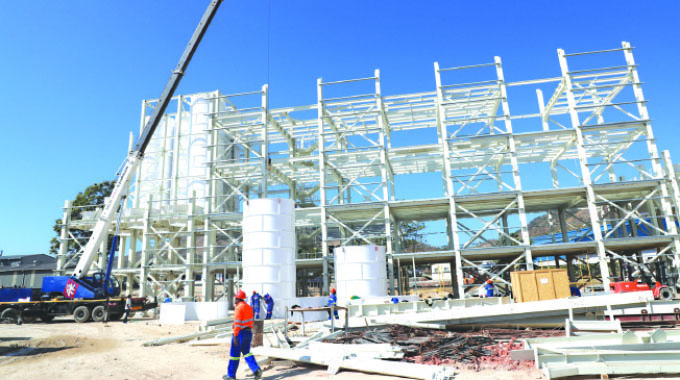
Cletus Mushanawani
News Editor
Pursuant to the agenda of leaving no one and no place behind, Manicaland completed 777 life-changing projects during the period running from 2018 to 2022 under the Second Republic, it has been established.
That projects are giving impetus to the promotion of inclusive and balanced socio-economic development, as the country works towards attaining Vision 2030.
An additional 174 projects are at various stages of completion, thereby making Manicaland the country’s second best province in terms of rolling out the projects which vary in scope.
Midlands has the highest number of completed projects at 791.
The Second Republic has distinguished itself by adopting a deliberate policy to utilise local expertise and natural resource endowments, thereby breaking from the donor dependency syndrome for technical skills and funding.
President Mnangagwa recently said: “Since the coming in of the Second Republic, most of the infrastructure programmes and projects were locally funded through the Inter-Governmental Fiscal Transfer System (devolution) and the Public Sector Investment Programme (PSIP), among other funding vehicles. Local companies were contracted to provide goods and services in line with the adage ‘Nyika inovakwa nevene vayo/Ilizwe lakhiwa ngabanikazi balo.’
“Going forward, together as a sovereign and unitary nation, let us continue building our country brick by brick and stone upon stone as we gravitate towards a prosperous and empowered upper middle-income society by 2030.”
In an interview with The Manica Post this week, Secretary for Manicaland Provincial Affairs and Devolution, Mr Edgars Seenza said: “A lot of work has been done across the province. More projects are being rolled out and we are happy with the progress achieved so far. “I want to hail the team spirit from all stakeholders because everyone is proving to be dedicated to their work. In every district, there is something happening there and we will soon have a whirlwind tour of most of the signature projects to assess progress.”
Director for Economic Development in the Office of the Permanent Secretary for Manicaland Provincial Affairs, Mr Munyaradzi Rubaya also said a lot of ground has been covered across the province, with some projects having already been completed and commissioned, thereby improving the province’s Gross Domestic Product.
The signature projects are from various sectors of the economy that include food processing (Mega Market Flour Milling Plant and Willowton Cooking Oil and Soap Plant), industry and commerce (Allied Timbers’ Cashel Valley Saw Milling Plant, Wattle Company’s Veneer Plant and Drying Kiln), establishment of CICADA Katiyo as well as La Rochelle Organics.
From the Wattle Company’s Veneer Plant and Drying Kiln project, exports worth US$2,1 million are now being realised annually, while more than 160 new jobs were created.
La Rochelle Organics in Penhalonga has over 200 hectares under herbs and chillies.
The company employs more than 250 people and exports around 230 tonnes of herbs, chillies, teas and flowers, mostly to Germany.
“We have a number of life-changing projects that have been completed in Manicaland and we are very excited about this positive development.
“Our thrust is to value add on all available resources and transform lives for the better. Gone are the days of exporting unprocessed goods or produce.
“A lot of investors are making enquiries on a lot of projects, and this is good news for the province as we want to see a changed Manicaland.
“The La Rochelle Organic Project in Penhalonga is producing herbs and teas for exports, mainly to Germany. They are crashing, grading and packaging the teas, herbs and chillies for the export market. This has created a lot of jobs for those directly employed by the company and its out-growers,” said Mr Rubaya.
In the energy sector, some work is also being done.
To ensure energy self-sufficiency, Manicaland is inviting more investors into this crucial sector.
A major player in the energy sector, Nyangani Renewable Energy in Honde Valley has established a 30-Megawatt hydro-plant that has increased internal power generation capacity, reduced import levels and created a lot of economic activity, especially for people around the plant.
“We want to ensure energy self-sufficiency in Manicaland. Apart from Nyangani Renewable Energy, we also have Chisumbanje Thermal Plant in Chipinge District that is producing 12MW.
“We have four more upcoming energy and power development projects that include the Sabi Star Thermal Plant in Buhera, which is set to produce 15MW. That plant is about 30 percent complete.
“There are also small solar powered plants that will be coming onboard in the near future (Mutasa eight to 10MW) and Makoni (eight to 10MW). Our provincial energy requirements stands slightly above 100MW and if all the earmarked projects are completed, we will be energy sufficient in the next five years and will be feeding the surplus into the national grid. Very soon load shedding will be a thing of the past in Manicaland,” said Mr Rubaya.
Under transport and infrastructural development, the National Railways of Zimbabwe refurbished eight locomotives and 443 wagons in Mutare, thereby improving the parastatal’s capacity to uplift freight traffic volumes.
And following Cyclone Idai in 2019, most of the restoration projects have been completed.
These include the construction of nine bridges that had been washed away by the cyclone and the rehabilitation of the Wengzi to Skyline and Jopa to Kopa roads.
This has helped in improving connectivity in the area and created employment for locals.
The Tanganda-Ngundu Highway which was littered with potholes was also rehabilitated.
In the education sector, a number of projects have been rolled out as Manicaland seeks to establish 300 new schools to reduce the ballooning teacher: learner ratio.
“Out of the 3 000 new schools to be established in the country, Manicaland is targeting 300 new schools. Government is working flat out to achieve that through support from various stakeholders such as churches, especially the white garment churches.
“They have come to the party and are rolling out various schools construction projects. Special mention goes to the Johanne Marange Apostolic Church which is constructing a number of schools across the province.
“Johanne Masowe Church will soon be constructing another school at their Gandanzara Shrine in Makoni District. These churches now value education. This is a complete turn-around for these churches as in the past they were known for not being interested in educating their children.
“Local authorities are also complementing Government’s efforts in establishing new schools,” said Mr Rubaya.
On health, Mr Rubaya said: “A number of clinics have been built across the province. Our vision is that every ward must have a clinic supported by at least 10 health posts. We want to ensure universal access to health. People should walk short distances to access medical facilities.”
Among some of the ongoing projects are the small-holder irrigation revitalisation projects in all of Manicaland’s districts.
The province is expected to contribute significantly on the national irrigation hectrage target.
The Mega Market Wheat Milling Plant is around 98 percent complete and is expected to create between 250 and 300 new jobs, increase flour production and also ensure import substitution.
In the mining sector, the expansion of the Dorowa Minerals Magnetite Plant is also ongoing and upon its completion, more than 50 new jobs will be created, while magnetite exports will be increased from the current 2 000 metric tonnes to 8 000mt annually.
Phase One construction of the Gemmology Centre in Fern Valley just outside Mutare is 51 percent complete.
The phase comprises of the perimeter fence, security fence, brick wall and gate house.
The Gemmology Centre will add value and beneficiate the diamonds, create employment and generate the much-needed foreign currency for the country.
“Manicaland should benefit from its resources as it has a versatile economy, producing more than 70 percent of the country’s diamonds, in addition to agricultural production of horticulture produce and timber,” said Mr Rubaya.


 Online Reporter