Chronicle Editor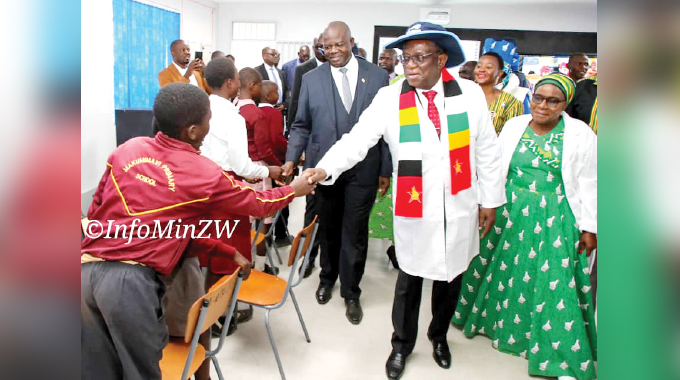
Richard Muponde, Zimpapers Politics Hub
PRESIDENT Mnangagwa last Thursday commissioned 17 new rural schools, equipped with modern facilities to provide quality education.
Among the newly built schools, three are in Matabeleland, and they are expected to take the lead in promoting the country’s diverse heritage through the Heritage-Based Education 5.0 model, which is designed to incorporate modern education with traditional cultural values, customs, and history.
The Opec Fund for International Development (Ofid) partnered the Government in this project, which was officially commissioned at Makumimavi Primary School in Chikomba District, Mashonaland East Province.
According to the Ministry of Primary and Secondary Education, the schools commissioned are Khokoloza Primary in Binga District and Thame Primary in Bubi District, Matabeleland North as well as Mokgampo Secondary in Mangwe District, Matabeleland South Province.
The other schools are Stakesroom Secondary and Lawrencedale Primary in Manicaland, Craigeside Primary, Tengenenge Primary and Belgonie Secondary in Mashonaland Central, Chehamba Primary, Tavoy Secondary, Sadomba Primary and Justright Primary in Mashonaland West Province, Nyuni Primary and Nyuni Secondary in Masvingo Province, and Budiriro Primary and Neta Secondary in the Midlands Province.
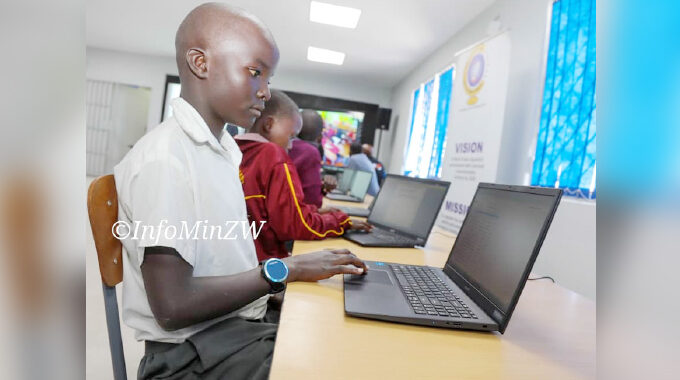
The modern schools feature state-of-the-art facilities such as computer labs, science labs, libraries, and sports facilities, providing a conducive learning environment for students. The Government plans to construct more schools and improve existing ones to ensure every child has access to quality education regardless of their location.
This is part of President Mnangagwa’s national Vision 2030 anchored by the National Development Strategy (NDS1) in line with an education system punctuated by science and technology.
Heritage refers to the natural endowments of Zimbabwe; flora, fauna, water, minerals and human resources. The underlying principle is an education, science and technology system that produces goods and services useful to the economy based on heritage.
In addition, heritage-based education, science and technology development is delivered conscious of the environment it seeks to transform.
The world over, nations have achieved and sustained significant economic prosperity using a heritage-based philosophy for national development. For example, Saudi Arabia has a heritage of oil and has developed its economy around the oil heritage.
Brazil has a heritage of the rainforest and has developed its economy around rainforest heritage. Mauritius has a heritage of the oceans and has developed its economy based on its marine heritage. Germany’s growth was based on coal because it was locally available.
Zimbabwe, therefore, shall use its agricultural, climatological and mineral heritage for national development. Our heritage-based philosophy shall use cutting-edge, competitive, universal scientific and technological knowledge for the production of quality goods and services.
Construction of the schools demonstrates the Government’s commitment to ensuring access to quality education for all under President Mnangagwa’s philosophy of leaving no one and no place behind.
The Ministry of Primary and Secondary Education said these schools signify the transformation of the country’s education sector towards achieving international standards.
Through the country’s Heritage-Based Education 5.0 model, President Mnangagwa said the Second Republic has ushered in a new era of learning, innovation and creativity.
President Mnangagwa stressed the importance of education as a key driver of development and urged parents to prioritise their children’s education for a brighter future. He also highlighted the need for students to embrace science, technology, engineering, and mathematics (STEM) subjects to keep up with the fast-changing world.
“Through the Heritage-Based Education 5.0 Model, we have ushered in a new era of learning, innovation and creativity. This is further exhibited by the integration of our abundant natural resources and rich heritage, with the innovative tools and technologies to produce goods and services,” President Mnangagwa said.
Educationists said the building of modern schools will enhance the teaching of the Heritage-Based Education 5.0 model which is centred on innovation and creativity.
They said investment in education is expected to have a positive impact on the country’s economy in the long term by producing skilled and innovative graduates capable of driving development in various sectors.
Educators Union of Zimbabwe (EUZ) secretary-general, Mr Tapedza Zhou, said the transformation will empower pupils, communities and the nation at large.
“We are all in support of educational transformation, which seeks to empower our children, communities and the nation at large. We, however, want to remind the President that achievements of heritage-based education can only be abundant after taking on board teachers’ concerns, namely salaries, staff development in using donated equipment, and improving their housing. He must take a holistic approach in educational transformation,” Mr Zhou said.



 Online Reporter