Online Reporter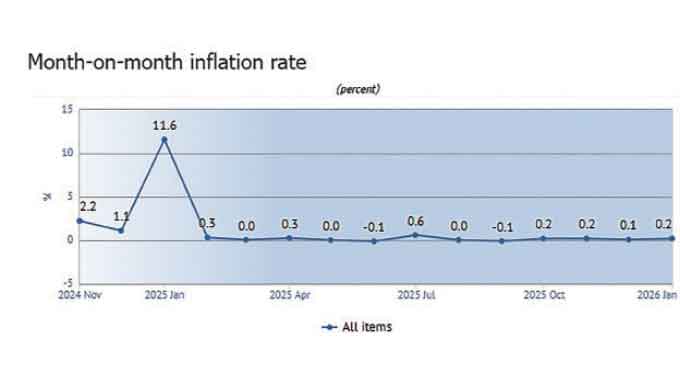
Richard Muponde-Zimpapers Politics Hub
THIS week, Finance, Economic Development and Investment Promotion Minister Professor Mthuli Ncube announced that Zimbabwe recorded single-digit year-on-year inflation of 4, 1 percent in January 2026, marking a key milestone in national price stability under the ZiG currency.
The Government credits this achievement to strict fiscal discipline and close monetary policy coordination with the Reserve Bank of Zimbabwe following the launch of the ZiG in April 2024.
Since its introduction, reserves backing the currency have risen from approximately US$276 million to over US$1, 2 billion. This stability has kept the prices of essential goods in check, thereby preserving household purchasing power, aiding business planning and bolstering investor confidence — key steps as Zimbabwe progresses toward SADC macroeconomic convergence targets and its national Vision 2030.
The achievement is therefore not accidental, but the outcome of deliberate, firm and sometimes painful reforms implemented under the Second Republic led by President Mnangagwa.
The decline in inflation in both local and foreign currencies signals a restoration of sanity in the transacting world, reflecting the success of sound fiscal discipline, monetary restraint and decisive action against market indiscipline.
This milestone also places Zimbabwe firmly on the path towards Vision 2030 of an upper middle-income economy, guided by the philosophy “Nyika Inovakwa Nevene Wayo/Ilizwe Lakhiwa Ngabanikazi Balo”, with no one and no place left behind.
Hyperinflation in the First Republic
To appreciate the magnitude of this achievement, one must revisit the hyperinflationary nightmare of the First Republic. Characterised by excessive money creation, weak fiscal controls and declining productive capacity, the economy descended into one of the worst episodes of hyperinflation in recorded history.
When the economic freefall reached its nadir in 2008, prices changed by the hour, wages were rendered meaningless and the national currency collapsed entirely.
By 2009, Zimbabwe was forced to abandon its own currency and adopt a multi-currency regime dominated by the United States dollar. While this brought temporary relief, it came at the cost of monetary sovereignty, policy flexibility and industrial competitiveness. The economy became import-dependent, liquidity constrained and vulnerable to external shocks, leaving ordinary citizens exposed and the productive sector strangled.
The Second Republic’s early stabilisation efforts
When President Mnangagwa assumed office in late 2017, he inherited an economy in distress, burdened by structural imbalances and policy distortions. The immediate priority of the Second Republic was stabilisation.
Through the Transitional Stabilisation Programme, Government focused on restoring fiscal discipline, cutting unbudgeted expenditures and aligning spending with available resources.
These early reforms laid the groundwork for macro-economic order. Budget deficits were curtailed, quasi-fiscal activities reduced and transparency enhanced. While the period was difficult for citizens, the stabilisation phase was necessary to halt the inflationary spiral and prepare the economy for sustainable growth anchored on the National Development Strategy 1, itself aligned to Vision 2030.
Under NDS1, Zimbabwe reintroduced its own currency in a bid to reclaim monetary policy autonomy and stimulate domestic production.
However, the Zimbabwe dollar’s early years were battered by indiscipline in the financial markets. Speculative activities, parallel market manipulation and abuse of exchange rate mechanisms quickly devalued the currency.
This indiscipline reignited inflationary pressures, once again hurting consumers and businesses.
Prices rose sharply, wages lagged behind and confidence wavered. It became evident that sound policy alone was insufficient without enforcement and accountability in the financial system.
Cracking down on saboteurs to restore market discipline
Recognising that ordinary Zimbabweans were bearing the burden of economic sabotage, President Mnangagwa authorised a decisive crackdown on financial misconduct. The Reserve Bank of Zimbabwe, working closely with the Financial Intelligence Unit under Director-General Mr Oliver Chiperesa, led an unprecedented blitz on market indiscipline.
Banks, pharmacies, hardware stores, retailers and foreign currency dealers were investigated, resulting in arrests, frozen bank accounts and recommendations for licence revocations for repeat offenders.
The message was clear, economic sabotage would no longer be tolerated.
RBZ Governor Mr John Mushayavanhu underscored this resolve: “We will not allow a few unscrupulous players to undermine national stability for selfish gain.
Monetary policy can only succeed when supported by discipline, transparency and adherence to the law,” Dr Mushayavanhu said. Similarly, FIU Director-General, Mr Chiperesa emphasised enforcement: “Our mandate is to protect the integrity of the financial system.
Those abusing exchange rates and engaging in speculative conduct are effectively stealing from the public, and we will pursue them relentlessly.” These measures restored order, curbed arbitrage and re-anchored prices to fundamentals, paving the way for durable stability.
ZiG introduction & return of confidence
The stabilisation achieved through enforcement and policy coherence culminated in the introduction of the ZiG currency. Backed by gold and foreign currency reserves, ZiG represented a decisive break from past mistakes.
Reserve money and broad money were fully covered, eliminating the unchecked expansion that had previously fuelled inflation.
The impact was immediate and profound. Inflation slowed dramatically, exchange rates converged with parallel markets and price volatility subsided.
Over time, ZiG gained public acceptance, becoming widely used in transactions and increasingly preferred over the US dollar. This acceptance reflects renewed confidence in the currency’s ability to preserve value.
With stability restored, the economy rebounded strongly. International financial institutions projected growth of around six percent last year, placing Zimbabwe among the fastest-growing economies in the Southern Hemisphere.
The momentum is expected to continue, with growth projections for 2026 remaining robust as investment, agriculture, mining and infrastructure expand under stable macro-economic conditions.
This rebound demonstrates the direct link between currency stability and economic performance. Businesses can plan, investors can commit capital and households can save with confidence.
A Second Republic success story
While the Government has done its part, sustaining these gains requires collective responsibility. Financial discipline by businesses, workers and consumers is essential to protect the hard-won stability. Acceptance and use of ZiG, restraint in pricing and alignment of wage demands with productivity are critical to ensuring that inflation remains low and growth inclusive.
The success of President Mnangagwa’s reforms has not gone unnoticed. Investors are increasingly falling over each other to enter Zimbabwe, signing mega deals in mining, energy, agriculture and infrastructure. Significant investments in lithium, platinum, gold processing and power generation were concluded last year, signalling renewed global confidence in the economy.
These investments validate the Second Republic’s reform agenda and demonstrate that stability, consistency and discipline attract capital.
President Mnangagwa’s currency and economic reforms have driven Zimbabwe to dizzy heights of recovery once thought impossible. From hyperinflation and monetary collapse to single-digit inflation and renewed growth, the journey reflects visionary leadership, firm policy choices and unwavering commitment to national development.
As Zimbabwe marches towards Vision 2030, the lesson is clear, when discipline, sovereignty and inclusive development guide policy, prosperity becomes attainable for all, with no one and no place left behind.