

 admin
admin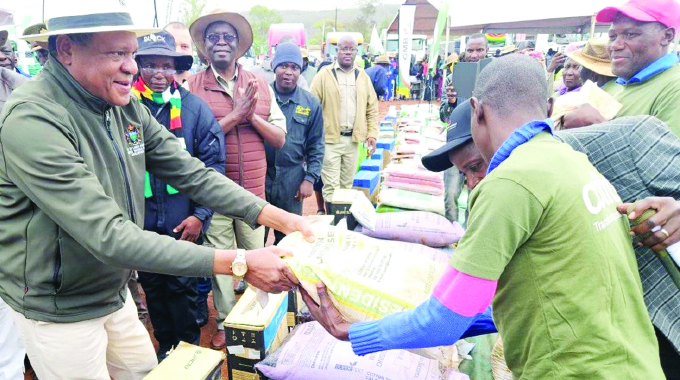
Obert Chifamba
Agri-Insight
THE grim outlook that had in recent weeks been slowly creeping into the agriculture sector, especially for dry land farmers, is now fast receding into the horizon, thanks to the rains and the current inputs distribution plus planting activities.
Understandably, the current rains and inputs distribution activities have brought the much-needed re-assurance and respite to farmers most of whom are now very busy wrapping up land preparations and concentrating on planting.
And, given the harrowing experiences they went through courtesy of last season’s El Nino, one can easily forgive them for approaching all seasons with suspicion.
In fact, it is important for the farmers to now make sure they do not waste any time but complete all the land preparations and start planting if they had not begun. It is always best for them to make the most of the weather prevailing at any given time because what will come in the unforeseeable future may come as a fulfilment of what experts would have predicted or even fail.
The weather is always highly unpredictable and requires farmers to factor in that aspect each time they get into a new season.
The trick is to ensure they do not put all eggs in one basket lest it falls and they lose everything. Farmers need to stagger planting dates so that they spread risk while choosing varieties that are designed to perform better under difficult conditions.
They must also help their situation by at least making the effort to understand their agro-ecological regions and the crop varieties they need to use.
It does not make sense for a farmer to get inputs that are not suitable to both the climatic and soil requirements of their various localities. But while that is happening, let me digress a bit and talk about a vice that has in recent times given Government and other stakeholders some anxious moments on how to tame it. The problem of inputs abuse.
This problem had become so rampant that it could have easily qualified for the ‘clear and present danger’ label and required urgent action.
It is exciting to note that the Government has moved in to address the matter and has even come up with fresh strategies to take care of the challenge. What is now important is for the farmers to fully appreciate why the various input support programmes are being availed and how they can easily benefit from them by just being responsible beneficiaries.
These support programmes are in essence designed to serve as launch pads for people coming out of difficult situations to re-launch their careers or pursuits. This means that beneficiaries must make effort to reach a stage where they break even and can sustainably run their operations without requiring assistance. Remember, there are always more and new people requiring that same assistance so using the inputs improperly will only mean that the problem is not being solved. On the one hand, it will also mean that the Government and other concerned stakeholders would every year be pouring resources into a bottomless pit where they are not being used productively but selfishly by some ungrateful beneficiaries.
The Government’s shipment of inputs to Grain Marketing Board (GMB) depots countrywide is a sure indication that it is not leaving anything to chance but hoping to make the most out of the positives associated with the La Nina weather expected in the current 2024/25 season.
It has since indicated intentions to increase production of cereals by 340 percent with 3, 5 million households set to benefit under its Pfumvudza/Intwasa programme. The targeted hectarage for Pfumvudza/Intwasa is 400 000 with 12 427 plots confirmed ready for planting.
This time around the Government has expanded its assistance to boosting food security even for livestock in the wake of cattle poverty deaths that were recorded in most of the country’s marginal areas. Poverty deaths among livestock units can be mitigated through bountiful crop production that naturally generates excess grain that can also be channelled to save livestock. The current push by the Government to have farmers also producing fodder and hay is a food security whose success depends on the honesty of farmers in the deployment of resources.
Cases of inputs abuse by some unscrupulous individuals, which have become synonymous with the inputs distribution process every season have had ripple effects that have also shaken the livestock though inadvertently. The Government’s decision to abandon the ‘business as usual’ mode and introduce mechanisms that reduce abuse of inputs it therefore the way to go, as efforts to re-build the national herd and also achieve food self-sufficiency among the citizenry reach fever-pitch.
The success of such efforts also hinges on the positive response that must come from the benefiting citizens, especially the farmers. The farmers are a special group of citizens from the entire population given that they take care of the national food requirements but to successfully do that, they need to be honest. Kudos to the Government for the various efforts it is making to plug all leakages in the past seasons but it cannot be there 24/7 to monitor the process, which requires all other stakeholders to be honest for the successful roll out of the programme. The Virtual Depot Distribution Strategy introduced for the Presidential Inputs Schemes has proved to be a major success following an efficient inputs distribution process.
This season, for instance, Government is targeting 9, 5 million plots of Pfumvudza/Intwasa and is duly releasing inputs enough to cover the targeted space. Nothing short of the projected hectarage will be enough to convince any sane person that all the inputs were put to good use. All inputs must be used for their intended purpose and nothing else.
It will be a misdemeanour analogous to an act of profanity in a great temple if the inputs dispensed fail to cover that hectarage, hence the need for stricter monitoring of how the inputs are going to be used.
Apart from the transparent distribution and deployment of inputs, farmers also need to adopt good agronomic practices if the dream to achieve bumper yields is anything to go by.
In some cases, farming practices are determined by the nature of the season and for a season like the current one, it is important to make sure that farmers work hand in glove with extension officers for guidance. This will make the bad season threat easier to go through and this will be one way of mitigating the impact of possible harsh weather outcomes.
The last piece to my otherwise long list of issues on the inputs distribution and harsh weather mitigation offering is to advise stakeholders and the Government to do strict vetting of beneficiaries, as some of the farmers who receive inputs under the various programmes may not be deserving candidates.
They are the kind of people who refuse the offer of a fish and ask for the entire fish pond, forgetting that there is a long list of other people waiting to use the same facilities they are abusing.



 Online Reporter