Chronicle Editor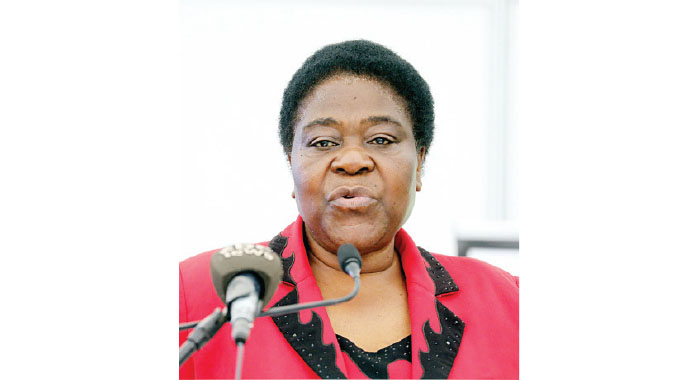
Nqobile Tshili
CDE Anthel Marufu (34) recounts the heartbreak she endured when she contested the Bulawayo Ward 8 elections in the 2018 harmonised elections.
During the campaign trail, some residents did not hide their disapproval of her candidature. She was rejected before she could even present her election manifesto.
Her only crime was that she is a woman.
“I remember this other time during the campaign period there was this old man who openly said he could not be represented by umuntu ongumfazi (I can’t be led by a woman).
That really broke my heart as it was an unfair assessment,” said Cde Marufu, who is also the Zanu-PF Bulawayo Youth League Secretary for Gender and Culture.
She said while she understood that it was not easy for women to break into politics, she did not expect to be judged on her sex as opposed to her capability.
Cde Marufu bemoaned the fact that some political parties are just pushing women to occupy Proportional Representation seats as opposed to contesting open elections.
“It’s already a sentiment of exclusion that women should just occupy PR seats. Even when women have a quota system, they should not be limited to it on the grounds that there is such a policy for women and should stick to that and not contest other seats.
Women can be great leaders. It’s sad that many people are blind to see that or don’t want to see it that way,” she said.
Cde Marufu is part of a handful of women who have braved up and contested for leadership positions besides the harsh realities of political participation by women.
Zimbabwe is a signatory to international and regional instruments such as Sadc Gender Protocol and African Gender Policy that seek to include women in all leadership positions.
As part of the measures to mainstream women into political leadership, Zimbabwe, through the 2013 Constitution, introduced a PR that resulted in 60 women, six from each of the 10 provinces being elected into Parliament depending on the votes of each political party.
Following this provision, women participation in the National Assembly increased to 32 percent from 14 percent. The figure slightly dropped by a percent in the 2018 harmonised elections. In the 2018 general election, 48 percent of women became senators, a 15 percent increase from the 2008 national polls.
From the 2008 national elections, there is evidence of systematic decline of women in positions of leadership as there were 19 percent female councillors in 2008 with the figure decreasing to 16 percent in 2013 and further dropping to 14 percent in 2018 harmonised elections.
The Government, in a bid to ensure more women are elected into Parliament, has extended the quota system while the same is being introduced to lower tiers of governance.
In 2020, female councillors successfully lobbied for a 30 percent quota system for women and this will be introduced in the 2023 national polls. There is optimism that the PR system will result in more women in leadership positions.
Concerns have, however, been raised over the sincerity of political parties to elect women in leadership positions.
Responding to Chronicle questions, Zimbabwe Gender Commission chief executive officer Ms Virginia Muwanigwa said since the introduction of PR, fewer women are now contesting in open elections also known as First Past the Post seats.
She said in 2013 polls, 23 percent of women won seats in open polls, but the figure dropped by nearly 100 percent in 2018 elections as only 12 percent in 2018 contested national polls.
“In as much as the PR was introduced as a temporary measure to groom new women politicians, it appears the PR became a comfort zone for many where we have witnessed even seasoned women politicians opting for the PR seats instead of the First Past the Post seats.
It has also appeared that in most political parties and as a result of PR women end up being relegated to PR and not FPP where the playing field is tough,” said Ms Muwanigwa.
She said legislators who join Parliament through PR are not even respected as they do not have constituencies and are nicknamed Bacossi (Basic Commodities Supply Side Intervention).
Bacossi is a term that became popular in the 2008 hyperinflation period when the Reserve Bank of Zimbabwe was providing subsidised basic commodities hence PR women’s political involvement is considered to be a product of subsidy.
Ms Muwanigwa said to effectively include women in political leadership, parties should comply with the country’s Constitution which compels 50/50 gender inclusivity in organisations.
“Political parties need to comply with provisions of the Constitution which demand 50/50 representation and come up with administrative measures to implement it. There might be a need to just enforce proportional representation to ensure 50/50 representation of men and women,” said Ms Muwanigwa.
She said the commission continues to lobby for the amendment of the Constitution and review of the Electoral Act to provide for Proportional Representation and do away with First Past the Post which is not favourable to women.
Ms Muwanigwa said political violence, cyber bullying, patriarchy and financial constraints have become some of the limitations that hinder women from participating in politics. She said apart from the social structural matters, most women candidates are not well versed with electoral systems.
“There is also a need for capacity building where aspiring women candidates are taken through training on electoral processes, campaigning, effective communication and transformational leadership. We have noted that although women want to participate in politics, they are not fully equipped with knowledge and requisite skills,” she said.
Bulawayo Provincial Affairs and Devolution Minister Judith Ncube, who is also Zanu-PF Politburo member said almost 10 years after the adoption of PR, the political systems in the country still do not favour women’s participation into leadership positions. She, however, said the election of women through PR has seen women’s issues being given prominence in Parliament.
“At least we now have women in Parliament because of this Proportional Representation. I’m sure you have seen women MPs standing up for women and trying to facilitate skills development even within communities. Those who are elected under proportional representation already know issues that affect the women and they discuss these issues in Parliament,” she said.
Minister Ncube said through lobbying from female MPs, there is now a national budget allocation for sanitary wear while pregnant girls are no longer expelled from school.
She, however, expressed concern that most men from different political parties were yet to accept women as equals. She said the continued extension of the PR system reflects lack of commitment by men in politics to come up with a permanent system to address the exclusion of women from participating in politics.
“In politics, men just want women to be their cheerleaders. Men will pretend as if they sympathise with us, but their intentions are to be the leaders in politics,” she said.
Minister Ncube said there was a need for women to support each other if they were to make it in politics.
“We don’t have a unity of purpose as women and as such we don’t support each other. Instead of supporting fellow women, we tend to support men,” she said.
Speaker of Parliament Advocate Jacob Mudenda said PR has brought a lot of confidence in women to participate in electoral processes and seek political power.
He, however, questioned the sincerity of political parties in promoting gender inclusivity saying organisations may need to change their constitutions to make provisions for equal representation. – @nqotshili


 Online Reporter