Online Reporter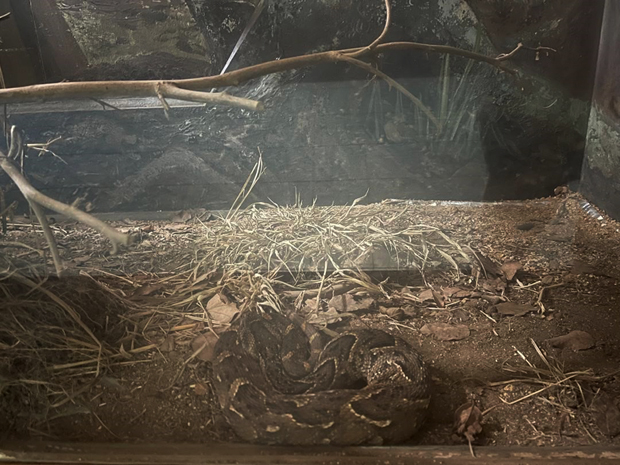
Lloyd Makonya
Correspondent
THE sight of a coiled snake is enough to stop most people in their tracks.
For some, it is a symbol of death. For others, it represents spiritual power, ancestral mysteries or supernatural forces. Across cultures, few animals evoke such intense emotions as snakes.
These emotions were recently brought into sharp focus after a 19-year-old self-styled traditional healer was arrested in Mutare, while allegedly carrying a live puff adder and a Mozambique spitting cobra in a satchel.
According to the police, he claimed to use the reptiles during rituals performed for clients, particularly those seeking prosperity from mining activities.
The incident dominated conversations across the country, and quickly spread on social media.
One of those reptiles – the puff adder – has found a new home at Mutare Museum, where it is on public display. Visitors are stopping to observe the mystery snake and one of Zimbabwe’s most feared snakes from the safety of a glass enclosure.
Yet behind the sensational headlines lies a story that stretches back centuries. It is a story about culture and conservation, belief and biodiversity, fear and fascination. Long before modern science began studying reptiles, snakes occupied a prominent place in African societies.
Among many Zimbabwean communities, snakes have featured in oral traditions, folklore and spiritual beliefs for generations. Some communities regard certain snakes as messengers of ancestral spirits, while others associate them with sacred places, rainmaking ceremonies or traditional healing practices.
Conversely, some beliefs link snakes to witchcraft and supernatural powers, reflecting deeply rooted cultural interpretations that have been passed down through generations. These beliefs form part of Zimbabwe’s rich intangible cultural heritage.
At Mutare Museum, these beliefs are preserved in the Beit Gallery, which explores aspects of the traditional culture of the Eastern Shona people. One of its sections examines historical beliefs surrounding witchcraft, where snakes feature among the objects and symbols associated with traditional narratives.
The exhibition is not intended to validate or dismiss such beliefs. Rather, it documents how communities understand the world around them and how cultural ideas evolved over time. Museums preserve these stories because they are part of Zimbabwe’s history.
Away from folklore and spirituality, science tells another story altogether. To ecologists, snakes are among nature’s most efficient pest controllers. Mutare Museum Curator of Botany and Zoology, Ms Talent Sithole, says snakes perform an indispensable role in maintaining healthy ecosystems.
“People often associate snakes only with danger because most are venomous, but they are extremely important animals in nature,” she said.
“They naturally control rodent populations and rodents destroy crops, contaminate stored grain and spread diseases. Without snakes, these populations would increase dramatically, affecting both agriculture and human health.”
She said snakes also occupy an important place within the food chain.
“They are both predators and prey. While they feed on rodents, frogs and other small animals, snakes themselves are food for birds of prey such as eagles, mongooses and honey badgers. Removing snakes from an ecosystem disrupts that natural balance.” The puff adder which is one the snakes which the self-styled healer was found in possession of is one of Africa’s most recognisable snakes. Its broad triangular head, thick body and beautifully patterned skin make it instantly identifiable. Ironically, despite being responsible for many snakebite incidents across Africa, the puff adder is not naturally aggressive.
Instead of fleeing when disturbed, it relies on camouflage, remaining perfectly still among dry leaves and grass. Most bites occur when unsuspecting people accidentally step on the snake or attempt to handle it.
“It is important for people to understand that snakes do not actively hunt humans,” explained Ms Sithole. “In almost every case, snakes bite because they feel threatened or cornered. If left alone, most snakes would rather avoid human beings altogether.”
She urged members of the public not to kill snakes indiscriminately.
“If a snake is found in a residential area, the safest option is to contact trained wildlife authorities instead of trying to catch or kill it.”
For Mutare Museum, the arrival of the puff adder presents an unusual educational opportunity. Visitors can move from the Beit Gallery, where they encounter the cultural beliefs surrounding snakes among the Eastern Shona, to the zoology displays, where they learn about the biological importance of reptiles. It is a journey that demonstrates how museums connect different ways of understanding the world. One gallery tells the stories people have believed. Another explains the science behind the animal itself. Together, they paint a fuller picture of one of Zimbabwe’s most misunderstood creatures.
Across history, snakes have inspired myths, religions, literature and folklore. They have appeared as symbols of healing, wisdom, temptation, protection, fertility and supernatural power in cultures around the world.
Yet beyond all these interpretations is a living animal performing an essential ecological function every day. Behind the silent gaze and patterned scales is not merely one of Zimbabwe’s most feared reptiles, but a remarkable survivor that has shaped human imagination for centuries while quietly maintaining the delicate balance of nature.
Sometimes the creatures we fear most are also those we understand least.